





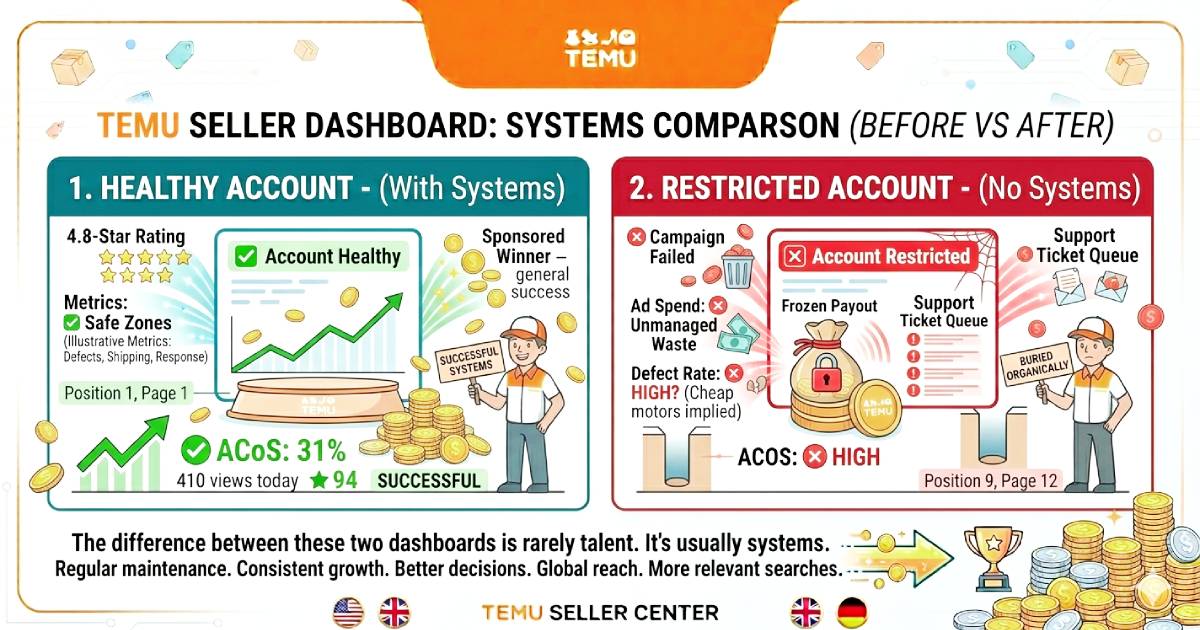
How to Scale on Temu Without Getting Suspended in 2026: Avoid Common Pitfalls & Protect Your Seller Account (USA, UK, Germany & Australia)
I've seen it happen too many times. A seller spends four
months building a Temu store finds a winning product, optimizes the listing,
gets the fulfillment dialed in, watches revenue climb past $12,000 a month.
Then one morning they log in and the dashboard is frozen. A suspension notice
sits in their inbox. And everything they built the rankings, the reviews, the
momentum is gone while Temu reviews the appeal.
Sometimes the suspension was deserved. Sometimes it was a
borderline compliance issue that could have been prevented with thirty minutes
of monthly housekeeping. And sometimes it was a fulfillment metric that drifted
quietly over the threshold while the seller was focused on scaling.
The difference between those outcomes is almost always
information. Sellers who understand how Temu monitors accounts, what triggers
enforcement action, and how to scale without exposing their account to
unnecessary risk they keep building. Sellers who treat account health as
someone else's problem find out the hard way that it isn't.
This guide is the survival manual for scaling on Temu in
2026. It covers how the account health system works, what causes suspensions
ranked by frequency, how to scale safely, country-specific compliance
realities, and exactly what to do if things go wrong. It is built on verified
platform policies, confirmed seller-reported experiences, and regulatory
enforcement actions not speculation.
If you have already read our Temu Algorithm Deep Dive, Listing Optimization Tutorial, Fulfillment Showdown, and Ads Mastery guides, this is the layer that protects everything you have built with those
strategies. Growing fast on Temu without protecting your account is like
building a house on sand. The foundations matter as much as the height.
Important: Temu's policies evolve rapidly. Always verify
current thresholds and requirements directly in your Seller Center. The
patterns and principles in this guide are grounded in verified 2026
information, but specific metric thresholds may change.

How Temu Monitors and Penalizes Sellers: The Account Health System
What Causes Temu Seller Suspensions in 2026?
Before you can protect your account, you need to understand
how Temu watches it. Temu's account health system operates on a continuous
monitoring basis it is not a quarterly review. Metrics are tracked in near
real-time, and the system evaluates both individual incidents and cumulative
patterns over rolling time windows.
The key performance dimensions Temu tracks for every seller
account include:
Order Defect Rate (ODR) — The percentage of your
orders that result in a buyer complaint, negative review, or return claim
citing product quality or inaccuracy. This is the single most heavily weighted
metric in account health. Temu's automated system flags accounts with order
defect rates above 1.2%. At scale, this matters enormously: at 500 orders a month, you can absorb 5
defective orders before hitting that threshold. Order number 6 starts the
clock.
Late Shipment Rate (LSR) — The percentage of orders
dispatched after your stated handling time. Late shipment rates above 8.7%
trigger account review. For self-fulfillment sellers in particular, this metric is vulnerable during
busy periods, holidays, and stock replenishment gaps exactly the moments when
scaling sellers are most likely to be distracted.
Unresolved Buyer Disputes — Open disputes that have
not been responded to or resolved within the platform's required timeframe.
Five or more unresolved buyer disputes within 30 days will trigger a review
flag. At low volume this sounds manageable. At 300+
orders a month, five disputes can accumulate faster than most sellers expect.
Listing Compliance — Inaccurate product descriptions,
prohibited content, intellectual property violations, and incomplete compliance
information (especially for EU/UK markets). This category accounts for a
significant proportion of suspensions and is almost entirely within a seller's
control to prevent.
Account Verification and Documentation — Outdated KYC
(Know Your Customer) documentation, missing VAT information, or incomplete
business verification. These issues can trigger account holds that look like
suspensions but are actually administrative freezes faster to resolve but
still disruptive.
The system works in phases. Sellers typically receive no
alert during an initial review window but can proactively audit their
dashboard under Account Health settings. A formal notification follows if
issues are not self-corrected, citing specific violations with order numbers
and dates. Sellers must submit an appeal within 15 calendar days using a
structured Corrective Action Plan form.
This timeline is critical. You have a self-correction window
before formal action. Sellers who monitor their metrics weekly and catch issues
during that window never receive the formal notice. Sellers who check their
account health monthly sometimes find they are already in the appeal window.
|
Metric |
Safe Zone |
At-Risk Zone |
Suspension Risk |
|
Order Defect Rate |
Under 1% |
1–1.2% |
Above 1.2% |
|
Late Shipment Rate |
Under 5% |
5–8.7% |
Above 8.7% |
|
Unresolved Disputes (30 days) |
0–2 |
3–4 |
5+ |
|
Listing Policy Violations |
0 |
1–2 warnings |
3+ violations |
|
IP Complaints |
0 |
1 complaint under review |
2+ unresolved |
|
Account Verification |
Complete |
Pending update |
Expired/missing |
Note: These thresholds reflect patterns reported by
sellers and referenced in platform documentation as of April 2026. Verify your
specific current thresholds in your Seller Center Account Health section.
Top Reasons for Temu Seller Suspensions in 2026
These are ranked by frequency based on consistent patterns
in seller community reports, platform enforcement communications, and
compliance guidance. The ranking matters the top three account for the
majority of suspensions and are also the most preventable.
1. Intellectual Property Violations — The #1 Account Killer
IP violations are the single most common path to permanent
account termination on Temu in 2026. Common reasons for Temu seller account
suspensions include policy violations and breaching specific terms outlined in
Temu's seller agreement. Among those violations, IP complaints carry the most severe consequences a
single upheld complaint from a brand can trigger immediate listing removal, and
repeat complaints can result in permanent account closure with no appeal path.
What triggers IP complaints:
- Product
images, logos, or packaging that resemble or replicate a trademarked brand
- Product
names that are intentionally similar to known brand names ("AirBuds
Pro," "SamsungCase")
- Listings
using celebrity names, character images, or franchise artwork without a
license
- Counterfeit
or replica products where the product itself infringes a patent or
registered design
The insidious thing about IP violations is that they often
arrive without warning through automated brand protection systems. Major brands Nike, Apple, Disney, and hundreds of others use third-party tools that
continuously scan marketplaces for infringing listings. Your listing can be
flagged and your account restricted before you even know a complaint was filed.
⚠️ Never Do This: Sell any
product where the main selling point is its resemblance to a branded product even if you describe it as "compatible with" or "inspired
by." If a buyer would purchase your product because it looks like a
branded item, you are in IP risk territory.
2. Listing Policy Violations — Inaccurate Descriptions and Prohibited Content
This is the most controllable suspension category and the
one where the most sellers get caught off-guard. Temu's listing policy
enforcement has tightened significantly in 2026, with automated and manual
review of listing content ongoing after publication not just at submission.
The highest-risk listing behaviours:
Exaggerated claims without evidence — Stating a
product is "100% organic," "clinically tested," "FDA
approved," or "medical grade" without documentation. These
phrases trigger compliance reviews. If you cannot provide certification to back
up the claim, do not make it.
Inaccurate product descriptions — As covered in our Listing Optimization Tutorial, listings that do not accurately represent the
product generate returns. Returns generate disputes. Disputes generate ODR
flags. The chain from a misleading description to an account health problem is shorter
and faster than most sellers realise.
Prohibited product categories — Certain categories
have strict documentation requirements or are outright restricted. Anything
with a health claim, any product for children under specific age thresholds,
and anything that could be classified as a weapon or hazardous material falls under
heightened scrutiny. Listing a product in the wrong category to avoid these
requirements is a policy violation in itself.
Using other sellers' images — Using competitor
product images, supplier photos that appear elsewhere on the platform, or stock
images with visible watermarks. Temu's image review systems flag duplicate or
watermarked images, and the listing either gets removed or suppressed.
3. Fulfillment and Shipping Metric Failures
This category is unique because it is the least dramatic
path to suspension no dramatic IP complaint, no prohibited content finding just quiet metric drift that crosses a threshold and triggers automated
enforcement.
As covered in our Temu Fulfillment Showdown, every
fulfillment decision affects your delivery metrics, which in turn affect your
account health score. A seller who runs self-fulfillment through a busy holiday
period and dispatches 30% of their orders late that week may not cross the
monthly LSR threshold but they are significantly closer to it. Three more bad
weeks and the account is flagged.
The most common fulfillment-related account risks:
- Self-fulfillment
sellers dispatching late during peak periods without a contingency plan
- Incorrect
tracking numbers uploaded — orders that appear as never-shipped in the
platform's system
- Stock
running out mid-campaign when ads are driving high order volume, resulting
in cancellations that count against ODR
- 3PL
integration failures where order notifications are not received in time
for the stated handling window
Action Step — Fulfillment Health: Every week, check
your late shipment rate and order defect rate in your Seller Center account
health dashboard. Set a personal threshold 50% below Temu's limit at 4% LSR,
not 8.7%. If you hit your personal threshold, pause ads and investigate before
the platform does.
4. Compliance Documentation Failures (EU and UK Markets)
For sellers operating in Germany, the broader EU, and the
UK, documentation compliance is a category unto itself. As of early 2026, Temu
actively removes listings that don't comply with GPSR requirements.
Non-compliant sellers face immediate listing removal and potential account
restriction.
The compliance documentation Temu now actively enforces for
EU/UK sellers:
- EU
Authorized Representative — Every seller shipping into the EU must
appoint an EU Authorized Representative, display their contact details on
product labels and listings, and upload the information to Temu's seller
backend. Budget four to six months to complete this if you haven't
started.
- CE
marking — CE marking is mandatory for products entering the EU market
across categories including electronics, toys, machinery, and personal
protective equipment.
- UKCA
marking — The post-Brexit equivalent for UK market products
- VerpackG
registration — German packaging compliance registration
- Product
safety test reports — For relevant product categories, test
documentation must be complete, current, and uploaded to the seller
backend
The risk here is not just listing removal it is that
unresolved compliance issues escalate to account-level review under EU Digital
Services Act enforcement. Temu has been designated a Very Large Online Platform
under the EU's Digital Services Act, which means compliance enforcement is
externally audited and carries regulatory consequences that are not within
Temu's discretion to overlook.
5. Review Manipulation and Fake Engagement
Temu's detection of artificial review generation has
improved significantly in 2026. Incentivized reviews (offering refunds or gifts
in exchange for positive reviews), coordinated review schemes, and purchased
review services all fall under this category.
The platform monitors review patterns algorithmically a
sudden spike in five-star reviews from accounts with no purchase history,
reviews submitted within minutes of each other, or review patterns inconsistent
with sales velocity all trigger flags. The consequences range from review
removal to account suspension depending on severity and evidence of intent.
Using multiple accounts or fake identities can lead to
permanent bans.This includes creating a second account to "start fresh"
after receiving warnings on a primary account Temu's verification systems
cross-reference business details, bank information, and IP addresses.
6. Account Identity and Multiple-Account Violations
Attempting to operate multiple seller accounts whether to
circumvent a suspension, to separate product lines, or for any other reason is a permanent ban risk. Temu's KYC verification process cross-references
business registration details, tax identification numbers, payment details, and
device/IP data. Using multiple accounts or fake identities leads to permanent
bans.There are no exceptions and no appeal path for
this category of violation.
|
Suspension Reason |
Frequency |
Reversible? |
Prevention Difficulty |
|
IP Violations |
Very High |
Sometimes |
Low — don't sell near-brand products |
|
Listing Policy Violations |
High |
Usually |
Low — audit before publishing |
|
Fulfillment Metric Failures |
High |
Usually |
Medium — requires consistent monitoring |
|
Compliance Documentation (EU/UK) |
High in those markets |
Usually |
Medium — one-time setup, then maintenance |
|
Review Manipulation |
Medium |
Rarely |
Low — simply don't do it |
|
Multiple Account Violations |
Low |
Never |
Low — simply don't do it |
Safe Scaling Strategies That Protect Your Account
Scale Products Before You Scale SKUs
The single most common scaling mistake that leads to account
health deterioration is expanding SKU count faster than fulfillment and quality
systems can support. Every new SKU you add is a new point of potential metric
failure a new product that could have an inaccurate description, a new item
that could generate returns, a new fulfillment line that could dispatch late.
The sellers who scale safely follow a strict sequencing:
validate one product fully strong metrics, clean reviews, consistent
fulfillment performance before adding the next. At 10 SKUs, your account
health is ten times more exposed to a single product failure than it was at one
SKU. Scaling without strong foundations per product is how good accounts get
into trouble.
Pro Tip: Before adding any new SKU, run your existing
listing portfolio through the Listing Optimization Tutorial checklist. A new
product launching into a store that already has listing quality issues is
compounding risk, not spreading it.
The 80/20 Scaling Rule for Temu in 2026
Spend 80% of your scaling energy on depth — optimizing,
improving, and protecting existing winners and 20% on breadth testing new
products. This ratio feels conservative to sellers who are tempted by every new
trending category. But it is the ratio that builds accounts which survive
peaks, policy changes, and the inevitable product that underperforms.
Scaling width aggressively (30 new SKUs in a month) without
the operational infrastructure to support them is how sellers end up with a
fragmented portfolio of poorly performing listings, declining metrics across
the board, and an account health score drifting toward the risk zone.
Build Metric Buffer Before You Push Volume
Before increasing ad spend, expanding fulfillment
operations, or launching into new markets, check your current metric baseline.
If you are running at 6% LSR and 0.9% ODR, you have almost no buffer before
crossing the review thresholds. Pushing higher volume in that state is pushing
toward a suspension with every order you add.
The target before any scaling push:
- LSR
below 3% (half of Temu's 8.7% flag threshold)
- ODR
below 0.6% (half of the 1.2% flag threshold)
- Zero
unresolved buyer disputes
- Zero
active IP complaints
- All
compliance documentation current
If you cannot reach these targets before scaling, the
scaling plan needs to be paused. Metrics that are borderline at current volume
become critical issues at double the volume.
Use TWF Strategically to Protect Fulfillment Metrics
As covered in depth in our Fulfillment Showdown, Temu
Warehouse Fulfillment removes delivery metric risk from your account by putting
Temu's own infrastructure in control of dispatch and delivery. For your
highest-volume products the ones where a bad fulfillment week creates the
most damage to your ODR and LSR TWF is not just an operational decision. It
is an account protection decision.
A product doing 100 orders a week under self-fulfillment is
100 opportunities per week for your LSR to take a hit. The same product under
TWF is zero opportunities because Temu's warehouse handles dispatch and you
do not control (or risk) that metric.
Country-Specific Scaling and Compliance
🇺🇸 United States — INFORM Act Compliance Is Now a Real Risk
The US market carries a compliance layer that many sellers
overlook: the INFORM Consumers Act. The INFORM Act requires online marketplaces
to collect, verify, and disclose certain information about high-volume
third-party sellers defined as those with at least 200 transactions and
$5,000 in gross revenue in a 12-month period.
For high-volume third-party sellers with $20,000 or more in
annual gross revenue, additional disclosure requirements apply including
displaying full name and physical address on product listings.
This matters because Temu settled an FTC enforcement action
in September 2025 for failing to meet INFORM Act requirements. The settlement
resulted in a $2 million civil penalty and a permanent injunction. The FTC has
indicated this is not likely to be its last INFORM Act case, signalling
heightened scrutiny for marketplace sellers and platforms alike.
For US sellers approaching or exceeding the $20,000 annual
revenue threshold, ensuring your seller profile contains complete, accurate,
and publicly displayed business information is not optional it is legally
required and actively enforced.
Action Step — US Sellers: If you are approaching
$20,000 in annual Temu revenue, verify that your Seller Center profile contains
your full legal business name and a valid physical business address. This
information must be accurate, current, and displayable on your listings per the
INFORM Act requirements.

🇬🇧 United Kingdom — UKCA, VAT, and the Speed Trap
UK scaling carries two distinct compliance tracks running
simultaneously: product compliance (UKCA certification for relevant categories)
and tax compliance (VAT registration once revenue thresholds are met).
The UKCA marking requirement is the post-Brexit UK
equivalent of CE marking. For electronics, toys, machinery, and personal
protective equipment, UKCA certification must be present in your listing and on
physical packaging. Temu's UK enforcement of this has become more active in
2026 listings in these categories without proper UKCA documentation are being
removed at higher rates than in previous years.
VAT registration in the UK is required once your business
turnover exceeds £90,000 in a 12-month rolling period. Sellers who scale past
this threshold without registering are exposed to HMRC enforcement which
creates business risk entirely outside of Temu's platform but can directly
impact your ability to operate as a UK seller.
The delivery speed trap is a subtler risk for UK scaling. As
covered in our Fulfillment Showdown, UK buyers have low tolerance for slow
delivery and UK metrics are sensitive to dispatch delays. Sellers who scale
volume without scaling their dispatch capacity — more orders, same-size
operation almost always see LSR creep upward as order volume increases. Plan
dispatch capacity increases alongside order volume increases, not after.
🇩🇪 Germany — The Strictest Compliance Environment on the Platform
Germany deserves the most detailed compliance guidance of
any market, because the consequences of getting it wrong are the most severe
and the framework is the most complex.
The compliance requirements for German sellers in 2026 stack
on top of each other:
GPSR (General Product Safety Regulation) — Effective
since December 13, 2024, the GPSR requires all sellers to designate an EU
Authorized Representative, display EU Rep contact information on products and
listings, and upload the information to Temu's seller backend.
VerpackG (Packaging Compliance) — Sellers must be
registered with a German dual system (such as Interseroh, Landbell, or Reclay)
for packaging compliance. This is not a one-time registration — it requires
annual reporting and fee payment based on packaging volume.
CE Marking — Required for all applicable product
categories. Test reports must be complete, covering all test locations,
materials, and colour variants. For toys and battery-powered products, Temu has
moved toward full-model testing rather than sample-based testing.
VAT Registration — German VAT registration is
required for any seller generating revenue from German buyers, regardless of
turnover threshold when operating as a foreign business entity.
The scaling risk in Germany is specific: sellers who grow
volume before completing this compliance stack are scaling their exposure to
enforcement action, not just their revenue. A seller at 50 German orders a
month with missing GPSR documentation has 50 opportunities for a return, a
complaint, or a regulatory flag. A seller at 500 orders a month with the same
gap has ten times the exposure.
Action Step — Germany Sellers: Before scaling past 30
units per week in Germany, complete this compliance checklist: (1) EU
Authorized Representative appointed and details live in your Seller Center
backend. (2) VerpackG registration active with a dual system. (3) CE marking
documentation complete and current for all applicable products. (4) German VAT
number registered and active. All four before scaling further.
🇦🇺 Australia — Distance, Pricing, and Consumer Law
Australia's consumer protection framework the Australian
Consumer Law (ACL) gives buyers strong statutory rights that affect how you
handle returns, warranty claims, and product representations. Unlike some other
markets where generous return policies are seller strategy, in Australia
certain return and repair rights exist by law regardless of your stated policy.
The practical scaling risk: a seller who describes products
in ways that do not match their actual quality, durability, or fitness for
purpose is not just risking returns they are potentially exposed to ACL
claims that go beyond Temu's dispute resolution system. Keep product
descriptions accurate. If a product has limitations, state them.
The other scaling challenge in Australia is financial: as
covered in our Fulfillment Showdown, AusPost's shipping costs mean that
expanding volume through product categories with thin margins is a fast way to
scale revenue without scaling profit. Before expanding your Australian product
range, run every new SKU through the Fees & Profit Calculator with
Australian-specific shipping costs included. Scaling volume on a product where
the margin barely covers shipping is worse than not scaling at all it increases
your workload and your metric exposure without adding profit.
Early Warning Signs and Your Weekly Monitoring Routine
The most effective account protection strategy is catching
issues before they reach the threshold that triggers a formal review. This
requires a monitoring habit not an emergency response system. Here is the
weekly routine that keeps accounts in the green zone.
Every Monday — Metrics Check (10 minutes)
Open your Seller Center Account Health dashboard. Record
your current ODR, LSR, and open dispute count in a simple spreadsheet. You want
a running 4-week trend, not just a snapshot. A metric that is within the safe
zone but trending upward week-over-week is a warning sign that a static
dashboard reading cannot show you.
Target checkpoints:
- ODR:
Should be under 0.6% (half of the flag threshold)
- LSR:
Should be under 4% (less than half of the flag threshold)
- Open
disputes: Should be zero older than 48 hours
Every Monday — Listings Review (10 minutes)
Check for any listing warnings, suppressed listings, or
policy notifications in your Seller Center notifications. Listings can be
suppressed without generating a prominent dashboard alert. A suppressed listing
silently loses all visibility while appearing technically active. Catching
suppression early means fixing it before the ranking damage compounds.
Every Wednesday — Returns Analysis (15 minutes)
Review the returns and refunds from the previous seven days.
Look for patterns — are returns clustering around a specific product? A
specific defect description? Returns with the same reason code across multiple
orders indicate a systemic listing or product quality issue that needs
addressing before it drives ODR into the risk zone.
Every Friday — Inventory and Fulfillment Check (10 minutes)
Check stock levels on your top five selling products against
your current weekly velocity. How many days of stock do you have at current
sales rate? If any product is under 21 days of stock, trigger a reorder.
Stock-outs that force cancellations are a direct ODR hit — and they compound
with the ranking loss that comes from a velocity interruption.
|
Day |
Task |
Time |
What You're Looking For |
|
Monday |
Metrics review |
10 min |
ODR, LSR, dispute trends |
|
Monday |
Listings audit |
10 min |
Suppressed listings, policy warnings |
|
Wednesday |
Returns analysis |
15 min |
Pattern returns, systemic issues |
|
Friday |
Inventory check |
10 min |
Stock-out risk on top sellers |
|
Monthly |
Compliance review |
30 min |
Certification expiry, policy updates |
|
Quarterly |
Full account audit |
60 min |
All listings, all metrics, all documents |
What to Do If You Get Restricted or Suspended
The worst thing you can do after receiving a Temu suspension
notice is panic and send an emotional appeal within the first hour. The
second-worst thing is to do nothing while the appeal window counts down.
Here is the step-by-step process that gives you the best
chance of reinstatement:
Step 1 — Read the Notice Completely (Day 1)
Temu's suspension notices cite specific violations with
order numbers, dates, and policy references. Cross-reference the stated reason
with Temu's official seller policies to understand the exact rule you've
breached. Understanding the specific rule is vital for crafting an effective
Plan of Action. Do not assume you know why the suspension happened read what Temu says
happened.
Step 2 — Audit Before You Appeal (Days 1–3)
Before writing your appeal, audit your entire account for
the issue cited. If the suspension is for IP violations, check every listing
for potential IP risk not just the one flagged. If it is for product
description inaccuracies, audit all your listings. Your appeal needs to
demonstrate that you understand the scope of the issue and have corrected it
across your entire store, not just the specific product that triggered the
action.
Step 3 — Write a Corrective Action Plan, Not an Apology (Days 3–7)
A strong Plan of Action must meticulously detail the root
cause of why the issue occurred, what specific corrective actions have been
taken across all affected listings, and what ongoing systems have been
implemented to prevent recurrence. Generic templates are easily spotted and
often ineffective.
Your POA structure:
- Root
cause — What specifically happened and why
- Immediate
actions taken — What you fixed already (with specifics: "Removed
14 listings containing imagery that could infringe on X trademark")
- Systemic
changes — What process you have implemented to prevent recurrence
("I will audit all new listings against Temu's IP policy checklist
before publishing")
- Documentation
— Attach any supporting evidence (invoices showing legitimate sourcing,
certification documents, updated listing screenshots)
Step 4 — Submit Through Official Channels Only (Day 7–10)
Submit your appeal through the official Seller Center appeal
pathway. Do not send appeals through multiple channels simultaneously email,
support chat, and the formal appeal form as this can create conflicting
records that complicate the review.
Step 5 — Monitor and Respond Promptly (Ongoing)
Temu's review process for suspension appeals can take from a
few days to several weeks. If Temu requests more details, respond promptly and
thoroughly. A slow response to a Temu follow-up request is one
of the most common reasons appeals stall or fail.
Pro Tip: While your appeal is under review, do not
launch new products, run ads, or make significant changes to remaining active
listings. Any new policy flag during an active appeal process complicates your
case significantly.
Advanced Protection Tactics for Sustainable Scaling
Separate Your Testing Infrastructure from Your Main Store
Every new product you test carries risk — a new listing
might have an inaccurate attribute, a product might generate unexpected
returns, a supplier might ship quality that does not match the sample. These
testing-phase risks should not be carried by the same account that holds your
proven, high-performing products.
The most experienced Temu sellers keep an intentional volume
buffer in their scaling they never push their top products to such a high
proportion of total account revenue that a single product failure could drag
overall account metrics into the risk zone. If one product accounts for 80% of
your revenue and it develops a quality issue, your entire account is in
jeopardy. Diversify revenue across multiple products before scaling any single
one to dominance.
Build a Compliance Calendar
Compliance documentation has expiry dates. EU Authorized
Representative appointments need to be maintained. CE marking test reports need
to be current. VerpackG registrations require annual renewal. VAT registration
details need to match current business information.
Build a simple compliance calendar a spreadsheet or
calendar reminder system that tracks every compliance document, its issue
date, and its renewal date. Set reminders 60 days before any document expires.
A compliance gap discovered by Temu's audit system is a listing suspension. A
compliance gap discovered by your own calendar is a 30-minute admin task.
Diversify Across Platforms Never Build Everything on Temu Alone
This is the meta-level protection tactic that most guides
avoid saying plainly: do not build your entire ecommerce business on a single
platform you do not control. Temu can change its policies, its fee structure,
its seller requirements, or its market priorities at any time and as a
seller, you have no leverage over those decisions.
Smart sellers enter with eyes open, test strategically,
maintain channel diversity, and stay ready to pivot if the environment shifts. Building a presence on Temu while simultaneously
developing your own direct channel a Shopify store, an Amazon presence, an
email list means a Temu account restriction is a serious problem, not a
business-ending one.
This is not a reason to avoid Temu. It is a reason to build
your Temu business in proportion to your overall business risk tolerance, not
to the exclusion of everything else.
Common Scaling Mistakes That Lead to Suspension
Launching 30+ SKUs simultaneously without testing
fulfillment capacity. Every new SKU is a new fulfillment line. Launching 30
new products without verifying that your dispatch operation can handle the
added volume reliably is how LSR spikes overnight.
Scaling ad spend before metrics are in the safe zone.
As covered in our Ads Mastery guide, ads drive volume. Volume drives metric
pressure. Scaling ad spend when ODR is already at 0.9% means you are buying
your way toward a suspension threshold faster than you are building revenue.
Ignoring policy update notifications. Temu updates
its policies regularly, and these updates are often communicated through Seller
Center notifications and in-app banners rather than email. Scheduling regular
reviews of the seller agreement and guidelines monthly or quarterly is
essential after reinstatement but equally important for active sellers who have
never been suspended. A policy that was fine to follow last quarter may no longer be compliant this
quarter.
Reusing supplier photos across multiple listings. As
covered in our [Listing Optimization Tutorial], supplier photos appear across
multiple sellers' listings on the platform. When Temu's image review system
flags duplicate images, every listing using that photo is at risk of
suppression. Invest in original product photography it protects your listings
and improves conversion rate simultaneously.
Responding to negative reviews with personal or defensive
language. Your public responses to buyer reviews are visible to Temu's
compliance team as well as to potential buyers. A seller who publicly disputes
a buyer's experience in aggressive language, or who offers refunds in exchange
for review changes, is creating a documentary record of behaviour that can be
used as supporting evidence in an enforcement action.
Treating the appeal window as the safety net. Some
sellers operate on the implicit assumption that a suspension just means filing
an appeal. The reality: reinstatement is not guaranteed, the review process
takes time, payouts are frozen during restriction, and the ranking damage from
even a week of suspension can take months to rebuild. Prevention is
categorically better than appeal.
|
Scaling Mistake |
Risk Level |
Prevention |
|
30+ SKU launch without fulfillment testing |
🔴 High |
Launch max 5 new SKUs per month |
|
Scaling ads with borderline metrics |
🔴 High |
Reach safe metric targets before scaling spend |
|
Ignoring policy update notifications |
🔴 High |
Monthly 15-min policy review habit |
|
Reusing supplier photos |
🟡 Medium |
Original photography for every listing |
|
Defensive review responses |
🟡 Medium |
Factual, professional responses only |
|
Single-platform dependency |
🟡 Medium |
Build parallel channels alongside Temu |
Conclusion + Your Temu Safe Scaling Action Plan
Scaling on Temu in 2026 is genuinely possible the platform
is growing, the infrastructure is improving, and local sellers in the US, UK,
Germany, and Australia have real opportunities that were not available three
years ago. But scaling without protecting your account is building revenue on a
foundation that can be removed without notice.
The sellers who are scaling sustainably share one
characteristic: they treat account health as infrastructure, not as an
afterthought. They check metrics weekly without being asked. They build
compliance documentation calendars. They scale SKU count in proportion to their
operational capacity. They respond to buyer disputes within 24 hours. And they
never sell a product that depends on looking like another company's brand.
Here is your safe scaling action plan based on where you are
right now:
If you are under $5,000 monthly revenue: Focus
entirely on one or two products. Perfect their listings. Build their review
base. Get fulfillment metrics into the safe zone. Do not scale anything until
ODR is below 0.6% and LSR is below 3%.
If you are between $5,000 and $20,000 monthly revenue:
Implement the weekly monitoring routine from this guide. Verify all compliance
documentation is current for your target markets. Check US INFORM Act
requirements if approaching the $20,000 threshold. Move your highest-volume
products to TWF to eliminate fulfillment metric risk on your biggest lines.
If you are above $20,000 monthly revenue: Build a
formal compliance calendar. Audit every listing against the [Listing
Optimization] checklist quarterly. Diversify revenue across at least five
products so no single product failure can push your overall metrics into the
risk zone. Begin building at least one parallel channel outside Temu.
If you are in Germany at any meaningful volume:
Complete the four-point compliance checklist EU Authorized Representative,
VerpackG registration, CE marking documentation, VAT registration — before your
next scaling push. Every unit you sell without that foundation is a unit of
exposure.
If you have already received a warning or restriction:
Stop scaling immediately. Audit first. Fix systematically. Then appeal with a
specific, evidence-backed Corrective Action Plan. Do not treat the appeal as a
formality treat it as the document that determines whether your business
continues on this platform.
Growth without discipline is just risk accumulation. On Temu
in 2026, the sellers building real businesses understand both sides of that
equation.
For the listing quality that prevents description-related
violations, work through our Temu Listing Optimization Tutorial. For
understanding how fulfillment choice affects your delivery metrics and account
health, revisit the Temu Fulfillment Showdown. For keeping ad spend from
pushing you toward unsustainable volume that strains metrics, see our Temu AdsMastery guide. And for making sure the products you are scaling are worth
protecting in the first place, the Product Research guide is your starting
point.
Work with ApexBin
Want your Temu store set up and managed properly?
Muhammad Mustafa has over three years in Amazon advertising and five Amazon certifications, working with sellers across the US, UK and UAE.
Temu Store Setup & Management →




Blog Comments (0)
No comments yet. Be the first to comment!