





Temu Product Listing Optimization Tutorial 2026: Before & After Examples That Boost Visibility & Sales (USA, UK, Germany & Australia)
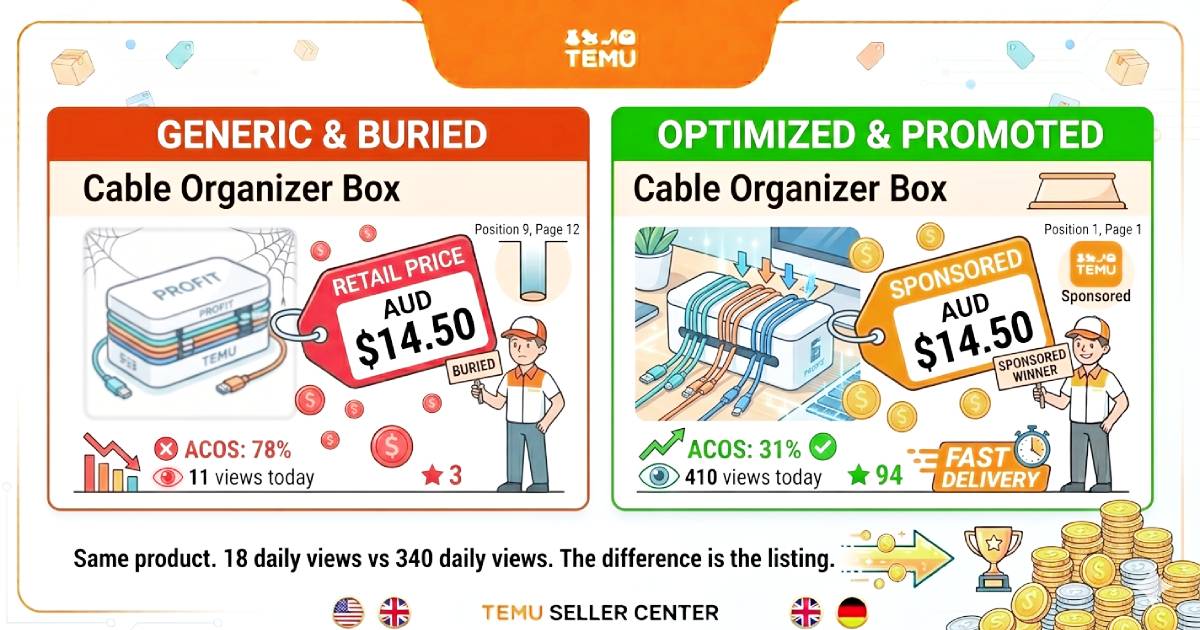
Two listings. Same product. Same price. Same category.
One is generating 340 views a day and converting at 9%. The
other is sitting at 18 views a day with a 2.1% conversion rate. The seller with
18 daily views has been blaming the algorithm, considering running ads, and
wondering whether Temu is even worth it.
The seller with 340 views has the same product. They just
built the listing properly.
This is the single most underestimated lever in all of Temu
selling. Most sellers spend weeks on product research, agonize over fulfillment
decisions, and build ad campaigns then publish a listing in 20 minutes and
wonder why nothing moves. In 2026, with tens of thousands of sellers now
competing across the US, UK, Germany, and Australia, a mediocre listing does
not just underperform — it actively signals to Temu's algorithm that the
product is not worth ranking. As covered in our Temu Algorithm Deep Dive,
conversion rate is one of the strongest ranking signals on the platform. A
listing that buyers skip is a listing the algorithm stops showing.
This guide is the hands-on tutorial for fixing that. Every
section contains a formula, a before/after example, or a checklist you can
apply to your own listings today. By the end, you will have a complete
optimization framework you can run on every listing in your store — new or
existing.
Note: Temu's specific field requirements vary by category
and market. Always verify current requirements in your Seller Center dashboard.
The principles here are consistent across markets; the compliance specifics
vary, and those are flagged in the relevant sections.

How Temu Evaluates Product Listings in 2026
Before touching a single field, you need to understand what
Temu's algorithm is actually measuring when it decides where to rank your
listing. This is covered in depth in our Algorithm Deep Dive, but here is the
listing-specific summary.
Temu's ranking system evaluates listings on two dimensions: indexability
and rankability.
Indexability — whether your listing appears in search
results at all — is determined by completeness. Listing completeness gets you
indexed. Recommended fields are optional for publishing but not for visibility.
Treat them as required across every listing. Inriver A listing
that is technically live but missing attributes, skipping specification fields,
or using a vague title may not appear in relevant search queries at all.
Rankability — where your listing appears among
indexed results — is determined by performance signals: click-through rate
(CTR), conversion rate (CVR), sales velocity, review score, and fulfillment
metrics. Every element of your listing either feeds or hurts these signals.
The practical implication: optimizing a listing is not about
making it look nice. It is about systematically improving the signals that tell
Temu's algorithm this listing deserves a higher position. A 1% improvement in
CTR means more organic impressions. A 2% improvement in CVR means more sales
from the same impressions. Both compound over time in ways that paid
advertising cannot replicate at the same cost.
|
Listing Element |
Affects Indexability |
Affects Rankability |
Priority |
|
Title |
✅ Yes — keyword matching |
✅ Yes — CTR from search |
🔴 Critical |
|
Main Image |
❌ No |
✅ Yes — CTR from search |
🔴 Critical |
|
Supporting Images |
❌ No |
✅ Yes — CVR on listing page |
🔴 Critical |
|
Bullet Points |
✅ Yes — keyword depth |
✅ Yes — CVR from description |
🟡 High |
|
Description |
✅ Yes — keyword depth |
✅ Yes — CVR, trust signals |
🟡 High |
|
Attributes/Specs |
✅ Yes — filter matching |
✅ Yes — reduces returns |
🟡 High |
|
Category (leaf level) |
✅ Yes — category indexing |
✅ Yes — relevant audience |
🟡 High |
|
Video |
❌ No |
✅ Yes — dwell time, CVR |
🟢 Medium |
|
Price |
❌ No |
✅ Yes — CVR, competitiveness |
🟢 Medium |
Temu Product Listing Requirements in 2026
What Does Temu Actually Require to Publish a Listing?
Every listing needs a title, description, leaf-level
category assignment, SKU identifier, and price. A minimum of three images is
required to publish. The main image must use a white or neutral background with
the product centered and clearly visible. Inriver
That is the minimum to go live. It is emphatically not the
minimum to perform.
You can add up to five bullet points per listing, each up to
5,000 characters. LitCommerce Helpdesk
Temu allows up to 8 product images and videos, and lifestyle photos are
encouraged. LitCommerce
Here is the full requirement map — minimum to publish versus
recommended for performance:
|
Field |
Minimum to Publish |
Recommended for Performance |
|
Title |
Required |
Keyword-optimised, 60–150 characters |
|
Description |
Required |
Full description with benefits + specs |
|
Bullet Points |
Optional |
All 5 used, each addressing a buyer question |
|
Main Image |
Required (white/neutral BG) |
High-res, product fills 85%+ of frame |
|
Supporting Images |
Min 3 total |
6–8 images covering all angles + lifestyle |
|
Video |
Optional |
15–60 second product demo strongly recommended |
|
Category |
Leaf-level required |
Double-checked for most specific subcategory |
|
Attributes/Specs |
Category-dependent |
All available fields completed |
|
Variants |
Required even for single variant |
Clearly labelled with accurate values |
For Germany and EU sellers, compliance fields add
another layer on top of this. Every seller shipping into the EU must appoint an
EU Authorized Representative, display their contact details on product labels
and listings, and upload the information to Temu's seller backend. Inriver As of
early 2026, Temu actively removes listings that don't comply with GPSR
requirements. AMZ Prep These are not
optional fields — they are enforced.
For UK sellers, UKCA certification replaces CE
marking for relevant product categories. This information must be present in
the listing and on physical packaging.
Action Step — Do This Today: Open your five
highest-revenue listings. Check how many of the "recommended" fields
above are actually completed. Most sellers will find at least two or three
gaps. Those gaps are costing indexability and ranking right now.
Optimizing Product Titles for Search and Clicks
What Makes a Strong Temu Product Title in 2026?
Your title does two jobs simultaneously: it tells Temu's
search algorithm what your product is (indexability), and it convinces a buyer
to click your listing over a competitor's (CTR). Most sellers write titles that
do one of these poorly and the other not at all.
Lead the title with your primary keyword and keep it
descriptive. Vague or generic titles reduce discoverability regardless of how
complete the rest of the listing is. Inriver
Here is the title formula that works across all four
markets:
[Primary Keyword] + [Key Feature/Material] +
[Size/Quantity/Variant] + [Use Case or Benefit] + [Secondary Keyword]
The order matters. Temu's algorithm weights the beginning of
the title more heavily for keyword matching — the same way Google weights the
first words of a headline. Put your most important search term first, not your
brand name or a creative product name nobody searches for.
What Makes a Strong Temu Product Title — and What Kills It
|
✅ Strong Title Elements |
❌ Weak Title Elements |
|
Primary keyword in first 3 words |
Brand name or creative name first |
|
Specific material or feature |
Vague descriptors ("nice," "great,"
"quality") |
|
Quantity or size stated clearly |
Missing size/quantity information |
|
Secondary keyword included |
Keyword stuffing (5+ keywords jammed together) |
|
80–130 characters |
Under 40 characters (too thin) or over 160 (truncated) |
|
Buyer language ("organizer") |
Seller/factory language ("storage solution
unit") |
Before & After: Title Transformations
Example 1 — US Market: Drawer Organizer
❌ Before: "Storage
Box for Drawers - Good Quality"
✅ After: "Modular
Drawer Organizer Set — Adjustable Dividers, 8-Pack, Kitchen & Desk
Storage"
What changed: Primary keyword ("Modular Drawer
Organizer") leads. Specific detail ("Adjustable Dividers")
answers the buyer's first question. Quantity ("8-Pack") sets
expectation. Secondary keywords ("Kitchen & Desk Storage") catch
alternative search terms. The word "Good Quality" was replaced with a
specific feature — because every seller claims good quality and no buyer
searches for it.
Example 2 — UK Market: Radiator Drying Rack
❌ Before: "Clothes
Drying Rack Foldable Space Saving"
✅ After: "Compact
Radiator Airer — Foldable Clothes Drying Rack for Small Spaces, 3-Tier"
What changed: "Radiator Airer" is the British
English term buyers actually search — not "drying rack." Leading with
the UK-specific term captures the audience. "3-Tier" is a specific
detail buyers filter by. "Small Spaces" addresses the primary pain
point UK buyers have with their homes.
Example 3 — Germany Market: Silicone Baking Mat
❌ Before: "Baking
Mat Silicone Reusable Non-Stick Kitchen"
✅ After: "Silikon
Backmatten Set wiederverwendbar, 3er-Set, BPA-frei, antihaftbeschichtet,
30x40cm"
What changed: Entirely in German — because German buyers
search in German compound nouns. BPA-frei (BPA-free) is a compliance signal
German buyers actively look for. Exact dimensions (30x40cm) are included —
German buyers measure. The 3er-Set (3-pack) is specified clearly. This is not a
translation of the English title; it is a title rebuilt from scratch for German
search behaviour.
Example 4 — Australia Market: Beach Mat
❌ Before: "Waterproof
Mat Beach Outdoor Use Sand Free"
✅ After: "Sand-Free
Waterproof Beach Mat — Quick-Dry, Lightweight, 200x200cm, Outdoor Festival
& Beach"
What changed: "Sand-Free" leads because that is
the primary benefit Australian beach buyers search for. Dimensions (200x200cm)
are Australian-standard. "Festival & Beach" captures the dual use
case common in Australian summer culture. "Quick-Dry" addresses the
specific functional concern of anyone who has carried a wet mat home from the
beach.

Action Step — Title Audit: Take your worst-performing
listing (lowest CTR). Count how many of the "strong title elements"
it contains. Rewrite it using the formula above. Publish the rewrite and check
CTR again after 7 days. This is the fastest single improvement you can make to
any listing.
Product Images and Videos: The Visual Conversion Machine
How Many Images Should I Upload on Temu?
The minimum is three. Temu allows up to 8 product images and
videos. LitCommerce The
answer to "how many should I upload" is: as many as you have
available up to 8, provided each one adds information the buyer could not get
from the previous image.
Here is the image sequence that converts — and the reason
each image earns its place:
Image 1 — Main Image (The Click Generator) White or
neutral background, product centered and filling at least 85% of the frame,
high resolution (minimum 800×800px, ideally 1500×1500px). This is the only
image the buyer sees before clicking. It must communicate what the product is
and make the click feel worth it. No text overlays on the main image — Temu's
guidelines restrict these on the primary image in most categories.
Image 2 — Lifestyle Image (The Desire Builder) The
product in use in a realistic, aspirational context. A drawer organizer inside
a well-organized kitchen drawer. A beach mat on actual sand with two people
sitting on it. This image answers the buyer's question "what will this
look like in my life?" and it is the most powerful conversion driver on
the listing page.
Image 3 — Dimensions/Size Reference (The Trust Builder)
An infographic showing exact dimensions with a size comparison (e.g., next to a
common object like a ruler, A4 paper, or a human hand). This is the number one
image that reduces returns — because most returns happen when the buyer's
expectation of size did not match reality.
Image 4 — Feature Callout (The Detail Closer) An
annotated image calling out two to four key features with short labels.
"Food-grade silicone." "BPA-free." "Fits standard EU
drawer sizes." This image converts buyers who are 80% decided but need one
more confirmation.
Image 5 — Material Close-Up (The Quality Signal) A
macro shot of the product's material, texture, or construction quality. This
image does disproportionate work for buyers who cannot physically touch the
product — which is all of them.
Images 6–8 — Variant Visuals, Use Cases, Packaging
Show the product in its colour or size variants, any secondary use cases, and
what the buyer receives when the package arrives. An image of the packaging
sets expectation and reduces "not as described" returns.
Video — The Conversion Multiplier A 15–60 second
product demonstration video consistently outperforms static images for
conversion rate on Temu. It does not need to be professionally produced — a
clean, well-lit video showing the product being used in context converts
significantly better than no video. Sellers who add video to existing listings
frequently report meaningful CTR and CVR improvements within the first two
weeks.
|
Image Slot |
Purpose |
Impact on Metrics |
|
1 — Main image |
Generate the click |
CTR — critical |
|
2 — Lifestyle |
Build desire |
CVR — critical |
|
3 — Dimensions |
Build trust, prevent returns |
CVR + return rate |
|
4 — Feature callout |
Close hesitant buyers |
CVR |
|
5 — Material close-up |
Justify quality at the price |
CVR + review quality |
|
6–8 — Variants/packaging |
Set accurate expectations |
Return rate |
|
Video |
Demonstrate real-world use |
CVR + dwell time |

Country-Specific Image Notes
USA: Lifestyle images that reflect US home aesthetics
convert best. American kitchen, American garage, American desk setups. Buyers
connect more strongly with environments they recognise. Avoid European-style
interiors for US listings if you can choose.
UK: Size reference images are non-negotiable. UK home
dimensions — particularly kitchens, bathrooms, and radiator sizes — are
specific. A buyer in a terraced house needs to know whether your product
actually fits their radiator before they order. Show this explicitly.
Germany: Compliance and certification images perform
uniquely well in Germany. An image showing CE marking, VerpackG compliance, or
BPA-free certification badges adds the trust signal that German buyers look for
before committing. Include this as one of your supporting images specifically
for the German market.
Australia: Outdoor lifestyle context is essential for
any product with an outdoor use case. A beach mat photographed in a studio does
not convert in Australia the way a beach mat photographed at an actual beach
does. If you sell outdoor products for the Australian market, photograph them
outdoors.
Writing High-Converting Descriptions and Bullet Points
The Buyer Questions Framework
Most Temu sellers write descriptions that describe the
product. The sellers with high CVR write descriptions that answer the buyer's
questions. There is a fundamental difference.
When a buyer lands on your listing, they have a mental
checklist of questions. Your description's job is to answer every single one
before they leave the page to find a competitor who does.
Here are the five questions every buyer asks — and they map
directly to Temu's five bullet point slots:
Bullet 1 — "What exactly is this?" State
the primary benefit and the specific use case. Not what the product is made of
— what problem it solves and for whom. Lead with the outcome.
Weak: "This is a set of silicone baking mats made
from food-grade silicone." Strong: "Eliminate single-use
parchment paper permanently — these food-grade silicone baking mats fit
standard 30×40cm baking trays and handle up to 230°C without warping."
Bullet 2 — "Will this actually fit / work for my
situation?" Provide exact compatibility information. Dimensions,
weight limits, compatible models or sizes, materials. This is the bullet that
prevents returns.
Bullet 3 — "Is this safe / good quality?"
Address material safety, durability, certifications. For German listings, lead
this bullet with compliance information. For the US and UK, focus on material
quality signals buyers associate with value.
Bullet 4 — "What do I get in the package?"
State exactly what is included. Buyers who are surprised by what arrives — in
either direction — leave reviews about it. Set accurate expectations here.
Bullet 5 — "What if something goes wrong?"
Address your return or satisfaction policy, care instructions, or a warranty
note. This bullet reduces purchase anxiety, which is one of the primary reasons
buyers leave without buying.
Before & After: Description Transformations
Example — US Seller: Cable Management Box
❌ BEFORE — Bullet Points:
- Good
quality cable box
- Can
hold many cables
- Made
of ABS plastic
- Easy
to use
- Great
gift idea
✅ AFTER — Bullet Points:
- FINALLY
TAME YOUR CABLE CHAOS — This modular cable management box hides up to
6 power strips and 8 cables inside a sleek, ventilated enclosure. Fits
desks, entertainment units, and home office setups. Available in white and
black.
- EXACT
FIT GUARANTEE — External dimensions: 35cm L × 13cm W × 11cm H.
Internal space fits standard UK/US/EU power strips up to 30cm long.
Measure your strip before ordering using our dimension guide in image 3.
- FIRE-SAFE
ABS MATERIAL — Constructed from UL94 V0 rated flame-retardant ABS
plastic. Ventilation slots maintain airflow and prevent heat buildup,
tested to remain safe at ambient cable-operating temperatures.
- COMPLETE
SET INCLUDED — 1× cable management box, 2× adhesive cable clips, 1×
cable tie pack (10 pieces), 1× instruction card. Everything you need for a
clean desk setup, out of the box.
- HASSLE-FREE
PURCHASE — If your power strip doesn't fit, contact us with your
strip's model number and we'll confirm compatibility or arrange a
straightforward return. Your desk should look great — we'll make sure it
does.
The difference is night and day. The "after"
version answers real buyer questions, uses the primary keyword naturally,
provides specific compatibility information, addresses safety concerns, and
closes with a trust signal. The "before" version communicates almost
nothing a buyer could not already see from the product image.

Adapting Descriptions by Market
USA: American buyers respond to direct, benefit-led
language with a slightly conversational energy. Phrases like
"finally" and "say goodbye to" and "you deserve"
land well. Hype is acceptable in measured doses. Lead with outcomes, not
specifications.
UK: British buyers are more skeptical of marketing
hyperbole. Keep the language specific and factual. "Fits standard UK
radiator fins up to 12cm depth" converts better than "perfect for any
radiator." Earn the sale with specificity, not enthusiasm.
Germany: Descriptions must be in German. Every bullet
point. Precise specifications, compliance statements, and exact measurements.
The phrase "geprüfte Qualität" (verified quality) with a specific
standard cited outperforms any marketing claim. Buyers trust verifiable
information over adjectives.
Australia: Conversational and direct, similar to the
US but without the hype. Australians respond well to practical, no-nonsense
language. Specific references to Australian use cases — "perfect for beach
days, camping, and outdoor festivals" — outperform generic lifestyle
descriptions.
Filling Attributes and Specifications Completely
Why Incomplete Attributes Kill Rankings
This is the most overlooked section of any Temu listing and
one of the most impactful for indexability. Temu uses a category-driven data
model. The attributes required for your listing depend entirely on the category
assigned, and categories must be selected at the leaf level — the most specific
subcategory available — before any fields appear. Inriver
When a buyer uses Temu's filter system to narrow search
results — filtering by size, colour, material, compatibility — your listing
only appears if those attributes are filled in correctly. A listing with an
empty "Material" field does not appear in results filtered for
"Silicone." A listing without dimensions completed does not appear in
results filtered by size. Every empty attribute field is a filter that excludes
you from a category of buyer.
Product data enrichment is what separates a listing that
gets indexed from one that gets ranked. Inriver Fill
every field that appears in your category attribute section. Even if a field
feels redundant or obvious — fill it. The algorithm does not know your product
is obvious.
The Attributes Audit — Five Minutes, Real Impact
Open any of your live listings. Click into the
attributes/specifications section. Count how many fields are blank. For most
sellers in most categories, the answer is between three and eight empty fields.
Each one is a lost filter match. Spend five minutes filling them in — this is
one of the highest ROI tasks available to any Temu seller with existing
listings.
Before & After Case Studies: Full Listing Transformations
Case Study 1: Desk Cable Organizer Box (US Seller)
Situation: Seller had been live for 6 weeks. 22 views
per day, 1.8% conversion rate, zero reviews yet. Running $15/day in ads with a
48% ACoS — unsustainably above break-even.
Before Listing Audit Results:
- Title:
"Cable Box for Desk Use" (11 words, primary keyword buried)
- Main
image: White background, product small and centered, lots of empty space
- Supporting
images: 3 total — two product angles, one packaging shot
- Bullet
points: 3 filled, all generic ("good quality," "easy
assembly," "nice design")
- Attributes:
4 of 11 category fields completed
- Video:
None
After Optimization (Changes Made):
- Title
rebuilt using formula: "Cable Management Box with Lid — Hides Power
Strips & Cables, Ventilated ABS, Fits Desks & TV Units"
- Main
image: Product now fills 88% of frame, slight angle showing the lid open
revealing organized cables
- Supporting
images: Added to 7 — lifestyle image (organized desk setup), dimension
infographic, feature callout (ventilation slots annotated), material
close-up, colour variants, what's in the box
- Bullet
points: All 5 rewritten using buyer questions framework above
- Attributes:
All 11 fields completed including material, dimensions, colour options,
compatibility
- Video:
28-second desktop setup demo added
Results After 21 Days:
|
Metric |
Before |
After |
Change |
|
Daily Views |
22 |
187 |
+750% |
|
CTR from Search |
1.2% |
4.8% |
+300% |
|
Conversion Rate |
1.8% |
7.4% |
+311% |
|
Ad ACoS |
48% |
22% |
-54% |
|
Weekly Sales |
3 units |
34 units |
+1,033% |
The same product. The same price. The same category. The
listing did all the work.
Case Study 2: Silicone Baking Mat Set (Germany Seller)
Situation: Seller listed an eco-friendly silicone
baking mat set in Germany with an English-language title and description
translated directly from their UK listing. Zero sales in 4 weeks despite a
solid product.
Before Listing Issues:
- Title
in English: "Reusable Silicone Baking Mat Set Non-Stick 3 Pack"
- Description
in English with metric measurements
- No
compliance information (VerpackG, BPA-free certification) visible
- Main
image: Studio white background (fine) but no size reference image
- Attributes
missing: Material certification, country of origin, specific compliance
standard
After Optimization:
- Title
rebuilt in German: "Silikon Backmatten Set wiederverwendbar —
3er-Set, BPA-frei, antihaftbeschichtet, 30×40cm, spülmaschinenfest"
- Full
German-language description with bullet points written in natural German
(not translated English)
- Added
compliance badge image showing BPA-frei and CE certification
- Added
dimension image with exact cm measurements and comparison to standard
German baking tray size
- All
attributes completed in German with specific material compliance standard
cited
Results After 14 Days:
|
Metric |
Before |
After |
Change |
|
Daily Views |
4 |
89 |
+2,125% |
|
Conversion Rate |
0% |
8.3% |
From zero |
|
Return Rate (first 30 days) |
N/A |
1.2% |
Below category avg |
The product was not the problem. The listing was invisible
to the German search algorithm and unconvincing to German buyers when they did
find it.
Case Study 3: Compact Radiator Drying Rack (UK Seller)
Situation: Mid-performing listing — 65 views per day,
4.2% conversion rate. Seller wanted to improve without changing the product or
price.
Key Changes Made:
- Title
changed from "Folding Clothes Rack Radiator" to "Compact
Radiator Airer — Foldable 3-Tier Clothes Drying Rack, Space-Saving, Fits
Standard UK Radiators"
- Added
a UK-specific image showing the rack fitted on a standard British column
radiator with dimensions annotated
- Added
bullet point explicitly stating compatibility with radiators up to 55cm
width — the most common UK radiator width
- Rewrote
description to lead with the UK-specific problem: "No tumble dryer?
Small flat? The compact radiator airer that actually fits your
space."
Results After 14 Days:
|
Metric |
Before |
After |
Change |
|
Daily Views |
65 |
141 |
+117% |
|
Conversion Rate |
4.2% |
9.1% |
+117% |
|
Return Rate |
6.8% |
2.3% |
-66% |
The return rate drop is significant — and directly
attributable to the dimension compatibility image and the explicit radiator
width specification. Buyers who previously ordered hoping it would fit their
radiator now knew before ordering.
Country-Specific Image Notes
USA: Lifestyle images that reflect US home aesthetics
convert best. American kitchen, American garage, American desk setups. Buyers
connect more strongly with environments they recognise. Avoid European-style
interiors for US listings if you can choose.
UK: Size reference images are non-negotiable. UK home
dimensions — particularly kitchens, bathrooms, and radiator sizes — are
specific. A buyer in a terraced house needs to know whether your product
actually fits their radiator before they order. Show this explicitly.
Germany: Compliance and certification images perform
uniquely well in Germany. An image showing CE marking, VerpackG compliance, or
BPA-free certification badges adds the trust signal that German buyers look for
before committing. Include this as one of your supporting images specifically
for the German market.
Australia: Outdoor lifestyle context is essential for
any product with an outdoor use case. A beach mat photographed in a studio does
not convert in Australia the way a beach mat photographed at an actual beach
does. If you sell outdoor products for the Australian market, photograph them
outdoors.
Writing High-Converting Descriptions and Bullet Points
The Buyer Questions Framework
Most Temu sellers write descriptions that describe the
product. The sellers with high CVR write descriptions that answer the buyer's
questions. There is a fundamental difference.
When a buyer lands on your listing, they have a mental
checklist of questions. Your description's job is to answer every single one
before they leave the page to find a competitor who does.
Here are the five questions every buyer asks — and they map
directly to Temu's five bullet point slots:
Bullet 1 — "What exactly is this?" State
the primary benefit and the specific use case. Not what the product is made of
— what problem it solves and for whom. Lead with the outcome.
Weak: "This is a set of silicone baking mats made
from food-grade silicone." Strong: "Eliminate single-use
parchment paper permanently — these food-grade silicone baking mats fit
standard 30×40cm baking trays and handle up to 230°C without warping."
Bullet 2 — "Will this actually fit / work for my
situation?" Provide exact compatibility information. Dimensions,
weight limits, compatible models or sizes, materials. This is the bullet that
prevents returns.
Bullet 3 — "Is this safe / good quality?"
Address material safety, durability, certifications. For German listings, lead
this bullet with compliance information. For the US and UK, focus on material
quality signals buyers associate with value.
Bullet 4 — "What do I get in the package?"
State exactly what is included. Buyers who are surprised by what arrives — in
either direction — leave reviews about it. Set accurate expectations here.
Bullet 5 — "What if something goes wrong?"
Address your return or satisfaction policy, care instructions, or a warranty
note. This bullet reduces purchase anxiety, which is one of the primary reasons
buyers leave without buying.
Before & After: Description Transformations
Example — US Seller: Cable Management Box
❌ BEFORE — Bullet Points:
- Good
quality cable box
- Can
hold many cables
- Made
of ABS plastic
- Easy
to use
- Great
gift idea
✅ AFTER — Bullet Points:
- FINALLY
TAME YOUR CABLE CHAOS — This modular cable management box hides up to
6 power strips and 8 cables inside a sleek, ventilated enclosure. Fits
desks, entertainment units, and home office setups. Available in white and
black.
- EXACT
FIT GUARANTEE — External dimensions: 35cm L × 13cm W × 11cm H.
Internal space fits standard UK/US/EU power strips up to 30cm long.
Measure your strip before ordering using our dimension guide in image 3.
- FIRE-SAFE
ABS MATERIAL — Constructed from UL94 V0 rated flame-retardant ABS
plastic. Ventilation slots maintain airflow and prevent heat buildup,
tested to remain safe at ambient cable-operating temperatures.
- COMPLETE
SET INCLUDED — 1× cable management box, 2× adhesive cable clips, 1×
cable tie pack (10 pieces), 1× instruction card. Everything you need for a
clean desk setup, out of the box.
- HASSLE-FREE
PURCHASE — If your power strip doesn't fit, contact us with your
strip's model number and we'll confirm compatibility or arrange a
straightforward return. Your desk should look great — we'll make sure it
does.
The difference is night and day. The "after"
version answers real buyer questions, uses the primary keyword naturally,
provides specific compatibility information, addresses safety concerns, and
closes with a trust signal. The "before" version communicates almost
nothing a buyer could not already see from the product image.

Adapting Descriptions by Market
USA: American buyers respond to direct, benefit-led
language with a slightly conversational energy. Phrases like
"finally" and "say goodbye to" and "you deserve"
land well. Hype is acceptable in measured doses. Lead with outcomes, not
specifications.
UK: British buyers are more skeptical of marketing
hyperbole. Keep the language specific and factual. "Fits standard UK
radiator fins up to 12cm depth" converts better than "perfect for any
radiator." Earn the sale with specificity, not enthusiasm.
Germany: Descriptions must be in German. Every bullet
point. Precise specifications, compliance statements, and exact measurements.
The phrase "geprüfte Qualität" (verified quality) with a specific
standard cited outperforms any marketing claim. Buyers trust verifiable
information over adjectives.
Australia: Conversational and direct, similar to the
US but without the hype. Australians respond well to practical, no-nonsense
language. Specific references to Australian use cases — "perfect for beach
days, camping, and outdoor festivals" — outperform generic lifestyle
descriptions.
Filling Attributes and Specifications Completely
Why Incomplete Attributes Kill Rankings
This is the most overlooked section of any Temu listing and
one of the most impactful for indexability. Temu uses a category-driven data
model. The attributes required for your listing depend entirely on the category
assigned, and categories must be selected at the leaf level — the most specific
subcategory available — before any fields appear. Inriver
When a buyer uses Temu's filter system to narrow search
results — filtering by size, colour, material, compatibility — your listing
only appears if those attributes are filled in correctly. A listing with an
empty "Material" field does not appear in results filtered for
"Silicone." A listing without dimensions completed does not appear in
results filtered by size. Every empty attribute field is a filter that excludes
you from a category of buyer.
Product data enrichment is what separates a listing that
gets indexed from one that gets ranked. Inriver Fill
every field that appears in your category attribute section. Even if a field
feels redundant or obvious — fill it. The algorithm does not know your product
is obvious.
The Attributes Audit — Five Minutes, Real Impact
Open any of your live listings. Click into the
attributes/specifications section. Count how many fields are blank. For most
sellers in most categories, the answer is between three and eight empty fields.
Each one is a lost filter match. Spend five minutes filling them in — this is
one of the highest ROI tasks available to any Temu seller with existing
listings.
Before & After Case Studies: Full Listing Transformations
Case Study 1: Desk Cable Organizer Box (US Seller)
Situation: Seller had been live for 6 weeks. 22 views
per day, 1.8% conversion rate, zero reviews yet. Running $15/day in ads with a
48% ACoS — unsustainably above break-even.
Before Listing Audit Results:
- Title:
"Cable Box for Desk Use" (11 words, primary keyword buried)
- Main
image: White background, product small and centered, lots of empty space
- Supporting
images: 3 total — two product angles, one packaging shot
- Bullet
points: 3 filled, all generic ("good quality," "easy
assembly," "nice design")
- Attributes:
4 of 11 category fields completed
- Video:
None
After Optimization (Changes Made):
- Title
rebuilt using formula: "Cable Management Box with Lid — Hides Power
Strips & Cables, Ventilated ABS, Fits Desks & TV Units"
- Main
image: Product now fills 88% of frame, slight angle showing the lid open
revealing organized cables
- Supporting
images: Added to 7 — lifestyle image (organized desk setup), dimension
infographic, feature callout (ventilation slots annotated), material
close-up, colour variants, what's in the box
- Bullet
points: All 5 rewritten using buyer questions framework above
- Attributes:
All 11 fields completed including material, dimensions, colour options,
compatibility
- Video:
28-second desktop setup demo added
Results After 21 Days:
|
Metric |
Before |
After |
Change |
|
Daily Views |
22 |
187 |
+750% |
|
CTR from Search |
1.2% |
4.8% |
+300% |
|
Conversion Rate |
1.8% |
7.4% |
+311% |
|
Ad ACoS |
48% |
22% |
-54% |
|
Weekly Sales |
3 units |
34 units |
+1,033% |
The same product. The same price. The same category. The
listing did all the work.
Case Study 2: Silicone Baking Mat Set (Germany Seller)
Situation: Seller listed an eco-friendly silicone
baking mat set in Germany with an English-language title and description
translated directly from their UK listing. Zero sales in 4 weeks despite a
solid product.
Before Listing Issues:
- Title
in English: "Reusable Silicone Baking Mat Set Non-Stick 3 Pack"
- Description
in English with metric measurements
- No
compliance information (VerpackG, BPA-free certification) visible
- Main
image: Studio white background (fine) but no size reference image
- Attributes
missing: Material certification, country of origin, specific compliance
standard
After Optimization:
- Title
rebuilt in German: "Silikon Backmatten Set wiederverwendbar —
3er-Set, BPA-frei, antihaftbeschichtet, 30×40cm, spülmaschinenfest"
- Full
German-language description with bullet points written in natural German
(not translated English)
- Added
compliance badge image showing BPA-frei and CE certification
- Added
dimension image with exact cm measurements and comparison to standard
German baking tray size
- All
attributes completed in German with specific material compliance standard
cited
Results After 14 Days:
|
Metric |
Before |
After |
Change |
|
Daily Views |
4 |
89 |
+2,125% |
|
Conversion Rate |
0% |
8.3% |
From zero |
|
Return Rate (first 30 days) |
N/A |
1.2% |
Below category avg |
The product was not the problem. The listing was invisible
to the German search algorithm and unconvincing to German buyers when they did
find it.
Case Study 3: Compact Radiator Drying Rack (UK Seller)
Situation: Mid-performing listing — 65 views per day,
4.2% conversion rate. Seller wanted to improve without changing the product or
price.
Key Changes Made:
- Title
changed from "Folding Clothes Rack Radiator" to "Compact
Radiator Airer — Foldable 3-Tier Clothes Drying Rack, Space-Saving, Fits
Standard UK Radiators"
- Added
a UK-specific image showing the rack fitted on a standard British column
radiator with dimensions annotated
- Added
bullet point explicitly stating compatibility with radiators up to 55cm
width — the most common UK radiator width
- Rewrote
description to lead with the UK-specific problem: "No tumble dryer?
Small flat? The compact radiator airer that actually fits your
space."
Results After 14 Days:
|
Metric |
Before |
After |
Change |
|
Daily Views |
65 |
141 |
+117% |
|
Conversion Rate |
4.2% |
9.1% |
+117% |
|
Return Rate |
6.8% |
2.3% |
-66% |
The return rate drop is significant — and directly
attributable to the dimension compatibility image and the explicit radiator
width specification. Buyers who previously ordered hoping it would fit their
radiator now knew before ordering.
Common Listing Mistakes That Tank Performance
These are the errors ApexBin sees repeatedly across seller
listings in all four markets. Each one has a specific fix.
Mistake 1: Generic Main Image With Too Much White Space
A product centered in a large white void signals a low-effort listing. The
product should fill at least 80–85% of the image frame. Buyers scan search
results in half a second — a small product in a sea of white does not attract
the eye the way a product that commands the frame does. Fix: Re-photograph
or crop your main image so the product fills the frame. Do not zoom out to show
the full product if cropping tighter still shows everything important.
Mistake 2: Title Starting With the Brand Name No
buyer on Temu searches for your brand name unless you are Nike or Apple.
Starting your title with a brand name buries your primary keyword and wastes
the highest-weighted position in the title field. Fix: Move the primary
search keyword to position one. The brand name, if included at all, goes at the
end.
Mistake 3: Copying the Same Listing Across Markets
Presentation is everything, and on Temu, product titles and descriptions can
often be the difference between conversion or cart abandonment. Whop What works in the
US listing market does not work in Germany. Same product, four different
listings — different language, different buyer psychology, different compliance
requirements. Fix: Treat each market as a separate listing build. Use the
country-specific guidance throughout this article.
Mistake 4: Leaving Bullet Points Generic or Empty
Three generic bullets and two empty slots is one of the most common listing
configurations on Temu. It communicates nothing to a buyer in the decision
phase and leaves keyword indexing depth on the table. Fix: Use all five
slots. Write each one to answer a specific buyer question as described in the
framework above.
Mistake 5: Missing Dimension Image A listing with no
size reference image generates returns at 2–4× the rate of a listing with a
clear dimension infographic. Every product that has a size component — which is
most products — needs this image. Fix: Create a simple dimension infographic
in Canva or equivalent. Dimensions, a size comparison object, and ideally a
note on what it fits inside or next to.
Mistake 6: Using Factory/Supplier Photos Supplier
photos are usually low resolution, often include foreign-language text,
sometimes show the wrong colour variant, and almost never include lifestyle
context. They also frequently appear on competitor listings — because you
sourced from the same supplier. Fix: Photograph your own inventory. A clean
table, a white foam board backdrop, and a phone camera with good lighting
produces images that beat supplier photos in almost every case.
Mistake 7: Ignoring Attributes After Publishing Most
sellers complete the mandatory attributes to publish and never return to fill
in the recommended ones. Those recommended attributes are the filters buyers
use to narrow search results. Fix: Schedule a one-time attribute audit for
all live listings. Fill every available field. This is a 5-minute fix per
listing with permanent indexability benefits.
|
Mistake |
Impact |
Fix Time |
|
Generic main image |
Low CTR from search |
30 min re-crop/reshoot |
|
Brand name leading title |
Buried keyword, low CTR |
2 minutes |
|
Same listing across markets |
Low CVR, zero German indexing |
30–60 min per market rebuild |
|
Generic/empty bullet points |
Low CVR, poor keyword depth |
20 min per listing |
|
Missing dimension image |
High return rate |
20 min to create infographic |
|
Supplier photos |
Low CVR, shared with competitors |
60–90 min to reshoot |
|
Incomplete attributes |
Filter exclusions, low indexability |
5 min per listing |
Optimization Workflow and Action Plan
The Listing Audit Routine — Run This on Every Listing You
Own
Use this as a repeatable process — not a one-time event. A
listing that is strong today may be outpaced by a competitor who rebuilds their
listing next month. Run this audit on your top five listings quarterly, and on
every new listing before it goes live.
Step 1 — Title Score (2 minutes) Does the title lead
with the primary keyword? Does it include a specific feature, quantity or size,
and a secondary keyword? Is it between 80–130 characters? Yes to all three:
pass. Any no: rewrite before moving on.
Step 2 — Image Audit (5 minutes) Count your images.
Do you have 6 or more? Does Image 1 fill the frame? Is there a lifestyle image?
Is there a dimension/size image? Is there a feature callout image? If any of
these are missing, create them before running ads on this listing.
Step 3 — Bullet Point Review (5 minutes) Are all five
slots used? Does each bullet answer one of the five buyer questions (What is
it? Will it fit? Is it quality? What do I get? What if it goes wrong?)? If any
slot is generic or empty, rewrite it.
Step 4 — Attribute Completeness (5 minutes) Open the
listing's attribute section. Count empty fields. Fill all of them. Every empty
attribute is a lost filter match.
Step 5 — Market Adaptation Check (5 minutes) Is the
language appropriate for the target market? Is the description in the buyer's
native language? Are dimensions in the correct units (metric for
Germany/UK/Australia, can be imperial for US but metric also acceptable)? Are
compliance details present for EU/UK listings?
Step 6 — Performance Data Review (5 minutes) In your
Seller Center analytics, check CTR and CVR for this listing over the past 30
days. If CTR is below 2%, the title or main image needs work. If CTR is strong
but CVR is below 4%, the description, bullet points, or supporting images need
work. If both are strong, the listing is optimized — move to the next one.
Your Temu Listing Optimization Checklist
Print this. Stick it next to your monitor. Run it on every
listing.
TITLE
- ☐
Primary keyword in first three words
- ☐
Specific feature, material, or key detail included
- ☐
Quantity, size, or variant stated
- ☐
Secondary keyword present
- ☐
80–130 characters total
- ☐
Written in buyer language, not factory language
- ☐
In native language of target market (German for DE, English for US/UK/AU)
IMAGES
- ☐
Minimum 6 images uploaded (aim for 8)
- ☐
Main image: white/neutral background, product fills 85%+ of frame
- ☐
Lifestyle image: product in realistic use context
- ☐
Dimension infographic: exact measurements with size comparison
- ☐
Feature callout: annotated key features
- ☐
Material/texture close-up
- ☐
Packaging/what's included image
- ☐
Video added (15–60 seconds product demo)
DESCRIPTION & BULLETS
- ☐
All 5 bullet point slots used
- ☐
Bullet 1: Primary benefit + use case
- ☐
Bullet 2: Compatibility/dimensions/fit information
- ☐
Bullet 3: Safety, material quality, certifications
- ☐
Bullet 4: Package contents listed precisely
- ☐
Bullet 5: Return policy or satisfaction assurance
- ☐
Description written in target market's language
- ☐
No marketing fluff — specific facts and benefits only
ATTRIBUTES
- ☐
Leaf-level category selected (most specific subcategory)
- ☐
All attribute fields completed — not just mandatory ones
- ☐
Dimensions entered in correct units for market
- ☐
Material, colour, and variant information complete
COMPLIANCE (EU/UK)
- ☐
CE marking included (EU) / UKCA (UK) for applicable products
- ☐
EU Authorized Representative information in listing (EU sellers)
- ☐
German-language safety information in description (DE)
- ☐
VerpackG compliance visible (DE)
- ☐
GPSR requirements met and documented (EU)
PERFORMANCE SIGNALS
- ☐
Listing has minimum 10 reviews before running paid ads
- ☐
CTR above 2% — if not, fix title and main image first
- ☐
CVR above 4% — if not, fix description, bullets, and supporting images
- ☐
Return rate below 5% — if not, fix dimension image and compatibility
information
Conclusion
Every element of a Temu listing either builds or destroys
the ranking signals that Temu's algorithm uses to decide who gets visibility. A
weak title means lost keyword matches. A poor main image means lost clicks.
Generic bullets mean lost conversions. Missing attributes mean lost filter
appearances. And every lost signal compounds — a listing that gets fewer clicks
gets ranked lower, gets fewer clicks still, and eventually stops appearing at
all.
The sellers dominating their categories in the US, UK,
Germany, and Australia in 2026 are not the ones with the best products. They
are the ones with the best listings for those products. A genuinely good
product with a weak listing will almost always underperform a mediocre product
with a strong listing — and that is an uncomfortable truth worth sitting with.
The checklist above is not a creative exercise. It is a
systematic audit of every signal your listing sends to Temu's algorithm and to
the buyers that algorithm puts in front of your listing. Run it today on your
worst-performing listing. The improvement will compound long after the hour you
spent on it.
For the complete picture of how listing quality interacts
with your ad performance, read our Temu Ads Mastery guide. For understanding
how listing visibility connects to the algorithm's ranking logic, revisit the Temu Algorithm Deep Dive. And for making sure the product you are optimizing
is worth the effort, check our [Product Research] guide before sourcing your
next SKU.
A great listing is the difference between an ad campaign
that works and one that burns money. It is the difference between a return rate
of 2% and 8%. It is, ultimately, the difference between a Temu business that
scales and one that stalls.
Build the listing first. Everything else follows.
Work with ApexBin
Want your Temu store set up and managed properly?
Muhammad Mustafa has over three years in Amazon advertising and five Amazon certifications, working with sellers across the US, UK and UAE.
Temu Store Setup & Management →



Blog Comments (0)
No comments yet. Be the first to comment!