





Temu vs Amazon 2026: Which Is Better for Sellers? Complete Comparison by Seller Type (USA, UK, Germany & Australia)
If you ask ten sellers which platform is better Temu or Amazon you will get ten different answers. And every single one of them will be correct for their specific situation.
That is not a cop-out. It is the actual reality of these two platforms in 2026.
A first-time seller with $800 in starting capital and a winning product idea has a completely different answer than a seven-figure private label brand protecting its margins. A UK seller in the home organization niche has a completely different answer than an Australian seller moving outdoor lifestyle products. Declaring one platform universally superior ignores the most important question: superior for whom, selling what, at what stage of their business?
This guide does not declare a winner. It gives you the framework to find your own answer with real 2026 data, clear comparison tables, and honest breakdowns by seller type and country.
Here is the two-sentence summary for people who want to skip ahead: Temu offers lower barriers to entry, faster volume growth potential, and significantly lower upfront costs. Amazon offers higher profit margins, a more established buyer trust system, and a deeper long-term brand-building infrastructure. Most serious ecommerce operators will eventually consider both.
This guide connects directly to the full ApexBin Temu series Fees & Profit Calculator, Fulfillment Showdown, AlgorithmDeep Dive, Listing Optimization Tutorial, Ads Mastery, and Scale WithoutSuspension. The principles from all of those guides inform every comparison in this one.

Quick Overview: Temu vs Amazon Business Models in 2026
Before the numbers, you need to understand the fundamental model difference. These are not just two versions of the same thing.
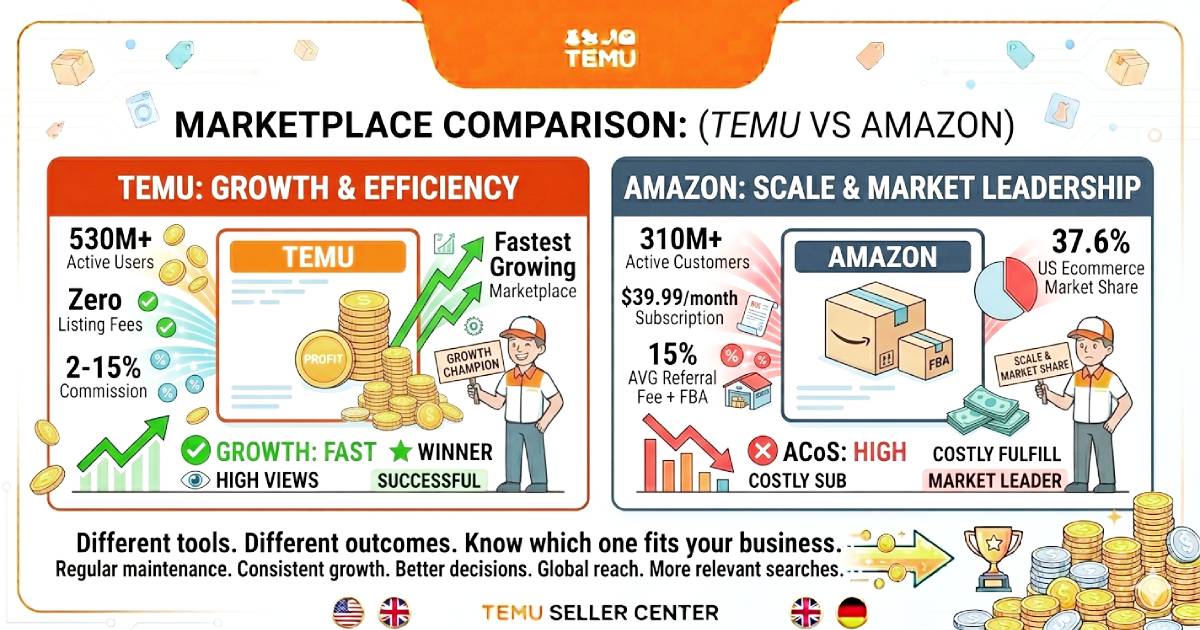
Amazon is a mature, established marketplace that has been operating since 1994. It has over 310 million active customers worldwide, more than 9.7 million registered sellers with approximately 2 million actively selling, and holds approximately 37.6% of US ecommerce market share. It operates on a clear, if expensive, third-party seller model where you list products, set prices, manage inventory, and pay Amazon a layered fee structure for the privilege of accessing its customer base.
Most Amazon sellers report a net profit margin between 15% and 20% depending on category, with margins above 20% considered excellent and margins below 5% considered unsustainable. The competition is intense Amazon registered just 165,000 new sellers in 2025, the lowest number in a decade, down 44% from 2024 but the buyers are sophisticated, loyal, and convert at high rates when listings are strong.
Temu is a fast-growing marketplace launched in 2022 and owned by PDD Holdings, the parent company of Pinduoduo. In June 2025 alone, temu.com drew 2.11 billion visits. The United States remains Temu's largest single market, accounting for 31.6% of total web traffic roughly 665 million visits from US shoppers in a single month. Temu anticipates that local sellers and local fulfillment will eventually account for 80% of its European sales a signal of how seriously the platform is investing in its local seller infrastructure.
Temu operates two distinct seller models that have no direct Amazon equivalent:
Consignment Model: You ship inventory to Temu's warehouse. Temu handles pricing, customer service, returns, and last-mile delivery. Your effective commission is lower typically 2–5% but you give up control over pricing. Best for manufacturers, wholesalers, and sellers who want hands-off operations and can ship in bulk.
Semi-Managed Model: You list products, set your own prices, and handle fulfillment directly to customers. This gives you more control but comes with higher referral fees typically 8–15% depending on category and the responsibility of managing logistics, returns, and customer service.
Understanding which model you would use on Temu changes the entire fee comparison with Amazon. The numbers look very different depending on your answer.
Head-to-Head Comparison Table: Core Metrics
Factor | Temu | Amazon |
Founded | 2022 | 1994 |
Active Customers (Global) | 530M+ users | 310M+ active customers |
Active Sellers | ~200,000 international merchants | ~2M active sellers |
US Ecommerce Market Share | Growing — ~5–8% | ~37.6% |
Monthly Subscription Fee | None | $39.99/month (Professional) |
Listing Fee | None | None (but subscription required) |
Commission/Referral Fee | 2–5% (Consignment) / 8–15% (Semi-managed) | 8–45% by category (typically 15%) |
Fulfillment Fee (FBA equiv.) | TWF rates vary by market | $3.50–$8.00+ per unit (FBA, US) |
FBA Fee Change 2026 (US) | N/A | +$0.08/unit average increase |
EU Fee Change (Amazon) | N/A | -£0.26/€0.32 per parcel avg reduction |
Avg Net Margin (Sellers) | 5–20% (varies heavily by model) | 15–20% reported avg |
Brand Control | Low — Temu controls much of the experience | High — full brand store, A+ content |
Buyer Trust Level | Growing, still below Amazon | Very high, established |
Advertising System | Sponsored Products, Sponsored Brands | Sponsored Products, Display, DSP |
Returns Handling | Temu manages (consignment) / Seller (semi-managed) | FBA = Amazon handles / FBM = seller |
Account Suspension Risk | Medium-High (stricter in EU) | Medium (complex appeal process) |
Best For | Volume, low-margin products, new sellers | Branded products, higher margins, established sellers |
Always verify current fee rates directly in your respective Seller Center dashboards — both platforms update fee structures regularly.
What Are the Real Fee Differences Between Temu and Amazon in 2026?
This is where most comparisons oversimplify. The headline numbers rarely tell the full story.
Amazon's fee stack in 2026 for a US FBA seller looks like this:
- Referral fee: 8–45% by category, most commonly 15%
- FBA fulfillment fee: approximately $3.50–$4.00 for a small standard item, $8.00+ for oversize
- 2026 FBA fee increase: average +$0.08 per unit, effective January 15, 2026
- Monthly subscription: $39.99
- Storage fees: $0.78/cubic foot January–September, $2.40/cubic foot October–December for standard items
- Inbound placement fees, advertising costs, returns processing
On average, Amazon takes around 15–20% of total sales revenue from sellers in the form of referral fees alone before FBA fees, storage, or advertising. Many sellers estimating their margins forget to include advertising, returns, and operational expenses. Sellers who only subtract cost of goods sold and referral fees are likely overestimating their Amazon profit margin by 5–10 percentage points.
In Europe, Amazon is cutting fees in 2026 a direct response to Temu's competitive pressure. Amazon will reduce FBA fulfillment fees for parcels by an average of £0.26/€0.32 in the UK, Germany, France, Italy, and Spain. Clothing and Accessories referral fees have been reduced from 8% to 5% for items up to £15/€15, and from 15% to 10% for items between £15/€15 and £20/€20. Home Products referral fees have been reduced from 15% to 8% for items up to £20/€20, effective February 1, 2026.
Temu's fee stack in 2026 for a semi-managed (local) seller:
- No monthly subscription
- No listing fee
- Commission rate: 5–20% depending on product category and margin profile
- TWF fees (storage, pick-and-pack, outbound shipping) if using warehouse fulfillment
- Advertising costs if running sponsored campaigns
The comparison is not as simple as "Temu is cheaper." It depends entirely on your product category, which Temu model you use, and how you account for Amazon's FBA infrastructure value versus Temu's lower upfront fees.
Here is a realistic profit comparison for the same product on both platforms:
Hypothetical Example: Silicone Baking Mat Set — $18.99 Sale Price
Cost Element | Amazon FBA (US) | Temu Semi-Managed (US) |
Sale Price | $18.99 | $18.99 |
Referral/Commission Fee (15% / 12%) | -$2.85 | -$2.28 |
Fulfillment Fee (FBA / TWF) | -$4.20 | -$4.10 |
Storage (per unit est.) | -$0.35 | -$0.22 |
Monthly Subscription (per unit at 200/month) | -$0.20 | $0.00 |
Sourcing Cost | -$4.50 | -$4.50 |
Advertising (est. 12% of sale) | -$2.28 | -$2.28 |
Total Costs | $14.38 | $13.38 |
Net Profit/Unit | $4.61 | $5.61 |
Net Margin | 24.3% | 29.5% |
Hypothetical but realistic example using 2026 fee structures. Your actual numbers will vary by category, volume, and product specifics. Always verify in your dashboards.
On this specific product, Temu's lower commission and no subscription fee deliver a materially better per-unit margin. But this ignores a crucial factor: Amazon's 310 million active customers versus Temu's still-growing base. If Amazon generates 3× the monthly sales volume on this product, the lower per-unit margin may still deliver more total profit. Volume and margin are both inputs to total profit optimizing one without considering the other leads to wrong decisions.
Which Platform Is Better by Seller Type?
This is the section that actually answers the question for most readers. The right platform is not about the platform it is about your specific situation.
Is Temu Better Than Amazon for Beginners in 2026?
Winner for Beginners: Temu — with conditions
The case for Temu as a starting platform is straightforward. No monthly subscription fee means a beginner can list products and test the market without committing $39.99 a month before making a single sale. No listing fees mean testing 10 products costs the same as testing 1. The onboarding process is faster, and the competition while growing is less entrenched than Amazon's mature seller ecosystem.
The condition: Temu's semi-managed model requires operational capability from day one. You need to fulfill orders reliably, maintain delivery metrics, and manage listing compliance in your target market. A complete beginner who cannot consistently dispatch orders within their stated handling time will damage their account health metrics before they generate enough revenue to learn from. As covered in our [Scale Without Suspension] guide, Temu's enforcement of delivery metrics is real and consequences are swift.
If you are a beginner with an operational setup even a small home-based operation Temu is a lower-risk starting point than Amazon. If you are a beginner with no fulfillment infrastructure and no compliance awareness, neither platform is the right first step.
Amazon for Beginners: The $39.99 subscription, the steeper learning curve, and the more intense competition in established categories make Amazon a harder starting platform for most true beginners. However, Amazon's FBA infrastructure does solve the fulfillment problem for a beginner who cannot manage dispatch reliably, paying for FBA removes that operational risk, albeit at significant cost.
Temu vs Amazon for Private Label Sellers
Winner: Amazon — clearly
Private label is Amazon's home turf. Amazon has a 37.6% share of US ecommerce and 250 million Prime members globally whose shopping behavior is built around trusting the Amazon ecosystem. Amazon's brand store features, A+ content, enhanced product descriptions, brand registry protection, and review management tools collectively create a brand-building environment that Temu simply does not offer in 2026.
Temu controls most of the product experience on the platform your business has far less ownership over how your brand is represented, positioned, and reviewed. For a seller trying to build a lasting brand identity, this is a fundamental limitation that no fee advantage can fully offset.
Private label sellers who want to explore Temu should treat it as a volume channel for their core product not as a brand-building platform. Use Temu to move units and generate cash flow, use Amazon to build brand equity.
Temu vs Amazon for High-Volume, Low-Margin Product Sellers
Winner: Temu — by design
This is the seller type Temu was built for. Products with thin margins that generate high unit volumes phone accessories, cable organizers, kitchen gadgets, cleaning products work better on Temu's fee structure in most cases. Lower commission rates, no subscription fee, and a buyer base that expects and responds to low prices create natural alignment.
On Amazon, a product with a 12% net margin before fees frequently becomes unprofitable after referral fees, FBA costs, storage, and advertising. The same product on Temu's semi-managed model, with its lower commission and TWF cost structure, may maintain a workable margin where Amazon cannot.
The trade-off is volume certainty. Amazon's buyer trust and search volume provide more predictable demand. Temu's buyer base is larger in raw numbers but less proven in its willingness to return to specific sellers repeatedly.
Temu vs Amazon for Seasonal and Trend Products
Winner: Temu — for speed, Amazon for stability
Temu's lower listing costs and faster onboarding make it better for rapid trend responses. When a product goes viral on TikTok and you need to list it within days, Temu's infrastructure is faster to get moving on than Amazon's FBA inbound process. For seasonal sellers who want to test 20 new products in Q4 without a $39.99/month commitment per dead SKU, Temu's cost structure is more forgiving.
Amazon wins for seasonal stability in established categories Christmas decorations, Halloween costumes, summer outdoor products where the platform's search volume and Prime delivery badge deliver predictable demand every year.
Temu vs Amazon for Handmade / Craft Sellers
Winner: Amazon (through Handmade) — or neither
Both platforms are genuinely poor fits for artisan handmade sellers. Amazon Handmade exists as a sub-program, but its fee structure is essentially the same as the main marketplace. Temu's price-competitive culture is fundamentally misaligned with the premium pricing that handmade products require to be profitable.
For handmade sellers, Etsy remains the most appropriate marketplace. Both Temu and Amazon are volume-over-craft platforms where handmade's higher production cost becomes a structural margin problem.
Temu vs Amazon for Established Multi-Channel Sellers
Winner: Both — run them in parallel
An established seller with proven products, operational infrastructure, and financial capacity to manage multiple channels should be on both platforms. Amazon provides stable, high-margin revenue from brand-loyal buyers. Temu provides volume, velocity, and access to a price-sensitive buyer segment that does not overlap heavily with Amazon's Prime-oriented customer base.
The hybrid strategy is covered in detail below.
Seller Type | Recommended Platform | Key Reason |
Complete beginners | Temu | No subscription fee, faster onboarding |
Private label / brand builders | Amazon | Brand tools, trust infrastructure, Prime |
High-volume, low-margin | Temu | Lower commission, buyer price sensitivity alignment |
Seasonal / trend | Temu (testing), Amazon (stable) | Speed vs. predictability trade-off |
Handmade / artisan | Neither (consider Etsy) | Price culture misalignment on both |
Established multi-channel | Both | Diversification maximizes total profit |
Country-Specific Insights
🇺🇸 United States — The Market Where Both Platforms Are Fighting Hardest
The US is simultaneously Temu's fastest-growing market and Amazon's most dominant. Amazon holds a 37.6% share of the US ecommerce market and Temu's US web traffic reached approximately 665 million visits in a single month in 2025. These are not competing for the same buyer they are competing for wallet share from the same US consumer who shops both.
For US sellers, Amazon's infrastructure advantage is most pronounced: FBA delivers Prime-badge speed that Temu is still working to match at scale, and Amazon's advertising system is more mature with better targeting granularity. For products where brand trust drives conversion supplements, electronics, baby products Amazon wins the conversion rate battle.
Temu's US advantage is volume potential in low-consideration categories home organization, car accessories, pet lifestyle, seasonal decor. Products where price is the primary decision driver convert on Temu with lower advertising investment than Amazon requires.
US-Specific Compliance Note: As covered in our [Scale Without Suspension] guide, the INFORM Consumers Act requires sellers with 200+ transactions and $5,000+ in annual gross revenue to provide verified identifying information, with additional disclosure requirements for sellers above $20,000 in annual revenue. This applies to Temu's US marketplace directly and was enforced via FTC action in September 2025. US sellers on either platform need verified business documentation current and displayed.
Action Step — US Sellers: If you are currently only on Amazon, search Temu's top-selling listings in your product category. If your product is already trending there with weak competitors, you have a window to establish a Temu presence before the category matures. If it is already saturated on Temu, your existing Amazon presence may have more defensible margins.


🇬🇧 United Kingdom — Amazon's Fee Cuts Change the Calculation
The UK market dynamic shifted meaningfully in late 2025 when Amazon implemented significant fee reductions specifically aimed at competing with Temu and Shein. Amazon reduced FBA fulfillment fees by an average of £0.26 per unit across UK stores, and cut referral fees in clothing from 8% to 5% for items under £15 and from 15% to 10% for items between £15–£20. Home Products referral fees dropped from 15% to 8% for items priced at or below £20.
For UK sellers in these specific categories, Amazon has narrowed the fee gap with Temu considerably. A home organization product priced at £18.99 that previously paid 15% Amazon referral now pays 8% a £1.33 per unit improvement in Amazon's favour. Combined with Amazon Prime's delivery credibility advantage in the UK market, the calculus has shifted compared to 2024.
Temu's UK position remains strong in categories outside these Amazon fee reduction zones, and for sellers whose products fall in Amazon's higher-cost categories, Temu's lower commission still delivers better unit economics.
UK compliance across both platforms requires UKCA marking for relevant categories and active VAT registration once turnover exceeds £90,000 annually. Both platforms' UK operations expect these requirements to be met, and enforcement is active on both sides.
🇩🇪 Germany — The Compliance-First Market on Both Platforms
Germany is the market where compliance requirements create the most meaningful operational difference between Temu and Amazon and where getting it wrong on either platform is most costly.
Amazon's German marketplace has also benefited from fee reductions effective February 2026, with Home Products referral fees dropping to 8% for items under €20 and FBA fulfillment fees reduced by an average of €0.32 per unit. This makes Amazon more competitive in Germany for home and lifestyle categories specifically.
On the compliance side, both platforms require:
- CE marking for applicable product categories
- EU Authorized Representative appointment and documentation
- VerpackG packaging compliance registration
- German VAT registration
- German-language product descriptions and safety information
The operational difference: Amazon's German marketplace has a more established compliance infrastructure that many sellers have already navigated. Temu's German compliance requirements are newer, more actively evolving, and the consequences of non-compliance as covered in our [Scale Without Suspension] guide include listing removal and account restriction.
German buyers on both platforms have high expectations for product accuracy and compliance presentation. A poorly localized listing fails on either platform. The investment in German-language listing optimization, compliance documentation, and precise product specification pays off regardless of which platform you choose.
For the German market specifically, an established Amazon Germany seller evaluating Temu should treat the compliance work as a sunk cost they have already incurred because most of it transfers directly. The documentation required for Amazon Germany largely satisfies Temu Germany's requirements too.
🇦🇺 Australia — Shipping Costs Reshape the Comparison
Australia's ecommerce market adds a layer to this comparison that does not exist in the same way elsewhere: domestic shipping costs are high enough to materially affect which platform's economics work for which product types.
Amazon Australia operates with FBA infrastructure, but its warehouse network is smaller than the US or UK, which affects delivery speed and fulfillment fee predictability. Temu's Australian market has grown significantly the Americas represent Temu's strongest region globally, and Oceania has seen consistent user growth and Temu's negotiated carrier rates for Australian delivery can undercut what individual sellers access at retail AusPost rates, as detailed in our Fulfillment Showdown.
For Australian sellers, the platform decision often comes down to product price point. The AusPost shipping reality means products under AUD $25 are structurally difficult to make profitable through self-fulfillment on either platform but Temu's TWF option and negotiated rates solve this problem more cleanly than Amazon's Australian FBA infrastructure currently does.
Amazon Australia's buyer base skews toward higher-income, Prime-oriented shoppers who expect brand trust signals and fast delivery. Temu Australia's buyers are more price-driven. These are genuinely different audiences, and a product that converts brilliantly on Amazon Australia may underperform on Temu AU despite lower competition simply because the buyer intent is different.
Australian GST Note: Both platforms require GST registration and collection for sellers meeting Australian turnover thresholds. For foreign sellers making sales into Australia, the AUD $75,000 annual threshold applies. Both Amazon and Temu have marketplace facilitator arrangements in Australia, but seller obligations for registration and reporting still exist — verify your specific obligations with an Australian tax advisor.
Pros and Cons Deep Dive
Amazon — The Honest Assessment
✅ Genuine Strengths in 2026
Buyer trust is irreplaceable. Amazon has over 310 million active customers who trust the platform deeply Prime members in particular have purchasing habits and return behavior that consistently favors Amazon over alternatives. For products where trust drives conversion (supplements, electronics, children's products), Amazon's trust infrastructure is worth the fee premium.
FBA is the gold standard for fulfillment. Amazon's fulfillment network is the most sophisticated in ecommerce. 70–80% of Amazon sellers use FBA , and for good reason: Prime delivery speeds, automatic returns handling, and the removal of delivery metric risk from your account create operational simplicity that Temu's TWF is still building toward.
Brand building tools are mature. Amazon Stores, A+ Content, Brand Registry, and enhanced brand analytics give established sellers tools for differentiation that do not exist on Temu. For a private label brand with a long-term horizon, Amazon's infrastructure is a genuine competitive moat.
Stable, established marketplace. Amazon is not going anywhere. Its market position, Prime membership loyalty, and logistics infrastructure create long-term stability that a platform launched in 2022 cannot yet match.
❌ Genuine Weaknesses in 2026
Fee complexity and ongoing increases. Between incremental fee increases in the US and major structural shifts globally, 2026 will see more sellers reevaluate profitability, pricing models, and inventory strategies. The 2026 average +$0.08 per unit FBA increase sounds small, but compounded across hundreds or thousands of SKUs, this "small" adjustment quietly erodes profit margins.
Advertising costs are rising faster than fee cuts are falling. The competitive bidding environment for Amazon PPC has pushed CPCs higher in most established categories. For new sellers without review velocity, the advertising spend required to achieve visibility often makes early-stage economics unworkable.
Competition from Amazon's own products. In many profitable categories, Amazon competes directly with third-party sellers by selling its own private label products, often with an inherent placement advantage. This is not a new problem, but it remains a real risk for sellers in high-margin categories that Amazon has identified.
Temu — The Honest Assessment
✅ Genuine Strengths in 2026
Lower cost of entry. No monthly subscription, no listing fees, and lower commission rates for consignment sellers make Temu genuinely accessible to sellers at earlier stages and smaller scales.
Massive and growing audience. Temu drew 2.11 billion visits to temu.com in June 2025 alone. That is a buyer pool that is still growing, still less saturated than Amazon in many categories, and actively being courted by the platform with buyer incentives that drive traffic to listings.
Less entrenched competition. In most product categories, the seller competition on Temu is less sophisticated than on Amazon. Strong listing optimization as covered in our Listing OptimizationTutorial delivers a disproportionate competitive advantage on Temu in ways it no longer does on Amazon's mature, optimization-saturated marketplace.
Local seller investment is real. Temu anticipates local sellers and local fulfillment will account for 80% of its European sales and the platform is investing in the infrastructure to support this. Sellers who establish local positions now are building on a foundation the platform is actively growing.
❌ Genuine Weaknesses in 2026
Buyer trust is still developing. Temu maintains strong user engagement with average sessions exceeding 14 minutes, but customer retention remains a key challenge with only 24% of first-time buyers likely to return. Repeat purchase behavior is lower than Amazon, which means the platform is still working to convert first-time shoppers into loyal return buyers.
Thin margins in a price-sensitive culture. Temu's price-driven positioning puts downward pressure on what sellers can charge. In categories where cost-of-goods is high and product differentiation is difficult, the margin compression is significant. Sellers expecting Amazon-level margins on Temu will be disappointed.
Platform maturity risks. Temu is three years old. Its policies, fee structures, and market strategies continue to evolve rapidly. As covered in our Scale Without Suspension guide, this creates ongoing compliance uncertainty that more established platforms have largely worked through.
Limited brand-building tools. Temu controls most of the product experience on the platform sellers have far less ownership over how their brand is represented, positioned, and reviewed. For brand-conscious sellers, this is a structural limitation.
Hybrid Strategy: Using Both Platforms in 2026
The most sophisticated ecommerce operators in 2026 are not choosing between Temu and Amazon. They are using both, deliberately, for different purposes.
Here is the hybrid framework that is working for established sellers:
Amazon = Brand and Margin Engine Your Amazon store carries your flagship products with strong A+ content, brand-loyal reviews, and optimized listings. These products sell at full margin to buyers who trust the platform and are willing to pay for Prime delivery. Your Amazon advertising focuses on protecting existing positions and converting high-intent searches.
Temu = Volume and Discovery Engine Your Temu store carries your same core products (or slight variations), positioned for the price-sensitive buyer. The goal is not maximum margin — it is maximum velocity and discovery. Sales on Temu generate cash flow, algorithm velocity, and data on which product variants resonate, with lower ad spend requirements than Amazon demands for equivalent visibility.
The Cross-Platform Learning Loop A product that fails on Temu's price-sensitive audience almost never fails for product quality reasons it fails for positioning reasons. That diagnostic data helps you refine your Amazon positioning too. And a product that generates exceptional review quality on Amazon (detailed, specific, trust-building reviews) provides listing optimization insights you can apply to your Temu listing's bullet points and description.
Pro Tip: Do not list the same ASIN title and description on both platforms. Amazon listings are optimized for its search algorithm and buyer psychology. Temu listings require different keyword language, different benefit emphasis, and critically for EU/UK markets different compliance documentation. Treat each platform's listing as a fresh build for that audience, informed by what you have learned elsewhere.

Common Pitfalls and the Decision Framework
The Five Mistakes Sellers Make When Choosing a Platform
Choosing based on fees alone. The platform with lower commission does not always deliver more profit. Volume, conversion rate, buyer trust, and advertising cost all determine total profit. Run a realistic full-profit scenario using our Temu Fees & Profit Calculator alongside Amazon's revenue calculator before deciding where to focus.
Treating Temu as "Amazon but cheaper." It is not. The buyer psychology is different, the listing requirements are different, the compliance requirements are different, and the seller community norms are different. Sellers who copy their Amazon strategy directly to Temu without adaptation consistently underperform.
Underestimating Amazon's advertising dependency. In most competitive Amazon categories, organic ranking without advertising investment is no longer achievable for new sellers. The effective total cost of selling on Amazon includes a significant advertising component that does not appear in the headline fee comparison. As covered in our [Ads Mastery] guide, Temu's advertising ecosystem is less expensive in most categories for now.
Ignoring platform risk concentration. Building your entire ecommerce revenue on a single platform whether Amazon or Temu creates a single point of failure. Account restrictions, policy changes, or competitive dynamics that erode your position on one platform should not be able to end your business. Diversification is risk management, not distraction.
Starting on Amazon when Temu's learning curve is lower. For a first-time ecommerce seller with limited capital, Amazon's subscription fee, FBA complexity, and competitive saturation in most profitable categories create high learning costs. Temu's lower barriers allow more experimentation with lower financial exposure during the learning phase.
The Decision Framework: Which Platform First?
Answer these four questions honestly:
1. What is your starting capital? Under $2,000 Temu's no-subscription model is more forgiving of early mistakes. Above $5,000 Amazon's FBA infrastructure becomes more accessible and justifiable.
2. What is your product's margin profile? Under 25% margin before platform fees Temu's lower commission may be necessary to stay viable. Above 30% margin Amazon's brand infrastructure and buyer trust may deliver more total profit despite higher fees.
3. Are you building a brand or moving inventory? Building a brand Amazon's tools are purpose-built for this. Temu is a secondary channel. Moving inventory at volume Temu's model is a better fit for the price-sensitive, high-volume play.
4. Which markets are you targeting? Germany or EU in general Compliance investment for either platform is substantial. Amazon Germany's more established infrastructure may reduce compliance learning curve, but Temu Germany's less saturated market may offer easier early wins. Australia Run the AusPost math before deciding. TWF on Temu often wins the shipping cost comparison for products under AUD $35. US or UK Both platforms are viable; the product and margin profile determine the better starting point.
Actionable Next Steps
If you are currently only on Amazon: Log into Temu Seller Center and browse your top product category. Check how many listings exist, what their review counts are, and what prices the top sellers are using. If the category is less saturated than Amazon and the prices support your margin requirements, Temu is worth a 90-day test with a small product batch.
If you are currently only on Temu: Calculate your true per-unit profit margin using our Temu Fees & Profit Calculator. If your margin is above 25% before advertising, you likely have a product that could command a premium on Amazon's brand-trust environment. A 90-day Amazon test with your strongest performing Temu product is the lowest-risk way to find out.
If you are on neither platform and evaluating your first move: Start with Temu if your capital is limited and your product is in a volume-oriented, price-sensitive category. Start with Amazon if you have a genuinely differentiated product with strong margins and the capital to absorb the startup costs of FBA and competitive advertising spend.
If you are in Germany: The compliance investment for either platform is substantial and largely overlapping. Complete the EU compliance stack once EU Authorized Representative, CE marking, VerpackG, German VAT and it applies to both platforms. Do not let compliance be the reason you choose one platform over the other in Germany; do the compliance work and then make the platform decision based on product fit and margin.
Action Step — This Week: Take your best-selling product on whichever platform you currently use. Calculate your true net margin per unit after all fees, advertising, and shipping costs. Then model the same product on the other platform using the fee structures in this guide. If the alternative platform improves your margin by more than 5 percentage points at comparable volume, run a 90-day test.
Conclusion + Your Temu vs Amazon Decision Checklist
The sellers who thrive in 2026 are not the ones who picked the right platform. They are the ones who understood what each platform is actually good at and used that understanding deliberately.
Amazon is a mature, stable, brand-trust-heavy marketplace with higher margins for the sellers who can earn them and increasingly competitive conditions for everyone else. Its fee structure is complex, its advertising dependency is real, and its saturation in most profitable categories means new entrants need a genuine point of differentiation to succeed.
Temu is a fast-growing, price-sensitive, volume-driven marketplace with lower entry barriers, lower commission rates in most models, and a buyer base that is still growing into habits that have not yet been locked to specific sellers. Its margins are thinner, its platform maturity is lower, and its policy environment is still evolving but its opportunity window for well-prepared sellers is genuinely real in 2026.
Your Temu vs Amazon Decision Checklist:
- ☐ Have you calculated true net profit on both platforms for your specific product — including all fees, advertising, and shipping?
- ☐ Is your product category oversaturated on Amazon with established sellers who have 500+ reviews?
- ☐ Does your product's margin support Amazon's 15% referral fee plus FBA costs and still deliver 20%+ net margin?
- ☐ Is your target buyer price-driven (Temu) or brand-trust-driven (Amazon)?
- ☐ Do you have the operational infrastructure to self-fulfill consistently enough for Temu's delivery metrics?
- ☐ Have you completed the compliance requirements for your target market on both platforms?
- ☐ Are you building a brand (Amazon priority) or building cash flow and volume (Temu priority)?
- ☐ Is your capital sufficient for Amazon's $39.99 subscription, FBA inbound shipping, and advertising ramp-up?
- ☐ Have you considered the hybrid approach — using both for different strategic purposes?
- ☐ Do you have a contingency plan if either platform changes its terms, fees, or policies?
The decision is not permanent. Start where the numbers work for your current situation, build the operational and compliance foundations properly, and expand to the other platform once the first is running profitably.
That is how the sellers who are winning on both platforms in 2026 got there.
For the complete Temu fee breakdown and profit calculation, use our Temu Fees & Profit Calculator. For how fulfillment choice affects your costs and metrics on Temu specifically, see the Fulfillment Showdown. For protecting your Temu account as you scale, read the Scale Without Suspension guide. For building listings that convert on Temu, the Listing Optimization Tutorial is the starting point.
Work with ApexBin
Want your Temu store set up and managed properly?
Muhammad Mustafa has over three years in Amazon advertising and five Amazon certifications, working with sellers across the US, UK and UAE.
Temu Store Setup & Management →





Blog Comments (1)
PPC SharkForce
Oct 17, 2026
The hybrid framework is the smartest takeaway here, using Temu as the volume and discovery engine while Amazon carries the brand and margin products makes a lot of sense. I also appreciated the realistic fee breakdown with the silicone baking mat example, since most comparisons stop at headline commission rates. The honest warning that Temu's lower fees don't automatically mean higher profit is something more sellers need to hear.