






How to Hunt Products for Selling on Temu as a Local Seller in the US, UK, Germany & Australia
I'll be honest with you —the first time I tried to find a
winning product for Temu, I spent two weeks, sourced 80 units of a
"trending" posture corrector, and watched it collect dust in my spare
bedroom for three months. Nobody told me the niche was dead. I found that out
the hard way.
That experience taught me something that no tool or software
will ever tell you: product research on Temu isn't about finding what's
popular. It's about finding what's popular right now, in your market, at the
right price point and getting there before the next seller does. In 2026,
with over 530 million active users on the platform, the window between
"emerging trend" and "completely saturated" has shrunk from
months to weeks.
This guide is everything I wish someone had handed me before
that posture corrector disaster. It's built specifically for local sellers in
the US, UK, Germany, and Australia because those four markets behave completely
differently, and what crushes it in Ohio will often quietly die in Manchester,
and what sells brilliantly in Manchester might get returned in Munich for
having the wrong label on the packaging.

Stop Copying What Everyone Else Is Researching
Here's the thing about paid product research tools — they're
useful, but they're useful for everyone. The moment a product shows up as
"trending" in a software dashboard, you're already three weeks behind
the sellers who found it organically. I'm not saying ditch the tools. I'm
saying they should be your second step, not your first.
Your first step is getting into the heads of real buyers.
Dig into the subreddits your customers actually use.
This sounds obvious but almost nobody does it properly. Don't just scroll
r/homeorganization looking for product mentions. Read the complaints.
Someone posting "I've tried four different under-sink racks and they all
tip over" is telling you exactly what to sell them. The product already
has a proven buyer with a proven frustration — you just need to find the $18
solution on Temu that solves it. I've found three of my best-performing
products this way, and none of them showed up on any trending list when I
sourced them.
Use TikTok as a leading indicator, not entertainment.
Search "Temu haul 2026" and filter by the last 30 days. Don't watch
the videos for fun — watch them like a detective. Pay attention to which
products the creator holds up longest, which ones get the most comments asking
"where is that from?", and which items appear in multiple hauls from
different creators. That overlap is a signal. When three separate TikTokers are
independently raving about the same silicone sink organizer, something is
happening.
The Amazon lag trick is real and underused. Amazon's
"Movers & Shakers" list updates hourly and tracks sudden sales
velocity spikes. The pattern I've noticed is this: whatever gets hot in a
lightweight, everyday-use category on Amazon tends to show up in Temu search
traffic roughly 30 to 45 days later, as budget-conscious buyers look for
cheaper alternatives. Check it every Monday morning. If a new type of compact
travel accessory or kitchen gadget is suddenly jumping 400% in sales rank,
start your Temu research on that category immediately.

How to Actually Read Temu's Own Data
Temu's platform tells you more than most sellers realize,
but you have to know where to look. Don't just browse the homepage trending
section — that's curated for buyers, not sellers.
Go into sub-categories three or four levels deep. Find a
product that looks interesting. Note the total sales count. Come back exactly
seven days later and check that number again. The difference between those two
numbers is the weekly velocity — and that's what actually matters. A product
sitting at 40,000 total sales sounds impressive, but if it only moved 200 units
last week, the momentum is gone. A product at 3,000 total sales that jumped 800
units in seven days is a completely different story. That's the one you want.
Also pay attention to review recency. Sort by newest
reviews, not highest rated. If the last review on a "bestseller" is
from four months ago, the algorithm has moved on. You're looking at a corpse
wearing a good ranking.
What's Actually Selling Right Now (April 2026)
Rather than give you a generic "top categories"
list, let me break this down by what's working with real context behind it.
Modular home organization keeps compounding. The
drawer divider and under-sink rack category specifically has been growing
steadily for 18 months without signs of saturation, because the products are
cheap, the use cases are visual (great for TikTok), and people keep moving into
new homes or re-organizing existing ones. The sub-niche I'd watch right now:
cable management. Every person with a home office setup has a rat's nest behind
their desk and feels vaguely guilty about it.
Car interior accessories are pure impulse territory.
LED ambient lighting strips, gap fillers between the seat and console, cup
holder expanders — these are the kinds of products people see, immediately
think "I need that," and buy without overthinking the price. The margins
tend to be decent because buyers aren't price-comparing the way they do with
more deliberate purchases.
Travel accessories with an aesthetic angle are
surging. Not just "packing cubes" — the market has moved past
utilitarian. Buyers want things that look good in a flat-lay photo. Matching
luggage tag sets, jewelry travel cases that look like mini vintage trunks,
TSA-approved toiletry bottles in coordinated colors. The product has to be
functional, but the look is what sells it.
Pet lifestyle products — and I mean lifestyle, not
basic supplies. Slow feeder mats, travel water dispensers, car seat covers
specifically designed for large breeds. Pet owners in 2026, especially in the
US, Germany, and Australia, are spending more on their animals than ever, and
they're buying on emotion first.

The Country Breakdown That Actually Matters
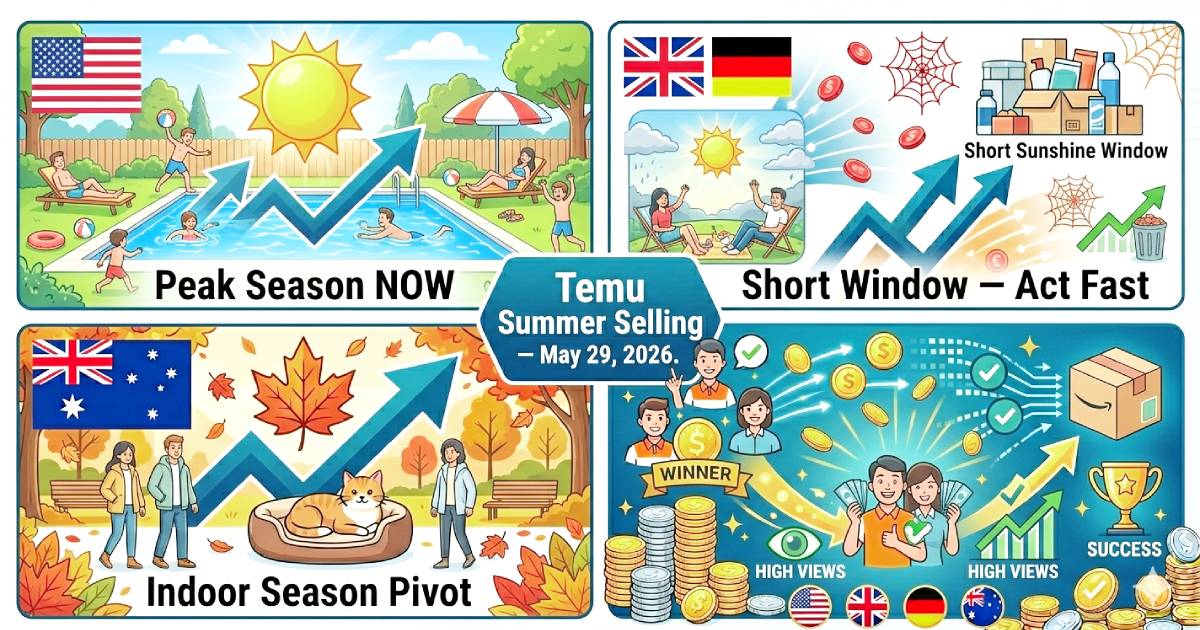
I cannot stress this enough: your market shapes your product
strategy more than anything else. I've talked to sellers who copied a US
strategy into Australia and burned through their starting budget in six weeks.
I've seen sellers list the same product in Germany that was flying in the UK,
only to get buried in returns because it wasn't compliant with German packaging
law. The markets are genuinely different — not just in taste, but in behavior,
infrastructure, and expectation.
United States — Volume, Impulse, and the TikTok Pipeline
The US market is the most TikTok-reactive market on the
platform. Trends hit hard and fast, and American buyers on Temu are highly
sensitive to perceived discount — they want to feel like they got a deal, even
if the original price was made up. Bundle deals and crossed-out
"original" pricing convert exceptionally well here.
The niches running hot right now: Stanley cup accessories
(the base product is everywhere, the accessories market is exploding — straw
toppers, handle attachments, protective boots), rapid car cleaning products
like cleaning putty, and anything that falls into the "fitness recovery
tool under $20" category. Massage balls, grip strengtheners, resistance
bands in sets. These aren't glamorous, but they move.
One honest note: the US market is also the most saturated.
If you're just starting out, I'd actually recommend launching in a mid-level
sub-niche rather than chasing the biggest trend. The competition in
"kitchen organizers" is brutal. "Corner sink organizers with
suction mounts" is a conversation you can actually win.
United Kingdom — Practicality, Space, and Genuine Skepticism
UK buyers are different in a specific way: they're
skeptical. They read the reviews. They check the dimensions against what they
measured at home. They've been burned by cheap imports before and they'll
reference that in their own reviews if you disappoint them.
The physical reality of UK homes shapes what sells: older
houses, smaller rooms, damper weather, and a lot of radiators. This is why
compact radiator drying racks consistently sell well — it's a product that
solves a real problem that basically doesn't exist in US or Australian homes.
Same with moisture absorbers and damp-proofing products. Mould and condensation
are genuine issues in a lot of UK homes, and people aren't embarrassed to buy
solutions for them. Highly modular kitchen storage also performs well,
specifically because UK kitchens tend to be smaller and buyers are constantly
trying to squeeze more functionality out of limited space.
One thing that will genuinely separate you from most sellers
in the UK market is fulfillment speed. UK buyers have been trained by Amazon
Prime to expect fast delivery, and Temu's international shipping times have
frustrated a portion of the market. If you can offer reliable 48-hour delivery
through a local setup integrated with Royal Mail or Amazon Shipping, you have a
real competitive edge over sellers who can't.
Germany — Quality, Compliance, and Zero Tolerance for Shortcuts
Germany is the market that punishes laziness harder than any
other. I say that with genuine respect — German buyers are not difficult,
they're just precise. They will read your product description word for word.
They will check the listed dimensions with a tape measure before the package
even arrives. And if what shows up doesn't match what you described, the return
is coming, the review is coming, and it won't be kind.
The first thing you need to understand about selling in
Germany is that compliance isn't optional — it's the entry fee. Temu now allows
sellers to upload PDF instruction manuals with their listings, and for the
German market, you should absolutely be doing this. Products need safety
labeling in German. Packaging needs to meet VerpackG requirements. These aren't
bureaucratic nuisances — they're the difference between a listing that converts
and one that quietly accumulates one-star reviews from buyers who feel misled.
German consumers are deeply familiar with their consumer rights and they
exercise them.
Once you clear the compliance hurdle, the market rewards
you. German buyers are loyal. If a product genuinely does what it says and
arrives in good condition, the review they leave will reflect that — and those
reviews carry real weight because other German buyers trust them.
What's working well right now: eco-friendly reusable kitchen
products are a consistent performer — silicone baking mats, beeswax wraps,
reusable produce bags. The environmental consciousness in the German market
isn't a trend, it's a baseline expectation, and products that lean into
sustainability authentically do well. Precision DIY tools are another strong
category — laser measuring devices, multi-bit screwdriver sets, organizers
designed to work with German standard drill sizes. Bicycle commuting accessories
are also genuinely strong, not as a niche curiosity but as a real everyday
market. Germany has one of the highest rates of regular cycling in Europe, and
the accessories market — lights, panniers, handlebar organizers, waterproof
seat covers — reflects that.
One thing I'd flag specifically for Germany: don't compete
on price alone. The German buyer is looking for value, which is not the same
thing as cheap. If a product looks low-quality in the photos, they'll skip it
regardless of the price. If it looks solid, well-made, and exactly what the
listing described, they'll pay a fair price without needing the 70%-off
crossed-out price gimmick that works in the US. Present your products honestly
and let the quality do the work.
Australia — High Value, High Shipping Costs, High Expectations
Australia is the market where product selection matters most
financially, because local postage through AusPost is expensive. If you're
selling a $6 item and it costs $9 to post, you're not running a business —
you're running a charity.
The rule I use for Australia: don't list anything where you
can't comfortably charge $25 or more. That means you need to be in niches where
the perceived value is high enough to support that price point without the
buyer feeling ripped off.
What works: beach and outdoor tech (waterproof phone
pouches, sand-free mats, anything that travels well to the coast), 4WD and
camping accessories for vehicle interiors, and premium-looking pet accessories.
Australians have strong disposable income for lifestyle goods and they spend it
— but they also have high expectations. The product needs to look and feel like
it's worth what you're charging.
The outdoor lifestyle angle is genuinely different here than
anywhere else. A "car camping organizer" barely registers in the UK
market. In Australia, where a significant portion of the population regularly
drives to remote areas for weekend trips, it's a real product solving a real
need.
Before You Source Anything: The Filter You Need
Not every trending product makes you money. Here's the quick
filter I run before I commit to sourcing anything:
The margin check comes first, always. Work backwards
from your sale price. Subtract your sourcing cost, local shipping, Temu's fees,
and any PPC spend. If the net margin is sitting below 15%, I walk away — no
matter how excited I am about the product. Excitement doesn't pay for reorders.
Look at the visual competition, not just the product
competition. Search your main keyword on Temu and look at the top 10
listing images. Are they all plain white backgrounds with no context? That's
your opening. A lifestyle image showing the product in use, or an image with
clean dimension callouts, will outperform a lazy white background almost every
time — even if your product is identical.
Start small on purpose. Source 50 to 100 units for
your first batch. Not because you can't afford more, but because you want the
data before you commit. Run a small PPC campaign — even $10 a day — to push
early traffic and get conversion signals. If the batch sells out in under two
weeks with reviews coming in clean, you have something real. Reorder, and
consider nudging the price up slightly to test where the ceiling is.
The Mistakes I See Sellers Make Constantly
Chasing the obvious. If you search "best
products to sell on Temu" and find a list, assume every item on that list
is already over-sourced. The posture corrector, the blackhead vacuum, the phone
stand — these have been saturated for years. The opportunity is always one
level deeper than the obvious answer.
Falling for your own taste. I genuinely hate those
LED strip lights that go under car dashboards. Think they look cheap and
garish. They're also one of the highest-velocity impulse products in the car
accessories category, and plenty of sellers are making good money from them.
Your personal opinion about a product is irrelevant. The buyer's behavior is
the only data point that matters.
Ignoring intellectual property. Temu has gotten
significantly more aggressive about IP enforcement in 2026. If a product has a
character on it, a logo that resembles a known brand, or a design that looks
like it might be patented — skip it. A banned account wipes out everything
you've built. It's not worth the shortcut.
Treating product research as a one-time event. The
sellers who consistently win do this weekly. Not monthly, not quarterly —
weekly. Trends on Temu move fast enough that a product that was goldmine
territory in January can be a graveyard by March. Build it into your schedule:
Monday for Amazon trend monitoring, midweek for community research on Reddit
and TikTok, Friday to audit your own listings and kill anything that's
underperforming.
A Realistic Starting Point
If you've read this far and you're not sure where to begin,
here's what I'd actually do if I were starting from scratch today:
Pick one market — whichever one you're actually located in
or closest to logistically. If that's Germany, start by sorting your compliance
before you even think about sourcing. If it's Australia, build your product
shortlist around the $25+ price point from day one. If it's the US, resist the
temptation to go after the biggest trend and go one level deeper. If it's the
UK, get your fulfillment speed figured out early.
Then pick one sub-niche two or three levels deeper than a
broad category — not "home organization," something like
"bathroom counter organizers for small spaces." Spend one week doing
nothing but research: Reddit, TikTok, Amazon Movers & Shakers, and Temu's
own velocity tracking. Build a shortlist of five products. Run them through a
margin check. Source the one with the best numbers, not the one you like most.
Then pay attention to what the data tells you after launch,
and adjust from there.
The sellers who make it work on Temu aren't the ones who
found a magic product. They're the ones who built a research habit and got good
at reading signals before everyone else did.
That's the real edge.
Work with ApexBin
Want your Temu store set up and managed properly?
Muhammad Mustafa has over three years in Amazon advertising and five Amazon certifications, working with sellers across the US, UK and UAE.
Temu Store Setup & Management →





Blog Comments (0)
No comments yet. Be the first to comment!