





Temu Fulfillment Showdown 2026: Self vs Temu Warehouse vs 3PL — Real Cost Examples & Which Wins for Sellers in USA, UK, Germany & Australia
There is a mistake that kills more promising Temu businesses than bad products, bad listings, or bad reviews combined. It happens quietly, in a spreadsheet, usually around month three. A seller looks at their revenue — let's say $18,000 for the month — and feels good. Then they actually do the math. Sourcing costs. Packaging. Labels. Shipping. Storage. Returns. Platform fees. And suddenly that $18,000 becomes $1,400 in actual profit. Sometimes less. Sometimes nothing.
The culprit, almost every time, is fulfillment.
In 2026, Temu sellers across the US, UK, Germany, and
Australia have three distinct fulfillment options — each with a completely
different cost structure, a different effect on your ranking, and a different
risk profile. This is the no-BS breakdown of all three, with real cost
examples, country-specific realities, and a clear verdict on who wins in each
scenario.
Before we dive in: if you haven't already read our [Temu
Fees & Profit Calculator] and [Temu Algorithm Deep Dive], bookmark them
now. Your fulfillment method affects both your fee structure and your
algorithmic ranking simultaneously — we'll reference both throughout this
guide.

The Three Options at a Glance
Before the deep dive, here is the full picture. Keep this
table in mind as you read everything below — it is the map before the journey.
|
Factor |
Self-Fulfillment |
Temu Warehouse (TWF) |
3PL |
|
Setup Cost |
Low |
Medium (inbound shipping) |
Medium-High (onboarding) |
|
Per-Order Cost |
Variable — you control |
Temu-set rates |
Negotiable at volume |
|
Storage Cost |
Your space (free early on) |
Temu storage fees apply |
Monthly storage fees |
|
Delivery Speed |
Depends on your carrier |
Fast — Temu managed |
Fast — 3PL carrier network |
|
Ranking Impact |
High risk if metrics slip |
Strong positive signal |
Strong if SLA is met |
|
Control Over Packaging |
Full |
None |
Partial to Full |
|
Scalability |
Low — hits a wall fast |
High |
High |
|
Returns Handling |
You manage everything |
Temu manages |
3PL manages (extra fee) |
|
Best For |
Testing phase, low volume |
High-volume proven winners |
Scaling, brand-conscious sellers |
|
Biggest Risk |
Time cost, metric failures |
Fee creep, loss of control |
Minimum commitments, setup complexity |
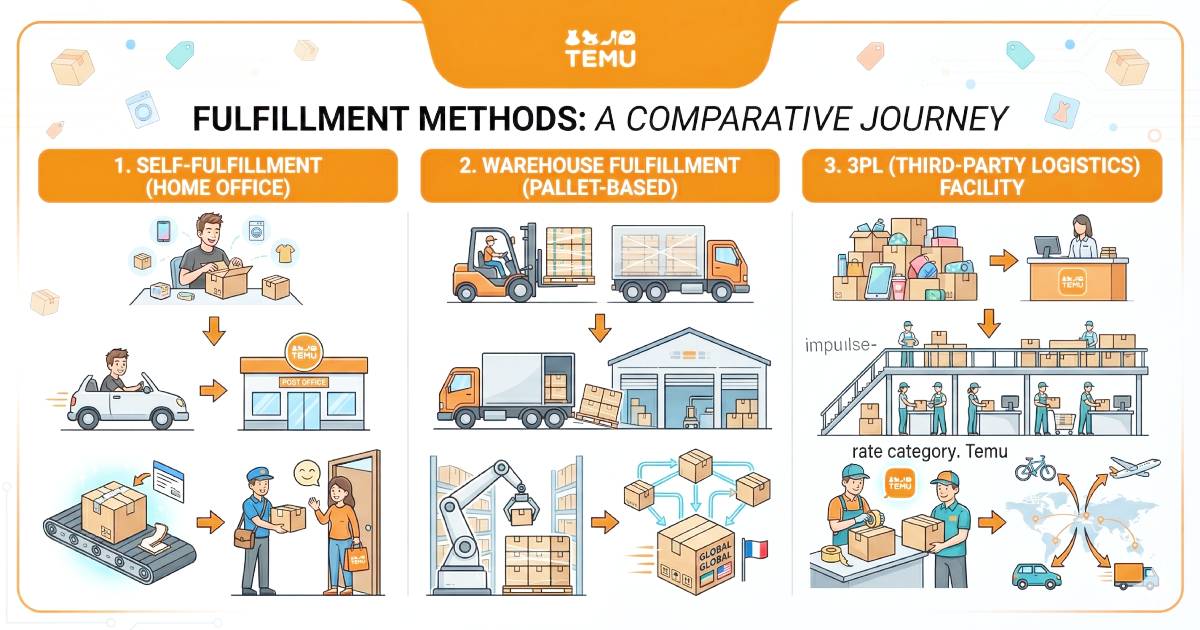
What Each Option Actually Means
Self-Fulfillment — You Own Every Step
You buy the stock, store it (spare room, garage, small
storage unit), and when an order comes in, you pick, pack, and post it
yourself. You choose the carrier, you set the delivery promise, and your
operational discipline is the only thing standing between you and a
late-shipment metric that tanks your ranking.
This is where most sellers start, and for good reason — zero
setup cost, full control, no minimum commitments. For the product testing
phase, it is exactly the right model.
The problem is scale. At 10 orders a day, self-fulfillment
is manageable. At 80 orders a day, you are running a small warehouse from your
home and spending 4–5 hours a day on packing. That time cost doesn't appear in
any fee table, but it is absolutely a cost — and it compounds every single day.
Temu's algorithm also tracks delivery metrics at the listing
level. One bad week with your carrier — delayed scans, late dispatch, missed
tracking uploads — and your listing visibility quietly drops. You won't always
see the cause-and-effect clearly until the damage is done.
Temu Warehouse Fulfillment (TWF) — Temu Handles the Last Mile
You ship bulk inventory to a Temu regional warehouse. From
that point, Temu picks, packs, ships, and in most markets handles returns. Your
delivery metrics are managed by Temu's own infrastructure, which means they
almost always hit platform requirements. TWF listings receive fast-delivery
badges in several markets, and those badges have a measurable impact on
conversion rates.
The risks are real though. Storage fees accumulate on slow
movers — and Temu's long-term storage penalty structure kicks in after 90 days
in most markets, similar to Amazon FBA. You lose all control over how orders
are packed. And if Temu changes their warehousing terms — which they have done
across multiple markets between 2024 and 2026 — you have no leverage.
TWF availability and fee structures also vary meaningfully
across markets. More on that in the country sections.
Third-Party Logistics (3PL) — The Professional Middle Ground
You send inventory to an independent fulfillment company.
They store it, receive order notifications through an API integration with your
Temu account, pick and pack each order, and dispatch using their carrier
network — often at rates individual sellers cannot access independently.
3PL sits between self-fulfillment and TWF in terms of
control. You are not doing the physical work, but you are also not handing
control to Temu. You can specify packaging requirements, set QC standards, and
switch providers if performance slips.
For sellers who have outgrown self-fulfillment but are not
ready to commit inventory to a Temu warehouse, 3PL is typically the most
sensible bridge. The complexity is upfront — finding the right provider,
integrating the account, establishing inbound processes — but once running, it
scales cleanly.
Most quality 3PL providers have minimum monthly order
thresholds, usually 100–200 orders per month. Below that floor, the per-order
economics often don't work.

Real Cost Examples 2026 — Where the Numbers Actually Land
This is where most comparison guides go vague. Not here.
Below are four realistic seller scenarios with full cost breakdowns across all
three fulfillment models. These are hypothetical but built on realistic 2026
cost patterns — exact fees vary by product dimensions, weight, and category, so
always verify your specific rates in your Temu Seller Center dashboard.
What Are the Real Costs of Temu Warehouse Fulfillment in 2026?
Here is what sellers across markets are reporting as
realistic ballpark figures as of April 2026:
|
Fee Type |
US (Approx.) |
UK (Approx.) |
Germany (Approx.) |
|
Inbound Receiving |
$0.15–$0.25/unit |
£0.12–£0.20/unit |
€0.14–€0.22/unit |
|
Storage (per unit/week) |
$0.02–$0.05 |
£0.02–£0.04 |
€0.02–€0.05 |
|
Pick & Pack (per order) |
$0.75–$1.20 |
£0.65–£1.00 |
€0.70–€1.10 |
|
Outbound Shipping |
$3.50–$6.00 |
£2.80–£5.00 |
€3.00–€5.50 |
Always check your Seller Center dashboard for your
specific rates — these vary by product size, weight, and category.
Scenario 1: Small Lightweight Product — Silicone Cable Organizer Set (US Seller)
Sale price: $12.99 | Sourcing cost: $2.80 | Weight:
120g
|
Cost Element |
Self-Fulfillment |
TWF |
3PL |
|
Sourcing Cost |
$2.80 |
$2.80 |
$2.80 |
|
Packaging Materials |
$0.45 |
$0.00 |
$0.10 |
|
Storage Cost/Unit |
$0.00 |
$0.18 |
$0.22 |
|
Pick & Pack |
$0.00 (your time) |
$0.95 |
$0.85 |
|
Shipping to Customer |
$4.20 |
$4.10 |
$3.80 |
|
Temu Platform Fee (~10%) |
$1.30 |
$1.30 |
$1.30 |
|
Total Cost |
$8.75 |
$9.33 |
$9.07 |
|
Net Profit/Unit |
$4.24 |
$3.66 |
$3.92 |
|
Net Margin |
32.6% |
28.2% |
30.2% |
🏆 Verdict:
Self-fulfillment wins on margin — but only if your volume is under 30 orders a
day and your time genuinely has no other use. At 50+ daily orders, the hours
spent packing erase that advantage entirely. At that volume, 3PL becomes the
smarter call on true cost.
Scenario 2: Medium Bulky Product — Compact Radiator Drying Rack (UK Seller)
Sale price: £18.99 | Sourcing cost: £4.20 | Weight:
680g flat-packed
|
Cost Element |
Self-Fulfillment |
TWF |
3PL |
|
Sourcing Cost |
£4.20 |
£4.20 |
£4.20 |
|
Packaging Materials |
£0.65 |
£0.00 |
£0.20 |
|
Storage Cost/Unit |
£0.00 |
£0.28 |
£0.35 |
|
Pick & Pack |
£0.00 (your time) |
£0.85 |
£0.90 |
|
Shipping to Customer |
£3.90 |
£3.60 |
£3.40 |
|
Temu Platform Fee (~10%) |
£1.90 |
£1.90 |
£1.90 |
|
Total Cost |
£10.65 |
£10.83 |
£10.95 |
|
Net Profit/Unit |
£8.34 |
£8.16 |
£8.04 |
|
Net Margin |
43.9% |
43.0% |
42.3% |
🏆 Verdict: Margins
are almost identical across all three. The real differentiator here is not cost
— it is delivery speed and consistency. A bulky item with a guaranteed fast
delivery badge outconverts the same item showing a variable 3–5 day estimate.
Pay the tiny margin difference. TWF wins this one on conversion, not cost.
Scenario 3: High-Volume Compliance-Sensitive Product — Silicone Baking Mat Set (Germany Seller)
Sale price: €14.99 | Sourcing cost: €3.10 | Weight:
350g | Volume: 200 units/month
|
Cost Element |
Self-Fulfillment |
TWF |
3PL |
|
Sourcing Cost |
€3.10 |
€3.10 |
€3.10 |
|
Packaging + Compliance Labels |
€0.90 |
€0.30 |
€0.45 |
|
Storage Cost/Unit |
€0.00 |
€0.22 |
€0.30 |
|
Pick & Pack |
€0.00 (your time) |
€0.90 |
€0.95 |
|
Shipping to Customer |
€4.80 |
€4.20 |
€3.90 |
|
Temu Platform Fee (~10%) |
€1.50 |
€1.50 |
€1.50 |
|
Total Cost |
€10.30 |
€10.22 |
€10.20 |
|
Net Profit/Unit |
€4.69 |
€4.77 |
€4.79 |
|
Net Margin |
31.3% |
31.8% |
32.0% |
🏆 Verdict: Margins
are almost identical across all three — but self-fulfillment at 200 units a
month in Germany is a compliance disaster waiting to happen. One mislabeled
batch means 200 potential return requests under German consumer law. TWF and
3PL both handle compliance labeling during inbound receiving. The tiny margin
difference is not the point. The risk difference is.
Scenario 4: Premium Lifestyle Product — Waterproof Sand-Free Beach Mat (Australia Seller)
Sale price: AUD $34.99 | Sourcing cost: AUD
$7.50 | Weight: 420g
|
Cost Element |
Self-Fulfillment |
TWF |
3PL |
|
Sourcing Cost |
AUD $7.50 |
AUD $7.50 |
AUD $7.50 |
|
Packaging Materials |
AUD $0.80 |
AUD $0.00 |
AUD $0.25 |
|
Storage Cost/Unit |
AUD $0.00 |
AUD $0.35 |
AUD $0.42 |
|
Pick & Pack |
AUD $0.00 (your time) |
AUD $1.20 |
AUD $1.35 |
|
Shipping to Customer |
AUD $9.40 |
AUD $8.20 |
AUD $7.80 |
|
Temu Platform Fee (~10%) |
AUD $3.50 |
AUD $3.50 |
AUD $3.50 |
|
Total Cost |
AUD $21.20 |
AUD $20.75 |
AUD $20.82 |
|
Net Profit/Unit |
AUD $13.79 |
AUD $14.24 |
AUD $14.17 |
|
Net Margin |
39.4% |
40.7% |
40.5% |
🏆 Verdict: Australia's
brutal AusPost retail rates make TWF genuinely attractive here. Temu's
negotiated carrier rates beat what an individual seller can access
independently — and that advantage compounds hard at volume. At 200 units a
month, TWF saves AUD $240 in shipping alone versus self-fulfillment. That is
real money.
Action Step — Calculate Your Break-Even Today: Take
your best-selling product. Map it against the three cost structures above. If
self-fulfillment's margin advantage is under 3%, the operational benefits of
TWF or 3PL almost certainly outweigh it. If it is more than 5% better under
self-fulfillment, you may genuinely be in a volume or product range where
staying in-house still makes sense — for now.

The Hidden Costs Nobody Puts in the Brochure
The table above shows the visible costs. What kills most
sellers are the ones that never appear on any fee schedule. These are the ones
that quietly drain your margin for months before you trace them back to the
source.
TWF long-term storage fees. Every Temu warehouse
market has a penalty structure for inventory sitting beyond a threshold —
typically 90 days in the US, similar in the UK and Germany. Sellers who send
six months of stock on their first inbound shipment, watch sales slow
unexpectedly, and then receive a long-term storage invoice have made an
expensive and entirely avoidable mistake. Send 60–90 days of stock maximum on
any single inbound.
3PL monthly minimums. Most 3PL contracts include a
base monthly fee regardless of order volume. If you have a slow month, a
seasonal dip, or a listing that underperforms, you pay that minimum whether you
ship 10 orders or 500. Read every contract specifically for monthly minimums,
contract length, and early termination fees before you sign anything.
Self-fulfillment metric decay. This one is invisible
until it is not. A seller falls behind on dispatch during a busy personal week
— a holiday, an illness, a family situation. Orders go late. Tracking uploads
are delayed. Temu's algorithm quietly demotes the listing. Sales drop. Three
weeks later the seller cannot figure out why revenue fell — because the
connection between a bad dispatch week and a ranking penalty is not obvious
until you know to look for it. This is one of the most common and most
expensive traps in self-fulfillment.
Dimensional weight pricing. All three fulfillment
models price shipping on either actual weight or dimensional weight — whichever
is greater. Large, lightweight products like flat-packed organizers, foam mats,
or bulky accessories get priced on dimensional weight, which can make the
shipping cost two to three times higher than the actual weight suggests. Always
calculate both before you commit to sourcing any product.
Returns processing in Germany. German consumer law
gives buyers a 14-day right of return on almost everything, no questions asked.
At a 5% return rate on 200 monthly orders, that is 10 returns per month to
inspect, repackage, and either restock or write off. TWF handles this within their
fee structure. 3PLs charge separately — typically €0.60–€1.80 per return in
Germany. Self-fulfilling sellers absorb the full time and cost. Factor this
into every German product decision.
Pro Tip: Build a simple monthly P&L that includes
a "fulfillment true cost" line — not just the per-order cost, but
storage fees, returns processing, packaging materials, and your own time at a
realistic hourly rate. Most sellers who run this calculation for the first time
discover their self-fulfillment "savings" were actually costing them
money.
Country-Specific Fulfillment Realities
🇺🇸 United States — Scale Fast, Watch the Storage Clock
The US is Temu's most developed market for TWF
infrastructure. Regional fulfillment hubs across the continental US mean TWF
delivery times genuinely compete with Amazon Prime's two-day window in major
metro areas. For a validated product moving 100+ units a week, that speed —
without the operational overhead — is a serious competitive advantage.
The risk is storage fees on slow movers. Temu's US warehouse
long-term storage penalty kicks in hard after 90 days, similar to Amazon FBA's
structure. The sellers managing this best run a hybrid: TWF for their proven
winners, self-fulfillment or 3PL for anything still in the testing phase. This
keeps slow-moving experimental stock out of the warehouse and the proven stock
hitting fast delivery targets.
The US 3PL market is also the most competitive in the world.
Providers like ShipBob and ShipMonk compete aggressively on pricing and many
have built Temu-specific integrations as of 2026. If you are scaling past
$30,000 monthly revenue and not ready to fully commit to TWF, a US 3PL gives
you professional speed with more flexibility than the warehouse model allows.
Action Step — US Sellers: If you are running
self-fulfillment at more than 40 orders per day, get a 3PL quote this week.
Most providers offer free quotes and 30-day trials. The time you are spending
on packing is almost certainly worth more than the per-order cost difference.

🇬🇧 United Kingdom — Speed Is Not Optional
UK buyers have been trained by Amazon Prime to treat 48-hour
delivery as the baseline — not a premium. In no other market does delivery
speed have a bigger impact on conversion rate relative to price.
Self-fulfillment in the UK is viable only if you can
consistently dispatch next-day via Royal Mail 48 or equivalent. The moment your
average dispatch time slips past 24 hours, conversion rate drops and your
seller metrics take an algorithmic hit. One bad week compounds into weeks of
suppressed visibility.
TWF in the UK delivers within 2–3 working days across most
of England, with slightly longer windows for Scotland, Wales, and Northern
Ireland. For most product categories, this is enough to secure the delivery
badge that lifts listing conversion.
The 3PL market in the UK is mature and well-priced.
Providers integrating with Royal Mail, DPD, and Evri give sellers reliable
next-day or 48-hour options at negotiated rates. For a seller moving 60–150
daily orders, a regional 3PL with Royal Mail integration is typically the sweet
spot — professional speed, controlled costs, no exposure to Temu's warehouse
terms.
Action Step — UK Sellers: Check your average dispatch
time in Seller Center right now. If it is consistently above 24 hours, you have
a fulfillment problem actively costing you ranking and revenue — regardless of
which model you are on. Fix the speed before you optimise anything else.
🇩🇪 Germany — Compliance First, Everything Else Second
Germany's fulfillment decision cannot be separated from its
compliance reality. VerpackG packaging compliance, German-language safety
labeling, and legally precise product descriptions are not optional — they are
the cost of operating in this market.
Self-fulfillment at any meaningful German volume is
operationally risky because compliance labeling at the individual order level
is time-consuming and error-prone. One mislabeled batch at 200 units does not
just generate returns — it generates one-star reviews citing incorrect product
information, which damages your listing's ranking for weeks.
TWF in Germany handles outbound packaging within Temu's
standard compliant packaging structure. The compliance burden shifts earlier in
the chain — you need to ensure inbound units arrive correctly labeled — but the
per-order risk largely disappears.
A well-established German 3PL is the option most experienced
sellers in this market prefer at scale. A good German 3PL has compliance
processes built into its receiving workflow — flagging non-compliant units
before they reach pick-and-pack, checking German-language labels on arrival,
and often maintaining relationships with local compliance consultants.
|
Compliance Factor |
Self-Fulfillment |
TWF |
3PL |
|
VerpackG Packaging |
⚠️ High risk — your
responsibility per order |
✅ Medium — Temu handles
outbound |
✅ Low — 3PL checks on receipt |
|
German Safety Labels |
⚠️ High risk — per unit, per
batch |
✅ Medium — inbound must be
compliant |
✅ Low — 3PL flags non-compliant |
|
Returns (BGB 14-day law) |
⚠️ High — you handle all
disputes |
✅ Low — Temu manages |
✅ Medium — 3PL processes, you
resolve |
Action Step — Germany Sellers: Before you scale past
50 units per week, audit your packaging against VerpackG requirements. If you
are not registered with a dual compliance system — such as Interseroh or Reclay
— this needs to happen before your next inbound shipment, not after your first
wave of returns.
🇦🇺 Australia — Do the AusPost Math Before Anything Else
Every fulfillment decision in Australia begins with the same
uncomfortable truth: local postage is expensive. AusPost retail rates for
parcels over 500g regularly exceed AUD $10 for metro delivery and can hit
$15–$18 for regional addresses. This single factor shapes which products are
viable and which fulfillment models make sense.
As shown in Scenario 4 above, TWF wins in Australia on pure
cost — Temu's negotiated carrier rates beat retail AusPost pricing, and that
advantage grows with volume. At 200 orders monthly, TWF saves approximately AUD
$240 in shipping costs alone compared to self-fulfillment at retail rates. That
is not a rounding error. That is a meaningful portion of your monthly profit.
3PL is the other strong option for Australian volume
sellers, specifically because a good local 3PL with volume carrier agreements
can access AusPost Business rates — or alternatives like CouriersPlease,
Sendle, or Aramex — at rates individual sellers cannot reach independently.
Self-fulfillment in Australia works only at very low volume
(under 20 orders weekly) or for products priced high enough that AusPost's
retail rates represent a small fraction of the sale price. For anything under
AUD $30, self-fulfillment at retail postage rates will eat your margin before
you even account for platform fees.

Self vs TWF vs 3PL — Full Pros, Cons and When to Switch
Self-Fulfillment
Choose it when: You are validating a new product,
running under 30 orders per day, selling a fragile or premium item that
requires specific packing, or operating at a volume where your time genuinely
has a low opportunity cost.
Stop using it when: You are spending more than two
hours daily on packing and shipping, your dispatch metrics show any consistent
slippage, or your monthly volume has crossed 500 units.
|
✅ Pros |
❌ Cons |
|
Zero setup cost |
Does not scale |
|
Full packaging control |
Your time is a hidden cost |
|
No minimum commitments |
Metric risk from carrier failures |
|
Perfect for product testing |
No delivery badge advantages |
|
Immediate to start |
Retail carrier rates — not negotiated |
Temu Warehouse Fulfillment (TWF)
Choose it when: You have a validated product with
consistent weekly velocity, your item is not unusual in size, fragility, or
presentation requirements, and you are competing in a market where delivery
speed directly affects conversion — which in 2026 means all four markets in
this guide.
Avoid it when: You are still in the testing phase.
Sending unvalidated inventory to a Temu warehouse and then discovering it does
not sell means paying storage fees on dead stock. Also avoid for very large or
dimensionally heavy items where TWF's dimensional weight pricing makes the
economics worse than alternatives.
|
✅ Pros |
❌ Cons |
|
Best delivery metrics and ranking signal |
Storage fees accumulate fast on slow movers |
|
Fast-delivery badge boosts conversions |
No packaging control |
|
Temu manages returns |
Fee structure set by Temu — no negotiation |
|
Better than retail carrier rates |
Requires accurate demand forecasting |
|
Scales without additional operational load |
Not available for all categories or markets |
Third-Party Logistics (3PL)
Choose it when: You have outgrown self-fulfillment
but do not want full dependency on Temu's warehousing. Also the right call when
your product requires specific QC, compliance checks, or brand-consistent
packaging that a Temu warehouse will not perform.
Avoid it when: Your monthly order volume does not
justify minimum commitments. Most quality providers require 100–200 orders
monthly minimum. Below that threshold, the per-order economics typically do not
work in your favour.
|
✅ Pros |
❌ Cons |
|
Professional speed without Temu dependency |
Upfront setup complexity |
|
Negotiated carrier rates at volume |
Monthly minimum commitments |
|
Full packaging and QC control |
Quality varies significantly by provider |
|
Compliance processes built in (good 3PLs) |
Returns handling charged separately |
|
Flexibility to switch providers |
Requires account integration work |
How to Optimise Fulfillment for Better Profits and Rankings
Run a Hybrid Model — This Is What the Best Sellers Are Doing
The strongest Temu sellers in 2026 are not locked into one
fulfillment method. They run a deliberate split:
TWF for proven winners — Products with consistent
velocity, healthy margins, and standard packaging requirements live in the Temu
warehouse. Fast delivery, strong metrics, zero daily operational effort. These
are the listings that pay the bills.
Self-fulfillment or flexible 3PL for testing — New
products, seasonal experiments, and anything with uncertain demand go through a
low-commitment channel. This keeps testing costs lean and prevents untested
stock from accumulating warehouse storage fees.
This hybrid approach works because Temu's algorithm
evaluates each listing's metrics independently — as covered in our [Temu
Algorithm Deep Dive]. Using TWF for one listing and self-fulfillment for
another does not create any cross-listing penalty.
Treat Delivery Speed as a Conversion Tool
In all four markets, Temu now displays estimated delivery
windows directly on listing cards — before the buyer even clicks through. A
listing showing "Arrives in 2–3 days" outconverts the identical
product showing "Arrives in 5–8 days" at a rate that more than
justifies the additional fulfillment cost in most categories.
If you are in a conversion-sensitive niche — home
organization, kitchen, pet accessories, car interiors — the delivery badge from
TWF or a fast 3PL is not a nice-to-have. It is a ranking and revenue lever that
pays for itself.
(Add Image here using: Two identical Temu product listing
cards for the same cable organizer set. Left card shows "Estimated
Delivery: 5–8 Business Days" — no badge. Right card shows a green
"Fast Delivery" badge and "Arrives in 2–3 Days." Below each
card, show a small conversion rate indicator — left: 2.1%, right: 3.8% — with
an upward arrow on the right.)
Negotiate With Your 3PL Every Year
3PL pricing is rarely fixed. Most providers will renegotiate
per-order rates, storage fees, and minimum commitments when you bring six
months of volume data to the conversation. If you have grown since signing your
original agreement, request a rate review. In a competitive market like the US
or UK, a good 3PL would rather reduce your rate than lose your account to a
competitor.
Action Step — Fulfillment Audit: Open your Temu
Seller Center and look at your top five revenue-generating listings. For each
one, check the delivery estimate buyers are currently seeing. If any listing
shows more than four days, it is losing conversions to a faster competitor
every single day. Decide this week whether a TWF transfer or 3PL switch is the
right fix — and check our [Temu Fees & Profit Calculator] to run the
numbers before you commit.
Your Temu Fulfillment Action Plan
No summary. No repetition. Just the decision framework based
on where you actually are right now.
You are just starting out — Self-fulfillment for your
first 1–3 products while you validate demand. Keep volumes small, learn the
platform, and graduate to TWF or 3PL once you have a proven winner in hand.
You are doing 30–100 orders per day — This is the
danger zone for self-fulfillment. You are likely spending 3–5 hours daily on
packing. Get a 3PL quote this week. The quotes are free and the comparison will
probably surprise you.
You have one or two clear winning products — Move
those specific winners into TWF. Keep everything else on self-fulfillment or
3PL until proven. Protect your strongest listings with the best possible
delivery metrics.
You are selling in Germany at any meaningful volume —
Sort compliance first. Then choose TWF or 3PL. Self-fulfillment at scale in
Germany is an operational liability that shows up in your reviews before it
shows up in your returns data.
You are selling in Australia — Run the AusPost math
before anything else. If your product is under AUD $30, self-fulfillment at
retail postage rates is almost certainly unviable. TWF or a 3PL with volume
carrier agreements is not optional at any real scale here.
The difference between a seller making $1,400 on $18,000
revenue and one making $5,200 on the same revenue is almost never the product.
It is the system behind the product.
Get fulfillment right, and every other part of your Temu business gets easier to fix.
Work with ApexBin
Want your Temu store set up and managed properly?
Muhammad Mustafa has over three years in Amazon advertising and five Amazon certifications, working with sellers across the US, UK and UAE.
Temu Store Setup & Management →


Blog Comments (0)
No comments yet. Be the first to comment!