





Temu Local Seller Program 2026: Complete Guide to Local Fulfillment, Benefits, Requirements & Scaling Tips for USA, UK, Germany & Australia Sellers
In March 2024, Temu made a decision that quietly changed the
opportunity landscape for ecommerce sellers across four continents. After years
of operating almost exclusively through Chinese manufacturers shipping direct
to consumers, Temu launched its Local Seller Program — opening its marketplace
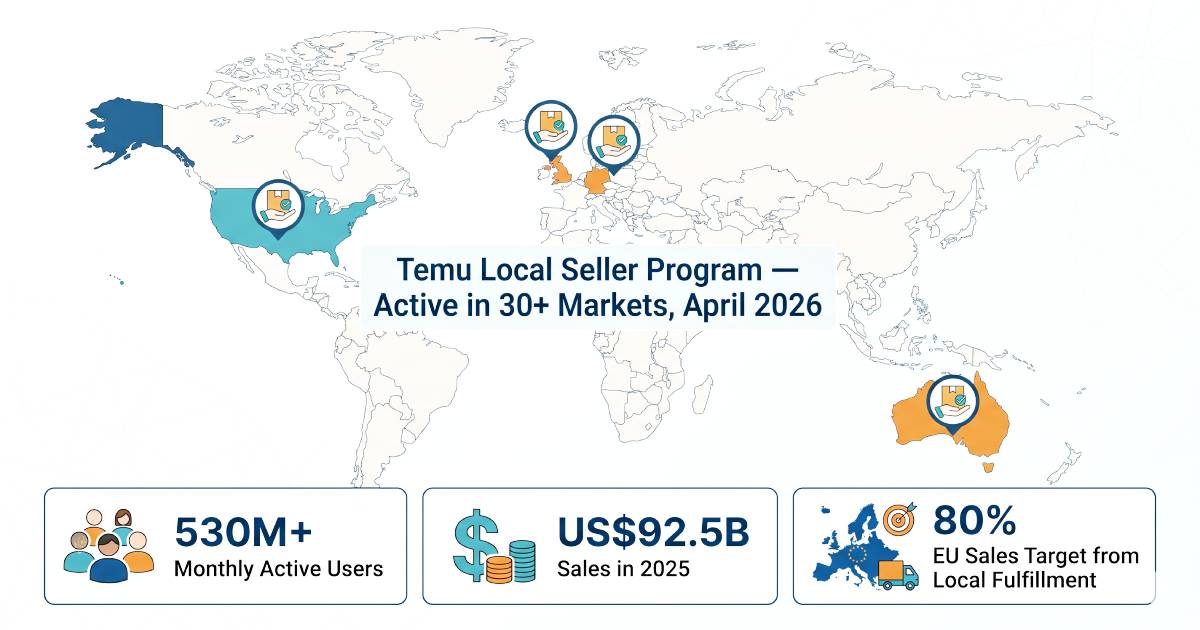
to businesses in the US, UK, Germany, Australia, and 30+ other markets to list
products and fulfill orders domestically.
Most sellers outside China either missed the announcement or
dismissed it as irrelevant to them.
That was an expensive mistake.
One US-based seller who tested Temu's Local Seller Program
with a batch of 500 units described receiving his first order within three days
of listing. The entire batch sold out in 18 days — boosted by Temu's
algorithmic recommendations that actively surface local inventory to buyers. In
2025, Temu.com generated US$92.5 billion in sales, a 70–75% increase from 2024,
and ranked as the most downloaded shopping app in the US for the second
consecutive year. The platform is not a fringe opportunity. It is a mainstream
channel with a growing structural preference for local sellers built directly
into its algorithm.
The problem is that most Western sellers still do not fully
understand how the Local Seller Program works, what it actually requires, and
how to enter it correctly without the compliance gaps and operational mistakes
that derail new participants. This guide fixes that.
Whether you are evaluating the program for the first time or
already enrolled and trying to scale without getting suspended, this is the
complete 2026 operational handbook.
Note: Temu's program requirements, fee structures, and
market availability continue to evolve rapidly. Always verify current
requirements in your Seller Center before making operational decisions. This
guide reflects the best available verified information as of April 2026.

What Is the Temu Local Seller Program and Why Does It Exist?
The Program's Origin — A Strategic Pivot, Not a Feature Launchvot, Not a Feature Launch
Understanding why Temu built the Local Seller Program
explains why the platform is so aggressively investing in making it work.
Temu debuted the Local Seller Program in November 2024 as a
hedge against mounting headwinds — President Trump's tariffs and the removal of
the de minimis loophole dramatically increased the cost of importing to the US,
which was particularly challenging for low-cost platforms like Temu. The same
pressures played out in Europe, where tighter VAT rules and evolving customs
regulations accelerated the need for locally sourced inventory
When the US de minimis exemption ended in April 2025 and
tariffs on Chinese imports spiked, Temu's marketplace hit a wall. Their
ultra-low prices evaporated overnight. Ad campaigns paused. Catalogs shrank.
Yet Temu didn't exit the market — instead, it pivoted aggressively: onboarding
US-based sellers to diversify its supply chain, investing in regional
warehouses for faster tariff-compliant fulfillment, and adjusting its model to
better fit Western regulatory environments.
The result: as of October 2025, the Local Seller Program was
available in more than 30 countries. The program has not only increased Temu's
assortment of local products but also helped improve delivery speeds — and Temu
launched a dedicated Shopify integration in December 2025 enabling Shopify
merchants to instantly list and sell through the Local Seller Program across
all 30+ markets. For local sellers in the US,
UK, Germany, and Australia, this context matters. Temu is not offering the
Local Seller Program out of generosity. It needs local inventory to solve a
structural business problem. That need translates directly into algorithmic
advantages, onboarding incentives, and platform support for local sellers that
cross-border Chinese competitors simply do not receive.
What the Local Seller Program Actually Is
The Local Seller Program — also called the Semi-Managed
Model in Temu's own documentation — is fundamentally different from Temu's
original seller model.
In the managed model (Temu's original), you ship inventory
to Temu's warehouses and they handle pricing, fulfillment, and customer
service. In the local seller model, you set your own prices, ship from your own
warehouse, and handle customer service directly. The local model gives you more
control but requires meeting strict shipping SLAs.
This distinction is critical because it changes everything:
your pricing control, your fee structure, your fulfillment responsibilities,
and your relationship with the platform.
|
Feature |
Original Managed Model |
Local Seller Program (Semi-Managed) |
|
Who sets the price |
Temu |
You |
|
Who fulfills orders |
Temu |
You (or your 3PL/TWF) |
|
Who handles customer service |
Temu |
You |
|
Commission rate |
2–5% (lower — Temu controls more) |
8–15% (higher — you control more) |
|
Inventory location |
Temu's warehouses |
Your warehouse, 3PL, or TWF |
|
Delivery speed |
Variable — cross-border often |
Fast — domestic fulfillment |
|
Best for |
High-volume manufacturers |
Local businesses, brands, retailers |
|
Algorithm treatment |
Standard |
Preferential local delivery badge |
The tradeoff is explicit: you pay a higher commission rate
in exchange for pricing control, brand ownership, and the operational
flexibility to fulfill orders from your own infrastructure. For most Western
sellers with established products and supply chains, this is the right
tradeoff.
How to Join the Temu Local Seller Program: Registration Requirements
What Are the Requirements to Join?
The registration requirements vary slightly by market, but
the core framework is consistent across the US, UK, Germany, and Australia.
For US Sellers: Temu has fully opened to all US
sellers since November 2024. US merchants can register directly at the Temu
Seller Center without an invitation code. You will need: business verification
documents (business license, tax ID, or other proof of legitimate operation),
bank account information that matches your business documentation, and a
fulfillment system capable of dispatching orders within the required SLA —
typically within 48 hours using approved carriers with tracking.
For UK and EU Sellers (including Germany): Temu's
registration in Europe is currently invite-only for new sellers. To begin, send
a request to merchandise@temu.com or contact a local seller
acquisition manager. You will need a valid VAT ID for the EU nation you want to
sell to, the ability to fulfill orders directly in your region, and business
papers including tax information, proof of ID, and company registration
certificates.
For Australian Sellers: As of July 2025, the Local
Seller Program was operational in Australia among other countries. Australian
sellers follow a similar documentation process to UK/EU, with GST registration
and ABN documentation required. Contact Temu's Australian seller acquisition
team directly through the Seller Center for current onboarding status.
The Registration Process Step-by-Step
Step 1 — Pre-Registration Preparation (1–2 weeks)
Before you open the registration portal, gather these
documents. Missing documentation is the most common reason registrations are
delayed or rejected:
- Business
registration certificate (current, not expired)
- Tax
identification number (EIN for US, UTR/VAT number for UK, Steuernummer for
Germany, ABN/ACN for Australia)
- Bank
account details matching your business registration name
- Government-issued
ID for the business owner or authorized representative
- For
EU/UK: VAT registration certificate
- For
Germany: VerpackG registration number (if selling packaged goods)
- Proof
of product inventory capability — this can be warehouse address, 3PL
agreement, or inventory photos
Step 2 — Account Application (1–3 business days)
Temu seller account approval can take anywhere from 1 to 3
business days for US sellers applying through the direct portal. EU sellers
requesting invitations should allow additional time for the initial
contact-response cycle before the formal registration begins.
For EU sellers: select your EU business location carefully
during registration — it determines tax settings and is non-editable after
submission. This is a mistake that cannot be corrected without starting a new
application. Choose the country where your business is physically registered,
not the country where you intend to ship most orders.
Step 3 — Seller Center Configuration
Once approved, configure these settings before uploading any
listings:
- VAT
information and VCS (VAT Calculation Settings) — required for EU and UK
sellers
- OSS
certificate upload if selling cross-border within the EU without German
stock
- Shipping
templates — set accurate handling times for each region you serve. Do not
set 24-hour handling if your operation realistically takes 48 hours.
Inaccurate handling times create metric failures before you have made a
single sale
- Payment
and payout settings
- For
Germany: upload EU Authorized Representative details in the compliance
section
Step 4 — First Listing Upload
Do not list all your products simultaneously. Start with
three to five of your strongest products — the ones with the best margin
profile, clearest product photography, and most defensible price point. As
covered in our [Listing Optimization Tutorial], a listing built correctly from
the start outperforms one corrected after launch.
Action Step: Before submitting your first Temu Local
Seller application, verify that you have all seven documentation items in the
list above ready and current. Incomplete applications add weeks to the approval
process. Complete applications often clear in 24–72 hours.

The Real Benefits of Local Seller Status — What the Algorithm Actually Does for You
This is the section most guides miss — or describe in vague
terms. The benefits of local seller status are not just about faster delivery
for buyers. They are about algorithmic structural advantages that compound over
time.
The Local Delivery Badge — More Than a Visual Signal
Local warehouse items on Temu arrive in 1–3 business days in
the US, 2–5 business days in the UK, and 1–6 business days in Australia. The
"Local Warehouse" or "Local" badge on product thumbnails
signals this speed to buyers before they click.
The conversion impact of this badge is significant and
consistent across markets. As covered in our [Temu Algorithm Deep Dive],
delivery speed estimate is displayed directly on search result cards — before
the buyer clicks through. A listing showing "Arrives in 2–3 days"
next to a "Local" badge outconverts an identical product showing
"Arrives in 10–15 business days" at a rate that more than justifies
the higher commission rate in most product categories.
But the badge is only the visible part. Behind it, the
algorithm treats locally fulfilled listings differently at the ranking level.
Algorithmic Preferential Treatment — Verified and Significant
Temu's algorithm heavily rewards sellers who provide
reliable fulfillment and consistent product quality. US sellers who ship
quickly, maintain quality control, provide accurate product descriptions, and
offer responsive customer service can rise to the top of search rankings and
receive increased promotional placement.
Temu reshuffles category rankings every few hours based on
click-through and add-to-cart rates. A SKU that converts at 4% from strong
local delivery visibility will outrank a longer-tenured SKU converting at 1.5%
from cross-border listings.
The practical implication: a local seller with a
well-optimized listing and consistent fulfillment metrics can outrank a
cross-border competitor with significantly more total reviews — because the
algorithm is continuously re-evaluating based on current conversion signals,
not historical accumulation. Local delivery speed feeds conversion rate.
Conversion rate feeds ranking. Ranking feeds more impressions. More impressions
feed more sales. The compounding effect is real.
Reduced Competition Window — Still Open, Closing Fast
Although Temu has become a major marketplace, its Local
Seller Program is still in its relatively early stages, offering many
opportunities for local sellers to participate and expand. This creates a rare
advantage: sellers can dominate categories where fast shipping or specialty
items matter.
Temu's early days of low competition are largely over in the
most saturated categories, but the Local Seller Program creates a new layer of
opportunity in markets where local inventory is still sparse. In Germany
specifically, compliant local sellers face competition primarily from
cross-border Chinese sellers whose listings will become significantly more
expensive after the €3 parcel fee takes effect in July 2026 — as covered in our
[Temu Germany Seller Guide]. No
Subscription or Listing Fees
Currently, Temu does not charge subscription, listing, or
payment processing fees for US merchants. This applies across the Local Seller
Program in all four markets covered in this guide. The absence of a monthly
subscription fee — in direct contrast to Amazon's $39.99/month — means the
program's entry cost is genuinely zero beyond the operational investment of
fulfillment infrastructure. As covered in our [Temu vs Amazon] guide, this fee
difference compounds significantly for sellers who are testing new products or
managing multiple SKUs.
Fulfillment Options for Local Sellers: Which One Fits Your Operation?
As covered in depth in our [Temu Fulfillment Showdown],
local sellers have three fulfillment paths. In the context of the Local Seller
Program specifically, here is how each one plays out:
Self-Fulfillment — The Starting Point
You store inventory at your premises, pick and pack orders,
and dispatch using approved carriers. You are required to ship within the
stated handling time (typically 48 hours), provide tracking numbers, and meet
performance benchmarks for delivery speed and accuracy.
Self-fulfillment is the right starting point for testing the
Local Seller Program with a small initial batch. It keeps costs low, preserves
flexibility, and generates the performance data you need to decide whether to
graduate to TWF or 3PL.
The exit trigger from self-fulfillment is simple: when you
are consistently dispatching more than 30 orders per day or spending more than
2 hours daily on packing, the time cost has made self-fulfillment uneconomical.
That is the moment to price out alternatives.
Temu Warehouse Fulfillment (TWF) — The Invite-Only Upgrade
Warehouse fulfillment on Temu is invite-only — eligible
sellers can send inventory to Temu's US-based fulfillment centers for FBA-style
handling. TWF is also active and expanding in the UK and Australia.
As of 2025, Temu significantly grew its Australian local
inventory network through WINIT Australia and additional local 3PL partners. In
the US, Temu operates confirmed fulfillment hubs in California (Rowland
Heights), Texas, and New Jersey.
TWF removes delivery metric risk from your account entirely
for TWF-fulfilled listings. Temu's infrastructure handles dispatch, tracking,
and in most cases returns. The ranking benefit is real — TWF listings carry the
fastest delivery badges on the platform and receive preferential algorithmic
treatment as a result.
The pathway to TWF invite eligibility typically involves:
consistent self-fulfillment performance above Temu's metrics thresholds for
60–90 days, a minimum monthly order volume (varies by market and category), and
clean account health with no active policy warnings.
Third-Party Logistics (3PL) — The Scaling Bridge
A local 3PL provides professional warehouse and fulfillment
services from within your market, integrating with your Temu seller account
through API or manual order processing. This is the preferred scaling model for
sellers with validated products who want professional speed without TWF's
invite requirement.
US sellers can partner with fulfillment services that have
specifically teamed up with Temu to help sellers expand their reach on the
platform. In the UK, established 3PLs with Royal Mail and DPD integrations
provide next-day and 48-hour fulfillment options. In Germany, a
compliance-aware 3PL adds GPSR label checking and VerpackG handling to the
fulfillment process — removing the most operationally complex compliance tasks
from the seller's daily workflow.
|
Fulfillment Model |
Invitation Required |
Best Volume |
Metric Risk |
Setup Time |
|
Self-Fulfillment |
No |
Under 30 orders/day |
Moderate — seller controls |
Immediate |
|
TWF |
Yes — earned through performance |
Any volume (unlimited) |
Low — Temu controlled |
4–8 weeks (invitation + inbound) |
|
Local 3PL |
No — choose your provider |
100+ orders/month |
Low — SLA managed |
2–4 weeks (onboarding) |
Country-Specific Local Seller Program Reality
🇺🇸 United States
— The Most Open and Most Competitive Market
Temu has fully opened to all US sellers since November 2024,
with US merchants beginning local fulfillment in March 2024. The US is
simultaneously the most accessible market for local sellers and the most
competitive — both because of the sheer volume of sellers who have already
enrolled and because of the post-tariff disruption that made local sourcing
essential for any seller wanting to compete on price with former Chinese
cross-border competitors.
The Temu Shopify integration launched in December 2025
enables Shopify merchants to instantly list and manage products across Temu's
Local Seller Program in 30+ markets, with one-click product sync, real-time
inventory updates, and access to 600+ product categories. For US sellers
already on Shopify, this integration removes a significant portion of the
operational friction of adding Temu as a channel.
The categories with the strongest opportunity for US local
sellers in 2026:
Popular product categories among US consumers that benefit
most from fast local shipping include health and beauty items, supplements,
electronics accessories, boutique clothing, customized products, handcrafted or
small-batch goods, and seasonal and holiday merchandise.
The US-specific compliance note for Local Seller Program
members: As covered in our [Scale Without Suspension] guide, the INFORM
Consumers Act applies to Temu US sellers with 200+ transactions and $5,000+
annual revenue. Sellers crossing the $20,000 annual revenue threshold face
additional disclosure requirements. Ensure your Seller Center profile has your
complete legal business name and physical address visible before reaching these
thresholds — not after.
Action Step — US Sellers: If you are currently
selling on Shopify, search the Shopify App Store for the Temu app today. The
one-click sync capability makes adding Temu as a channel a same-day project
rather than a multi-week integration effort. Start with five of your best-converting
Shopify products.
🇬🇧 United Kingdom
— Invite-Only But Actively Expanding
The Local Seller Program was operational in the UK as of
July 2025. UK registration remains invite-based for new sellers — the path in
is through direct contact with Temu's UK seller acquisition team at merchandise@temu.com
or through the formal application process in the Seller Center.
The UK market rewards local sellers disproportionately
because British buyers have been conditioned by Amazon Prime to expect 48-hour
delivery as a baseline. A local seller who can consistently hit 1–2 day
delivery in England, Wales, and Scotland holds a structural conversion rate
advantage over every cross-border competitor on the platform.
UK local warehouse items typically arrive within 2–5
business days, which is already faster than most cross-border alternatives.
Sellers who combine local fulfillment with a strong 3PL providing next-day
Royal Mail or DPD options can hit the fastest delivery estimates on the UK
platform — which feeds directly into the algorithmic ranking advantages
described above.
UK compliance requirements for local sellers:
- UKCA
marking for applicable product categories (electronics, toys, machinery)
- VAT
registration mandatory once turnover exceeds £90,000 annually — register
before you hit the threshold, not after
- WEEE
(Waste Electrical and Electronic Equipment) registration for applicable
products
- Battery
Directive compliance for any product containing or sold with batteries
Sellers in the UK need to sign up for relevant compliance
categories including packaging, WEEE, and Battery Directive, and complete
registration, reporting, and payment of the environmental charge.
Action Step — UK Sellers: Send your seller
application request to merchandise@temu.com
today if you have not already. Include your business registration details, VAT
number, product category focus, and a brief description of your fulfillment
capability. Applications with complete information are processed significantly
faster than incomplete ones.
🇩🇪 Germany —
Highest Compliance Barrier, Highest Reward
Germany is the Local Seller Program market where compliance
creates the most significant competitive moat. The €3 parcel duty arriving July
1, 2026 — covered in full detail in our [Temu Germany Seller Guide] —
permanently changes the cost structure for every non-EU seller shipping into
Germany. Local sellers with German warehouse inventory are completely
unaffected by this duty. Every sub-€15 product their cross-border competitors
previously sold at competitive margins becomes structurally harder to maintain
after July.
This is not a minor edge. It is a fundamental shift in who
can profitably sell at Temu Germany's price points — and local sellers sit on
the right side of that shift.
The German Local Seller Program requirements stack on top of
standard business registration:
Full compliance stack required:
- EU
Authorized Representative appointed and uploaded to Temu backend (allow
4–6 months to complete — start immediately if you have not)
- GPSR
product safety documentation complete for all listings
- German-language
product descriptions, titles, and safety warnings
- VerpackG
packaging compliance registration (Interseroh, Landbell, Reclay, or
equivalent)
- CE
marking for applicable product categories
- German
VAT number (Umsatzsteuer-Identifikationsnummer) — mandatory for any seller
storing stock in Germany
- German-language
listing content built from scratch, not translated from English
The competitive reality: the sellers who complete this
compliance stack now are building a position that becomes increasingly valuable
every month as non-compliant competitors get removed and the €3 fee erodes the
economics of cross-border competition.
As of early 2026, Temu actively removes listings that don't
comply with GPSR requirements. Non-compliant sellers face listing removal and
potential account restriction. Compliant local sellers gain market share by
default as non-compliant listings disappear.
🇦🇺 Australia —
Expanding Infrastructure, High Price Point Requirements
Temu Australia warehouse operations are active and
expanding. As of 2025, Temu significantly grew its Australian local inventory
network through WINIT Australia and additional local 3PL partners. Local
delivery typically arrives in 1–6 business days. Temu
The Australian Local Seller Program follows the same general
framework as the UK — invite-based registration, domestic fulfillment from
Australian stock, and compliance with Australian Consumer Law (ACL). The unique
operational challenge in Australia is shipping cost, as covered in our
[Fulfillment Showdown]: AusPost retail rates for parcels above 500g regularly
exceed AUD $10, making products under AUD $25 structurally difficult to make
profitable.
The practical guidance for Australian local sellers: focus
the Local Seller Program strategy on products priced above AUD $25–30, where
the delivery speed advantage of local inventory significantly improves
conversion rate and the shipping cost represents a manageable percentage of the
sale price.
Local warehouse items in Australia arrive in 1–6 business
days — already dramatically faster than cross-border alternatives. For outdoor,
lifestyle, pet, and home organization products where Australian buyers have
demonstrated willingness to pay above AUD $30, local inventory creates a
genuine conversion advantage that the AusPost cost absorbs without destroying
the margin.
Australian seller requirements: ABN, ACN, GST registration
(mandatory when turnover exceeds AUD $75,000), and compliance with ACL consumer
protection provisions — particularly the statutory guarantee provisions that
give buyers stronger rights than Temu's own return policy in some categories.
Profitability Framework for Local Sellers in 2026
What Margins Are Realistic?
The honest answer: margins are tighter in the Local Seller
Program than on Amazon in most categories, but the volume potential and lower
advertising costs offset this in many cases. Here is a realistic framework:
Fashion, footwear and beauty categories typically see
commission rates around 8–12% in 2026; hardgoods like phone accessories and
home items run 2–4%. For the semi-managed local seller model, expect the higher
end of these ranges as the baseline.
Hypothetical profitability example — Home Organization
(US Local Seller):
|
Cost Element |
Amount |
|
Sale price |
$19.99 |
|
Temu commission (~12%) |
-$2.40 |
|
Fulfillment (3PL — pick, pack, ship) |
-$5.80 |
|
Storage (per unit) |
-$0.25 |
|
Sourcing cost |
-$4.20 |
|
Advertising (~15% ACoS on $10 ad spend) |
-$1.50 |
|
Net Profit/Unit |
$5.84 |
|
Net Margin |
29.2% |
This margin is achievable — but requires a product priced
above $15, sourcing costs below 25% of sale price, and ad ACoS at target.
Products priced below $12 with thin sourcing margins will struggle to generate
workable margins in the Local Seller Program's commission structure.
Temu's buyer protection often issues refunds without
requiring the item back on low-ticket orders — so build this loss into your
pricing, not into your customer service workflow. Track returns SKU-by-SKU so
you can delist the small number of items that typically drive most refunds.
Pro Tip: Before enrolling any product in the Local
Seller Program, run the full cost model through our [Temu Fees & Profit
Calculator]. Include commission, local fulfillment costs, advertising estimate,
and a returns allowance of 3–5% of revenue. Any product where the net margin
falls below 15% after all of these inputs needs either a price adjustment or a
sourcing cost reduction before it is viable in the program.
Scaling Within the Local Seller Program
The Scaling Sequence That Protects Your Account
Scaling in the Local Seller Program follows the same
fundamental principle as scaling on Temu generally — metrics before volume,
depth before width. As covered in our [Scale Without Suspension] guide, the
sellers who scale into account problems are almost always the ones who expanded
product count or order volume faster than their operational infrastructure
could support.
For Local Seller Program sellers specifically, here is the
sequencing that works:
Phase 1 — Validation (Month 1–2): 3–5 products,
self-fulfillment
Test your best products under self-fulfillment. Establish
that your listings convert, your products generate clean reviews, and your
dispatch operation can maintain LSR below 3% and ODR below 0.6%. Do not run
significant ad spend during this phase — let organic visibility and a small
test budget generate the data you need without risking budget on unvalidated
listings.
Phase 2 — Optimisation (Month 2–4): Add 3PL, optimize top
performers
Move your best-performing products to a local 3PL to
eliminate fulfillment metric risk and improve delivery speed. Rebuild
underperforming listings using the [Listing Optimization Tutorial] framework.
Begin running structured ad campaigns on validated winners only, using the
break-even ACoS methodology from our [Ads Mastery] guide.
Phase 3 — Scale (Month 4+): TWF application, new SKUs,
increased ad spend
Apply for TWF access based on the performance data from Phases 1 and 2. Add new SKUs at a rate your operational infrastructure can support — maximum 5 new products per month until you have a team or 3PL with capacity for rapid onboarding. Increase ad spend in proportion to proven ACoS performance, not in proportion to revenue growth.
Common Scaling Mistakes Specific to Local Seller Program
Treating the Local Seller Program like Amazon FBA. It
is not. You do not have Amazon's buyer trust infrastructure, Prime membership
loyalty, or review accumulation history. Listings that would rank organically
on Amazon because of 500 reviews need active ad support and strong listing
quality on Temu to achieve equivalent visibility. Adjust your expectations and
your strategy accordingly.
Setting optimistic handling times that your operation
cannot reliably meet. A stated 24-hour handling time that you hit 80% of
the time generates a 20% Late Shipment Rate — more than double Temu's 8.7% flag
threshold. Set handling times that your operation hits 98%+ of the time. Slower
stated times that you consistently beat are better for your metrics than fast
times you occasionally miss.
Launching into Germany without completing the compliance
stack. The compliance documentation for Germany takes 4–6 months to
complete in full. Sellers who launch German listings before completing GPSR
documentation, VerpackG registration, and EU Authorized Representative
appointment are exposing themselves to listing removal and account restriction.
Complete the stack first — then launch.
Scaling ad spend before the listing is optimised. As
covered in our [Ads Mastery] guide, ads drive traffic. If the listing does not
convert that traffic, you pay for every click and earn nothing. Run the full
listing optimisation checklist from our [Listing Optimization Tutorial] before
increasing ad spend on any listing in the Local Seller Program.
Reserve inventory in advance for platform promotions — Temu
rewards sellers who maintain ready-to-ship stock. Stock-outs during a
promotional period are a double loss: you miss the sales from the promotion and
your metrics take an ODR hit from cancelled orders.
Your Temu Local Seller Program Action Checklist
Use this as your launch checklist, your scaling checkpoint,
and your quarterly audit tool.
Registration and Documentation
- ☐
Business registration documentation current and ready
- ☐
Tax identification number confirmed (EIN / UTR / Steuernummer / ABN as
applicable)
- ☐
VAT / GST registration active where required
- ☐
Bank account details match business registration name
- ☐
EU Authorized Representative appointed (EU/UK sellers)
- ☐
VerpackG registration active (Germany)
- ☐
UKCA marking documentation prepared for applicable products (UK)
- ☐
Seller Center profile complete with accurate business address (INFORM Act
— US sellers above $20k)
Seller Center Setup
- ☐
VAT / tax information uploaded and verified
- ☐
Shipping templates set with achievable (not aspirational) handling times
- ☐
Payout bank account linked and verified
- ☐
Compliance documentation uploaded to backend (GPSR for EU/UK)
- ☐
Market restrictions defined (exclude regions you cannot serve reliably)
Product and Listing Readiness
- ☐
Starting product selection: 3–5 products with 25%+ pre-ad margin
- ☐
Each listing fully optimised per [Listing Optimization Tutorial] checklist
- ☐
German listings built in German compound nouns — not translated
- ☐
Compliance badge image included in image set (EU/UK/Germany)
- ☐
Dimension infographic included for all sized products
- ☐
All attribute fields completed at leaf-level category
Fulfillment and Metrics
- ☐
Fulfillment model chosen (self / 3PL / TWF) and operational before first
listing goes live
- ☐
Carrier selected with continuous tracking capability
- ☐
Returns process documented and resourced
- ☐
Weekly metrics monitoring schedule set (ODR, LSR, disputes)
- ☐
Stock replenishment triggers set for all initial products
Scaling Milestones
- ☐
Phase 1 (Months 1–2): Self-fulfillment, 3–5 products, metrics clean
- ☐
Phase 2 (Months 2–4): 3PL transition, listing optimisation, structured ads
on winners
- ☐
Phase 3 (Month 4+): TWF application, new SKU additions at controlled rate,
scaled ad spend
Conclusion
The Temu Local Seller Program is the most significant
ecommerce opportunity in the markets it covers that most Western sellers have
not yet acted on. Temu generated US$92.5 billion in sales in 2025 and is
structurally shifting toward local inventory to solve its cross-border cost and
regulatory problems. The sellers who enter correctly in 2026 — with complete
documentation, operational infrastructure that can meet delivery SLAs, and
listings built for their specific market — are entering at precisely the moment
when Temu's platform incentives for local sellers are strongest.
Your Temu Local Seller Program Action Checklist
Use this as your launch checklist, your scaling checkpoint,
and your quarterly audit tool.
Registration and Documentation
- ☐
Business registration documentation current and ready
- ☐
Tax identification number confirmed (EIN / UTR / Steuernummer / ABN as
applicable)
- ☐
VAT / GST registration active where required
- ☐
Bank account details match business registration name
- ☐
EU Authorized Representative appointed (EU/UK sellers)
- ☐
VerpackG registration active (Germany)
- ☐
UKCA marking documentation prepared for applicable products (UK)
- ☐
Seller Center profile complete with accurate business address (INFORM Act
— US sellers above $20k)
Seller Center Setup
- ☐
VAT / tax information uploaded and verified
- ☐
Shipping templates set with achievable (not aspirational) handling times
- ☐
Payout bank account linked and verified
- ☐
Compliance documentation uploaded to backend (GPSR for EU/UK)
- ☐
Market restrictions defined (exclude regions you cannot serve reliably)
Product and Listing Readiness
- ☐
Starting product selection: 3–5 products with 25%+ pre-ad margin
- ☐
Each listing fully optimised per Listing Optimization Tutorial checklist
- ☐
German listings built in German compound nouns — not translated
- ☐
Compliance badge image included in image set (EU/UK/Germany)
- ☐
Dimension infographic included for all sized products
- ☐
All attribute fields completed at leaf-level category
Fulfillment and Metrics
- ☐
Fulfillment model chosen (self / 3PL / TWF) and operational before first
listing goes live
- ☐
Carrier selected with continuous tracking capability
- ☐
Returns process documented and resourced
- ☐
Weekly metrics monitoring schedule set (ODR, LSR, disputes)
- ☐
Stock replenishment triggers set for all initial products
Scaling Milestones
- ☐
Phase 1 (Months 1–2): Self-fulfillment, 3–5 products, metrics clean
- ☐
Phase 2 (Months 2–4): 3PL transition, listing optimisation, structured ads
on winners
- ☐
Phase 3 (Month 4+): TWF application, new SKU additions at controlled rate,
scaled ad spend
Conclusion
The Temu Local Seller Program is the most significant ecommerce opportunity in the markets it covers that most Western sellers have not yet acted on. Temu generated US$92.5 billion in sales in 2025 and is structurally shifting toward local inventory to solve its cross-border cost and regulatory problems. The sellers who enter correctly in 2026 — with complete documentation, operational infrastructure that can meet delivery SLAs, and listings built for their specific market — are entering at precisely the moment when Temu's platform incentives for local sellers are strongest.
The sellers who enter incorrectly — rushing listings live with incomplete compliance, setting handling times their operation cannot meet, or scaling SKU count faster than their fulfillment capacity — will struggle with the same account health problems that derail sellers on every platform.
The difference is preparation. This guide is that preparation. Use the checklist. Follow the scaling sequence. Complete the compliance stack before you launch in Germany. Run the margin math before you source. And check our Scale Without Suspension guide regularly as you grow — because the account health principles that protect a new local seller protect a scaling one too.
The Local Seller Program window is open. The sellers who move through it carefully and correctly will find it the most rewarding channel they have operated in years.
For the full fulfillment cost comparison between self-fulfillment, TWF, and 3PL for local sellers, read our Temu Fulfillment Showdown. For building listings that convert once you are inside the program, see the Listing Optimization Tutorial. For understanding how your ad spend strategy works within the Local Seller Program's algorithm, the Temu Ads Mastery guide is your reference. For protecting your account as you scale, the Scale Without Suspension guide is essential reading before you move to Phase 3.
Work with ApexBin
Want your Temu store set up and managed properly?
Muhammad Mustafa has over three years in Amazon advertising and five Amazon certifications, working with sellers across the US, UK and UAE.
Temu Store Setup & Management →


Blog Comments (0)
No comments yet. Be the first to comment!