





Selling on Temu Germany 2026: VAT, GPSR Compliance, €3 Parcel Fee, Local Fulfillment & Practical Seller Tips
Germany does not forgive shortcuts. That is not a cultural
stereotype it is a regulatory reality that costs ecommerce sellers real money
every year. A listing without German-language safety information gets removed.
A product without a documented EU Responsible Person gets pulled from the
platform. A seller who ships cross-border without VAT registration faces
backdated liabilities. And from July 1, 2026, every non-EU seller shipping a
parcel into Germany faces a new €3 customs duty that fundamentally changes the
cost structure for cross-border ecommerce into Europe's largest market.
The good news and there genuinely is good news is that
compliance in Germany is not as complicated as it first appears. It requires
front-loaded effort, but once the framework is in place, it becomes a
competitive advantage. While non-compliant sellers get their listings pulled,
compliant local sellers with German-language listings, local fulfillment, and
proper documentation gain market share by default.
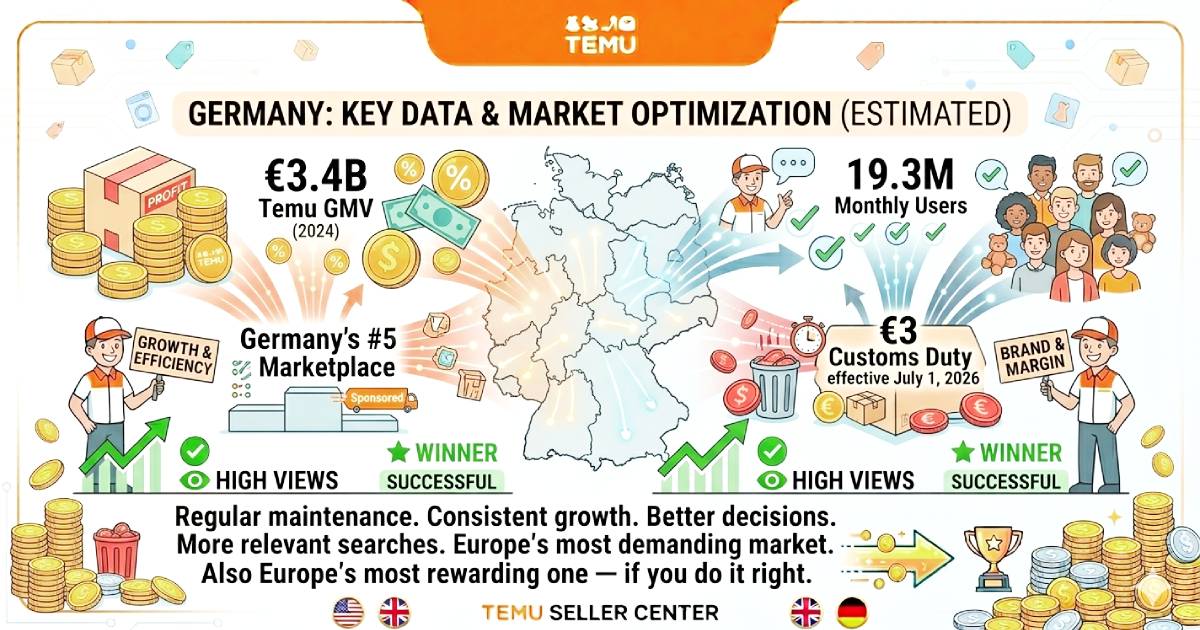
Temu's GMV in Germany reached €3.4 billion in 2024, making
it Germany's fifth-largest marketplace behind only Amazon (€52B), eBay
(€8.7B), Otto (€7.1B), and Zalando (€4.1B). Germany remains Temu's largest EU market, averaging 19.3 million monthly users
in the first half of 2025, a 13.5% increase versus the second half of 2024. This is not a marginal opportunity. Germany is
where Temu's European growth is concentrated, and the platform is actively
investing in the local seller infrastructure to sustain it.
This guide is the complete operational handbook for selling
on Temu Germany in 2026 whether you are already selling there and need to
tighten your compliance, or you are targeting Germany for the first time and
want to enter correctly from day one.
Important: Tax law, customs regulations, and platform
requirements change regularly. Every figure, threshold, and deadline in this
guide reflects the best available information as of April 2026. Always verify
current requirements with your Seller Center, a qualified VAT advisor, and a
compliance specialist before acting on specific regulatory guidance.

Temu Germany Market Overview in 2026
Is Germany Worth the Compliance Investment?
The short answer: yes unambiguously, for sellers who
understand what the investment involves and what it returns.
Germany's ecommerce market reached €80.4 billion in total
net revenue in 2024, with growth forecast to sustain a CAGR of 8.4% through
2029, reaching an estimated €97.2 billion. Temu reached 44% of all cross-border shoppers in
Germany in 2024, leading all non-domestic platforms ahead of Shein at 26% and
AliExpress at 20%.
German shoppers approach online purchasing with methodical
precision. Their research habits run deeper than most markets, creating a
sophisticated ecosystem where peer opinions carry substantial weight. This is the buyer profile that rewards
well-constructed, compliant, accurately described listings and punishes
everything else.
The competitive landscape in Germany is shifting in favour
of local sellers for two structural reasons. First, Temu has stated its goal of
ensuring 80% of all European orders are shipped from within the EU with Germany as its primary European logistics
hub. Second, the incoming €3 parcel duty from July 2026 permanently degrades
the economics of cross-border shipping into Germany for non-EU sellers while
having zero impact on locally fulfilled inventory.
For local German sellers and EU-based sellers shipping from
German warehouses, the regulatory changes arriving in 2026 are not a threat.
They are a moat.
|
Germany Market Snapshot |
2026 Data |
|
Temu Germany GMV (2024) |
€3.4 billion |
|
Monthly Active Users (H1 2025 avg.) |
19.3 million |
|
YoY User Growth (H1 2025) |
+13.5% |
|
Temu Rank in German Marketplace |
#5 (after Amazon, eBay, Otto, Zalando) |
|
Germany's Online Retail Market |
€80.4B total (2024) |
|
Cross-Border Shopper Reach |
44% of all German cross-border shoppers |
|
Key Compliance Deadlines |
GPSR: Active since Dec 2024 / €3 fee: July 1 2026 |
|
German VAT Standard Rate |
19% |
|
Reduced VAT Rate (food, books etc.) |
7% |
VAT Requirements for Temu Sellers in Germany
Do I Need VAT Registration to Sell on Temu Germany?
This is the question that trips up more sellers than any
other, and the answer depends on three variables: where you are based, whether
you hold stock in Germany, and your annual sales volume.
Here is the definitive breakdown:
If you are a German-based seller: You are subject to
German domestic VAT rules. Businesses established in Germany can use the
small-business exemption if annual turnover is below €25,000 (updated from
€22,000 in 2025). Once you exceed this threshold, VAT registration is
mandatory. For most Temu sellers with meaningful volume,
registration is required from the outset.
If you are an EU seller (outside Germany) shipping to
German buyers: Once your total cross-border B2C sales within the EU exceed
€10,000 per year, you are generally required to register for VAT — or use the
OSS (One Stop Shop) scheme — in the relevant countries, including Germany.The OSS allows you to file a single quarterly VAT return covering all EU
markets through your home country's tax authority, rather than registering
separately in Germany.
If you are a non-EU seller: Foreign businesses have
no registration threshold and must register from their first taxable sale into
Germany. Additionally, the moment your goods physically
touch German soil for storage — whether through a Temu warehouse, a 3PL, or
your own facility you must immediately register for German VAT, regardless of
sales volume or country of establishment.
The critical rule for warehouse users: Any storage of
inventory in Germany creates a fixed establishment for VAT purposes and makes
German VAT registration mandatory. This applies regardless of whether you use
Amazon FBA, Temu's local warehouse, or a third-party 3PL facility. OSS
does not override this requirement if goods are stored in Germany, German VAT
registration is mandatory in addition to any OSS registration you hold.
The OSS Scheme — What It Covers and What It Doesn't
The EU's OSS scheme allows distance sellers to maintain a
single VAT registration and submit one quarterly VAT return covering sales
across all EU member states. It is the most practical compliance route for sellers who ship goods from
outside Germany to German buyers without holding stock there.
The OSS does not replace German VAT registration when stock
is held in Germany. EU businesses selling goods online to German consumers can
avoid a German registration by using OSS, provided they have no stock in
Germany. Once stock is held in Germany, national registration is required
regardless.
For local fulfillment sellers: You will need both.
OSS for reporting cross-EU sales, and a German VAT number
(Umsatzsteuer-Identifikationsnummer) for the inventory stored in Germany.
|
Seller Type |
Stock in Germany? |
German VAT Required? |
OSS Available? |
|
German-based seller, <€25k turnover |
N/A |
No (small business exemption) |
N/A |
|
German-based seller, >€25k turnover |
N/A |
Yes |
Yes for cross-border EU sales |
|
EU seller, <€10k cross-border sales |
No |
No |
Not needed yet |
|
EU seller, >€10k cross-border sales |
No |
No (use OSS instead) |
Yes — use OSS |
|
EU or non-EU seller |
Yes (Temu warehouse/3PL) |
Yes — immediately |
Yes (in addition to DE reg) |
|
Non-EU seller, any volume |
No |
Yes — from first sale |
Yes (IOSS for imports ≤€150) |
Always verify your specific situation with a qualified
VAT advisor. These are general frameworks — individual circumstances vary.
VAT Registration Process in Germany — Timelines and Steps
The average processing time for German VAT registration is
around 6–10 weeks, depending on the tax office's workload and the completeness
of your documentation.This timeline is critically important — if you are planning to move inventory
into a German warehouse in Q3 2026, your VAT application needs to be submitted
in Q1 or early Q2 at the latest.
The registration involves:
- Identifying
the correct German tax office responsible for foreign business
registrations (the Bundeszentralamt für Steuern — BZSt — handles most
foreign applications)
- Completing
the online questionnaire (Fragebogen zur steuerlichen Erfassung) — in
German
- Submitting
business registration documents, proof of business identity, and bank
account information
- Receiving
your German tax number (Steuernummer) — used for general tax purposes
- Separately
applying for a VAT identification number
(Umsatzsteuer-Identifikationsnummer, or USt-IdNr.) — used for intra-EU
transactions and required on your Temu listing and invoices
Germany has two distinct numbers — the Steuernummer and the
USt-IdNr. Both are required for compliant operation. Confusing them or using
one where the other is required is a common error that generates unnecessary
correspondence from German tax authorities.
Action Step — VAT Timeline: If you plan to use local
German fulfillment in 2026, begin your VAT registration application today. Six
to ten weeks of processing time means a decision made in April needs to start
now to be resolved before a Q3 fulfillment launch. Do not wait until you have
stock moving — register in advance.

Customs, Tariffs and the 2026 EU Parcel Fee Changes
How Does the €3 Parcel Fee Affect Sellers in Germany?
This is the single most consequential regulatory change for
ecommerce sellers shipping into Germany and the broader EU in 2026, and it
requires a clear, accurate understanding before you build any pricing or
fulfillment strategy around it.
As of July 1, 2026, goods entering the EU in small
consignments valued at less than €150 will be subject to a fixed €3 customs
duty per item. The rate will be applied to all goods entering the EU for which
non-EU sellers are registered in the EU's Import One Stop Shop (IOSS) for VAT
purposes.
There are several critical details that most summaries get
wrong:
It is per item, determined by tariff heading — not per
parcel. The €3 duty is charged per item based on tariff classification, not
simply per parcel or per shipment. Each distinct product in a consignment,
identified by its customs tariff heading, attracts a separate €3 duty. A parcel
containing one smartphone, a charger, and earphones will be treated as three
distinct items, each with its own tariff heading, resulting in a total duty of
€9.
However, the Euronews reporting on the EU Council's December
2025 agreement specifies that the fee applies per parcel, not per item —
meaning if a customer buys three items shipped together in a single parcel, the
tax will be €3; if the items are delivered in three separate parcels, the tax
will apply to each one.
Note: There is genuine ambiguity in official sources
between "per item" and "per parcel" interpretations. The
vatcalc.com and Council press release sources use "per item" language
tied to tariff headings, while Euronews reports "per parcel." This
interpretation question will be resolved in implementing regulations before
July 1, 2026. Check for official EU Customs implementing guidance closer to the
effective date.
It is separate from VAT. The €3 customs duty is
separate from VAT, which will continue to be declared and paid via IOSS where
applicable. Sellers must account for both the €3 duty
and the applicable German VAT (19% standard rate) on qualifying shipments.
A separate €2 handling fee may follow. A proposed €2
EU-wide handling fee on e-commerce parcels is also under negotiation, expected
potentially from October 2026, though no final decision has been adopted as of
April 2026. This is separate from the €3 duty and would
add additional cost if confirmed. Monitor official EU Customs announcements for
developments.
Local fulfillment eliminates the €3 fee entirely.
EU-established sellers operating under OSS are unaffected by the €3 duty, which
heightens the competitive advantage of having tax and commercial operations
inside the EU. Goods already inside Germany that are shipped
domestically to German buyers are not subject to the import duty because they
are not imports.
The Strategic Implication for Germany Sellers
This is where the regulatory change becomes an opportunity
rather than just a cost. From July 1, 2026:
- A
non-EU seller shipping a €12.99 cable organizer from China to a German
buyer pays an additional €3 customs duty per item a 23% increase in
landed cost on that item before any other fees
- A
local German seller (or a seller using a German warehouse) shipping the
same product domestically pays €0 in additional duty
That gap changes the competitive pricing dynamics
permanently. Products that non-EU cross-border sellers could previously price
at €8.99 with thin margins become significantly harder to maintain at that
price point after July. Local sellers do not face this pressure.
|
Cost Impact of €3 Fee on Non-EU Cross-Border Shipments |
|
Product Sale Price |
|
€5.99 |
|
€9.99 |
|
€14.99 |
|
€24.99 |
|
€34.99 |
The clear conclusion: Products priced under €15
become structurally very difficult to ship profitably from outside the EU into
Germany after July 1, 2026. Products priced above €25 absorb the fee more
comfortably. For sellers sourcing from outside the EU, either moving inventory
into local German fulfillment or focusing on higher-price-point products
becomes the economically rational response.
⚠️ Warning: If you currently
sell sub-€15 products cross-border into Germany with thin margins, model the
full impact of the €3 duty before July 1. Do not wait until the first post-July
shipment clears customs to discover the fee has made your entire product range unprofitable.
GPSR and Product Safety Compliance — Non-Negotiable for Germany
What Is the GPSR and What Does It Mean for Temu Sellers?
The General Product Safety Regulation (EU 2023/988) applies
since December 13, 2024, repealing and replacing the General Product Safety
Directive that had been in force since 2001. The GPSR is one of the most
significant updates to the EU's product regulatory landscape in modern history.
For Temu sellers in Germany, the GPSR is not a compliance
project you complete once and forget. It is an ongoing obligation that affects
every product you list, every label you print, and every shipment you send.
Non-compliance can result in product recalls, fines, or
having listings removed from platforms such as Temu, Amazon, Etsy, eBay, and
TikTok Shop. Authorities may also ban your products from the EU market.
Temu began enhanced verification of GPSR compliance
information from October 15, 2024. Products lacking required information, or
where the information is inaccurate or does not meet requirements, may not be
allowed to be sold in the EU.
GPSR Requirements Step-by-Step for Temu Listings
Step 1 — Appoint an EU Responsible Person
A product covered by the GPSR cannot be placed on the market
without an economic operator established in the EU, known as the
"responsible person." The responsible person can be any of: (a) a
manufacturer established in the EU, (b) an importer, if the manufacturer is not
established in the EU, (c) an authorised representative, or (d) a fulfillment
service provider established in the EU if no other economic operator is
established in the EU.
For most non-EU sellers targeting Germany, the practical
path is appointing a professional EU Authorized Representative — a service
offered by numerous compliance firms for a one-time or annual fee. Temu advises
that completing the EU Representative appointment and all related compliance
steps may take 4–6 months, and sellers should contact providers well in
advance.
Step 2 — Update Product Labels to GPSR Standards
Product labels must include: (1) contact information of the
EU Responsible Person (postal address and email address/URL); (2) warnings and
safety information in the language of the country/region of sale — in German
for Germany; (3) product type, batch or serial number or other product
identifiers; (4) postal address and email/URL of the manufacturer; and (5) CE
marking or other applicable certification marks where required.
For Germany specifically: all safety information, warnings,
and instructions must be in German. An English-language warning label that has
been adequate in other markets does not satisfy German requirements.
Step 3 — Upload Documentation to Temu Seller Backend
All GPSR-required information — EU Responsible Person
details, manufacturer information, product safety documentation — must be
uploaded to your Temu Seller Center backend. Temu actively verifies this
information and listings without complete, accurate documentation are removed.
Step 4 — Maintain Technical Documentation
The EU Responsible Person must have access to the technical
documentation and, in some cases, will need to collaborate with local
authorities in case of product recalls or safety concerns.This means maintaining a technical file for each product that includes: product
description, safety assessment, test results, conformity declarations, and
instructions for use. This documentation must be retained for 10 years from the
date the product was placed on the market.
Step 5 — CE Marking Where Applicable
CE marking is required for electronics, toys, machinery,
personal protective equipment, and a range of other product categories. If your
product falls within a CE-marked category, the CE mark must be present on the
product and packaging, and the underlying test documentation must be complete
and current. For toys and battery-powered products, Temu has moved toward
requiring full-model testing rather than sample-based testing for the German
market.
GPSR Compliance Costs — What to Budget
For sellers new to the German market, here is a realistic
budget framework for GPSR compliance:
|
Compliance Element |
Typical Cost Range |
Frequency |
|
EU Authorized Representative |
€200–€800/year per entity |
Annual |
|
Product risk assessment (per SKU) |
€150–€400 |
One-time per product |
|
CE marking test report (electronics) |
€500–€2,000+ |
Per product, periodic renewal |
|
German-language label design |
€50–€200 |
Per product |
|
Technical documentation preparation |
€200–€500 |
Per product |
|
VerpackG registration |
€200–€600/year |
Annual (volume-dependent) |
These numbers look significant until you compare them to the
cost of a listing removal, a product recall, or a regulatory ban from the
German market. For a seller doing €5,000/month in German sales, the compliance
investment typically represents 3–8% of monthly revenue a cost that compounds
into a competitive advantage as non-compliant sellers get removed.
⚠️ Priority Action: If you
are targeting Germany and have not yet appointed an EU Responsible Person, do
this before uploading any listings. Temu enforces this requirement actively,
and a listing published without it will not survive the verification process.

Fulfillment and Logistics Best Practices for Germany
Local vs Cross-Border Fulfillment: The 2026 Decision
This decision has become significantly clearer in 2026 than
it was in 2024. The combination of the incoming €3 parcel fee, Temu's stated
goal of 80% local EU fulfillment, and the algorithmic ranking advantages of
fast local delivery make local German fulfillment the stronger choice for
sellers with proven products and sufficient volume to justify the working
capital.
As covered in detail in our Temu Fulfillment Showdown,
three fulfillment models are available to Germany sellers: Self-Fulfillment,
Temu Warehouse Fulfillment (TWF), and Third-Party Logistics (3PL). In Germany's
specific context, here is how that choice looks:
|
Factor |
Self-Fulfillment (Germany) |
TWF (German warehouse) |
3PL (Germany-based) |
|
€3 July 2026 fee impact |
None (domestic) |
None (domestic) |
None (domestic) |
|
Delivery speed to German buyer |
Variable — your carrier |
2–3 working days |
Next day to 48hr |
|
GPSR compliance support |
Entirely on you |
Temu handles outbound |
3PL checks on receipt |
|
VerpackG handling |
Entirely on you |
Temu handles outbound |
3PL manages |
|
Return handling (BGB 14-day) |
Entirely on you |
Temu manages |
Extra fee per return |
|
Metric risk |
High — any dispatch delay |
Low — Temu controlled |
Low — SLA managed |
|
Best for |
Very low volume (<20/week) |
Validated, consistent sellers |
Scaling with compliance needs |
The German return right — the 14-day Widerrufsrecht under
the BGB (Bürgerliches Gesetzbuch) — deserves specific mention. German consumers
have a statutory right to return most goods purchased online within 14 days, no
questions asked. This is not a Temu policy — it is German law. At a 5% return
rate on 200 monthly orders, that is 10 returns per month that require receipt,
inspection, and either restocking or writeoff. TWF handles this within Temu's
fee structure for warehouse-fulfilled orders. 3PLs charge per return —
typically €0.60–€1.80 per item depending on the provider. Self-fulfillment
sellers absorb the full time and cost.
Carrier Options for Germany Self-Fulfillment
For sellers running self-fulfillment from Germany, the
primary carrier landscape in 2026:
- Deutsche
Post / DHL — The dominant carrier. Reliable tracking, extensive
network including rural areas. Preferred by German buyers who expect
tracking at every stage
- DPD
— Strong business accounts, competitive rates for small parcels, good
next-day options
- Hermes
(now myHermes) — Lower cost, lower service level — acceptable for
non-fragile, low-value items
- GLS
— Good for medium-weight parcels, well-regarded tracking
German buyers have strong tracking expectations — more so
than UK or US buyers in most categories. A shipment that goes two days without
a tracking update generates a disproportionate number of buyer inquiries and
potential negative reviews. Use carriers with continuous tracking as your
default, and set expectations clearly in your listing's dispatch time.
Product Listing, Pricing and Advertising Tips for Germany
What Makes a Strong Temu Germany Listing?
As covered in depth in our Listing Optimization Tutorial,
every listing element contributes to either indexability or rankability. In
Germany, two elements matter more than anywhere else: language precision and
compliance visibility.
Language: Everything must be in German. Title,
description, bullet points, safety warnings, and compliance statements. This is
not just a buyer psychology point it is partly a legal requirement under GPSR
and German product law. A translation of an English listing is not the same as
a listing built in German. German compound nouns, specific technical terms, and
the exact phrases German buyers use in search ("wiederverwendbar,"
"spülmaschinenfest," "BPA-frei") need to be in the title
and description from the ground up.
As noted in our previous guides: rebuild keyword lists in
German using Google's Keyword Planner set to Germany and German language. Do
not translate —rebuild.
Compliance visibility: German buyers actively look
for compliance signals before buying. A listing image showing CE marking,
BPA-frei certification, or food-grade safety standards converts at a measurably
higher rate than an identical listing without these signals. Add a compliance
badge image as one of your supporting image slots. It is not just reassurance —
it is a conversion driver.
Dimensions in metric: Germany uses metric
exclusively. Dimensions in centimeters and millimetres, weights in grams and
kilograms. Listing dimensions in inches, or providing both imperial and metric,
signals a non-German-native listing to buyers who notice these things — and in
Germany, many buyers notice.
Price psychology: German buyers are price-conscious
but not impulsive. Unlike the US market, where a large crossed-out
"original price" and a heavy discount percentage drive impulse
purchases, German buyers are more suspicious of manufactured discount claims. A
genuine, sustainable price that appears consistently over time builds more
trust than an aggressive markdown that changes week to week.
Advertising in Germany — What's Different
As covered in our Temu Ads Mastery guide, Germany's ad
market rewards specificity more than any other. The key differences for
German-market campaigns:
Keyword language: German compound-noun search terms
dramatically outperform English translations. "Silikon Backmatten Set
wiederverwendbar" outperforms "reusable silicone baking mat" in
German-market campaigns because German buyers search in German. Rebuild keyword
lists in German before spending a euro.
Conversion rate: German buyers who find a genuinely
compliant, well-described product in their language convert at 10–13% in
well-matched categories — significantly above UK or Australian averages. This
makes ad ACoS more sustainable once the listing is properly optimized.
Review trust: German reviews carry more weight than
in most markets. A listing with 20 detailed German-language reviews converts at
a substantially higher rate than the same listing with 80 short English
reviews. Encourage German-language reviews from German buyers by providing
excellent product-description accuracy that makes the buyer experience match
expectations — the surest path to a detailed, positive review.
Account Setup, Scaling and Risk Management in Germany
Setting Up Your Temu Germany Account Correctly
Before listing a single product for the German market,
complete this account setup checklist:
Business documentation: Temu requires verified
business registration documents for the German market. Ensure your business
entity is correctly registered and all identification documents are current and
uploaded.
VAT information: Your German VAT number (or IOSS
number for cross-border sellers) must be entered in your Seller Center tax
information section. Incorrect or missing VAT information prevents payouts and
can trigger account holds.
EU Responsible Person: Appointed and uploaded to the
backend. This is verified by Temu's system and is a condition for German market
listing approval.
VerpackG registration: Your dual system registration
number (Interseroh, Landbell, Reclay, or equivalent) must be documented. Temu
is increasing enforcement of this requirement for German market sellers in
2026.
Bank account: German market payouts typically require
a SEPA-compatible bank account. Verify your payment method accepts EUR
transfers.
The Germany-Specific Scaling Risk
As covered in our [Scale Without Suspension] guide,
Germany's compliance environment means that scaling without a complete
compliance stack is not just operationally risky — it is legally risky. The
GPSR makes non-compliant sellers liable to enforcement from German market
surveillance authorities (Marktüberwachungsbehörden), not just Temu. This is
external regulatory risk that exists independently of platform enforcement.
The practical scaling rule for Germany: complete your
compliance foundation at 20–30 units per week. Scale once everything is
verified and operational. Do not scale first and fix compliance later — in
Germany, later sometimes means after an enforcement notice.
Pro Tip: The compliance investment for Germany
largely transfers to other EU markets. An EU Responsible Person appointment
covers France, Netherlands, Italy, Spain, and all other EU markets
simultaneously. VerpackG registration is Germany-specific, but equivalent
packaging compliance schemes exist in most EU markets and the documentation
process is similar. Doing Germany right first creates a compliance framework
that makes EU expansion significantly easier.
Profitability Examples and Best Categories for Temu Germany
Realistic Profitability Scenarios
These are hypothetical but realistic examples built on 2026
cost structures. Always verify your specific costs in your Seller Center. For
the full calculation framework, use our Temu Fees & Profit Calculator.
Scenario 1: Local German Seller — Silicone Baking Mat Set
Sale price: €17.99 | Sourcing: €3.10 | Net margin before
ads: 31%
|
Cost Element |
Cross-Border (Pre-July 2026) |
Cross-Border (Post-July 2026) |
Local Fulfillment |
|
Sourcing |
€3.10 |
€3.10 |
€3.10 |
|
Platform commission (~12%) |
€2.16 |
€2.16 |
€2.16 |
|
Shipping to customer |
€4.20 |
€4.20 |
€3.90 (local TWF rate) |
|
€3 customs duty |
€0.00 |
€3.00 |
€0.00 |
|
Storage |
€0.22 |
€0.22 |
€0.22 |
|
Compliance amortized/unit |
€0.35 |
€0.35 |
€0.35 |
|
Total Costs |
€9.03 |
€12.03 |
€9.73 |
|
Net Profit/Unit |
€5.58 |
€2.58 |
€5.26 |
|
Net Margin |
31% |
14.3% |
29.2% |
The €3 fee does not eliminate profitability for this
product, but it halves the net margin. For products priced at €12.99 or below,
the math becomes genuinely difficult after July.
Scenario 2: Precision DIY Tool Set — Local Seller
Sale price: €24.99 | Sourcing: €6.50 | Product: Multi-bit
precision screwdriver set with German safety labeling
|
Cost Element |
Amount |
|
Sourcing cost |
€6.50 |
|
Platform commission (~12%) |
€3.00 |
|
TWF fulfillment (local) |
€5.20 |
|
Storage |
€0.28 |
|
Compliance (amortized) |
€0.40 |
|
Advertising (~15% ACoS) |
€2.00 |
|
Total Costs |
€17.38 |
|
Net Profit/Unit |
€7.61 |
|
Net Margin |
30.5% |
A well-priced, compliant local product in a category with
genuine German demand delivers a healthy margin. The key levers: a sale price
above €20, compliant local fulfillment eliminating the €3 fee, and an ad ACoS
at target.
Best Product Categories for Temu Germany in 2026
Based on verified buyer behaviour, Temu Germany's
fastest-growing categories, and the compliance and margin profiles that work in
this market, here are the categories with the strongest opportunity for local
sellers:
Eco-Friendly Kitchen Products — Silicone baking mats,
beeswax wraps, reusable produce bags, compostable cleaning products. Germany's
environmental consciousness is not a trend — it is a cultural baseline.
Products that are genuinely sustainable, correctly labeled with eco-credentials,
and priced competitively convert at above-average rates.
Precision DIY and Home Improvement Tools — Laser
measuring devices, multi-bit precision screwdriver sets, tile spacer kits,
level sets. German homeowners use these regularly and expect precision in both
the product and its specifications. Exact measurements, German-language
instructions, and test documentation all contribute to conversion.
Bicycle Commuting Accessories — Germany has one of
the highest cycling rates in Europe. Bike lights, panniers, handlebar
organizers, saddle covers, cycle computers, and rain protection accessories all
have genuine, year-round demand. This is not a niche — it is a mainstream
German lifestyle category.
Home Organization (Modular, Space-Efficient) — Drawer
dividers, under-sink racks, cable management boxes, wall-mounted organizers.
Works globally on Temu but performs particularly well in Germany where buyers
research dimensions carefully and the "does it fit" question is
answered by a detailed dimension image.
Pet Lifestyle Accessories — Slow feeder mats, travel
water dispensers, seat protectors, grooming tools. German pet ownership rates
are high and pet spending per owner is among the highest in Europe. Products
that are BPA-free, dishwasher-safe, and correctly certified convert well.
What to Avoid:
- Products
with character designs, branded logos, or any design resembling a known
trademark — IP enforcement on Temu Germany is active and German consumer
protection authorities add an additional layer of scrutiny
- Electronic
products without complete CE marking and test documentation — the
compliance gap is enforced quickly in Germany
- Products
priced under €12 with cross-border fulfillment after July 2026 — the €3
fee makes these margin-negative in most cases
Conclusion + Action Checklist for Temu Germany Sellers
Germany in 2026 is the most compliance-intensive market on
Temu's platform. It is also, for sellers who do the work upfront, one of the
most rewarding. Temu reached €3.4 billion GMV in Germany in 2024 with growth
still accelerating and the incoming €3 parcel fee creates a structural
advantage for local sellers that did not exist twelve months ago. The sellers
who complete their compliance framework before July 2026 will be operating in a
market where their cross-border competitors face significant additional cost
pressure.
The sellers who skip the compliance work will, at some
point, receive a listing removal notice from Temu, an inquiry from a German
Marktüberwachungsbehörde, or a payout hold triggered by incomplete VAT
documentation. None of these outcomes are recoverable quickly. All of them are
preventable.
Your Complete Temu Germany Action Checklist
VAT and Tax Compliance
- ☐
Determined your VAT registration requirement based on your seller type and
storage location
- ☐
Applied for German VAT registration if required (6–10 week processing time
— do this now)
- ☐
Registered for OSS if shipping cross-border from another EU country
without German stock
- ☐
IOSS registration confirmed if importing goods into Germany from outside
EU (≤€150)
- ☐
German VAT number entered accurately in Temu Seller Center tax information
- ☐
VAT advisor engaged for your specific cross-border or local situation
GPSR Product Safety Compliance
- ☐
EU Responsible Person appointed and details uploaded to Temu backend
- ☐
All product labels updated with EU Responsible Person contact information
- ☐
German-language safety warnings on all product labels
- ☐
Product type, batch/serial number, and manufacturer information on labels
- ☐
CE marking documentation complete for applicable product categories
- ☐
Technical documentation files prepared and stored for each SKU (10-year
retention required)
- ☐
Product risk assessments completed
Packaging and Environmental Compliance
- ☐
VerpackG dual system registration active (Interseroh, Landbell, Reclay, or
equivalent)
- ☐
Registration number documented and available for Temu compliance
verification
- ☐
Packaging volume reporting schedule established for annual obligations
Listing Quality
- ☐
Title rebuilt in German compound nouns — not translated from English
- ☐
All bullet points and description written in natural German
- ☐
Dimensions in metric only (cm, mm, g, kg)
- ☐
Compliance badge image added (CE mark, BPA-frei, etc. as applicable)
- ☐
German-language dimension infographic included in image set
- ☐
Attributes section fully completed in German
Fulfillment and €3 Fee Planning
- ☐
Assessed whether local German fulfillment is viable for your volume and
product range
- ☐
Modeled full cost impact of €3 July 2026 fee on all sub-€15 products
currently shipped cross-border
- ☐
Decision made on TWF vs 3PL vs self-fulfillment for each SKU
- ☐
German carrier selected with continuous tracking capability (DHL, DPD,
GLS)
- ☐
Return handling process documented for BGB 14-day Widerrufsrecht
compliance
Account and Risk Management
- ☐
Business documentation complete and verified in Seller Center
- ☐
Weekly metrics monitoring routine established (ODR, LSR, open disputes)
- ☐
Compliance calendar built for annual renewal dates (VerpackG, EU Rep
appointment, CE certs)
- ☐
Legal advisor identified for rapid response if regulatory inquiry received
For the complete fulfillment cost comparison including TWF rates and 3PL options for Germany, see our Temu Fulfillment Showdown. For building a German-market listing that converts at 10%+, work through our Listing Optimization Tutorial. For understanding how your compliance foundation protects your account as you scale, the Scale Without Suspension guide covers the Germany-specific enforcement risks in detail. For understanding how your overall profitability works after fees, compliance costs, and fulfillment, use our Temu Fees & Profit Calculator.
Work with ApexBin
Want your Temu store set up and managed properly?
Muhammad Mustafa has over three years in Amazon advertising and five Amazon certifications, working with sellers across the US, UK and UAE.
Temu Store Setup & Management →





Blog Comments (0)
No comments yet. Be the first to comment!