





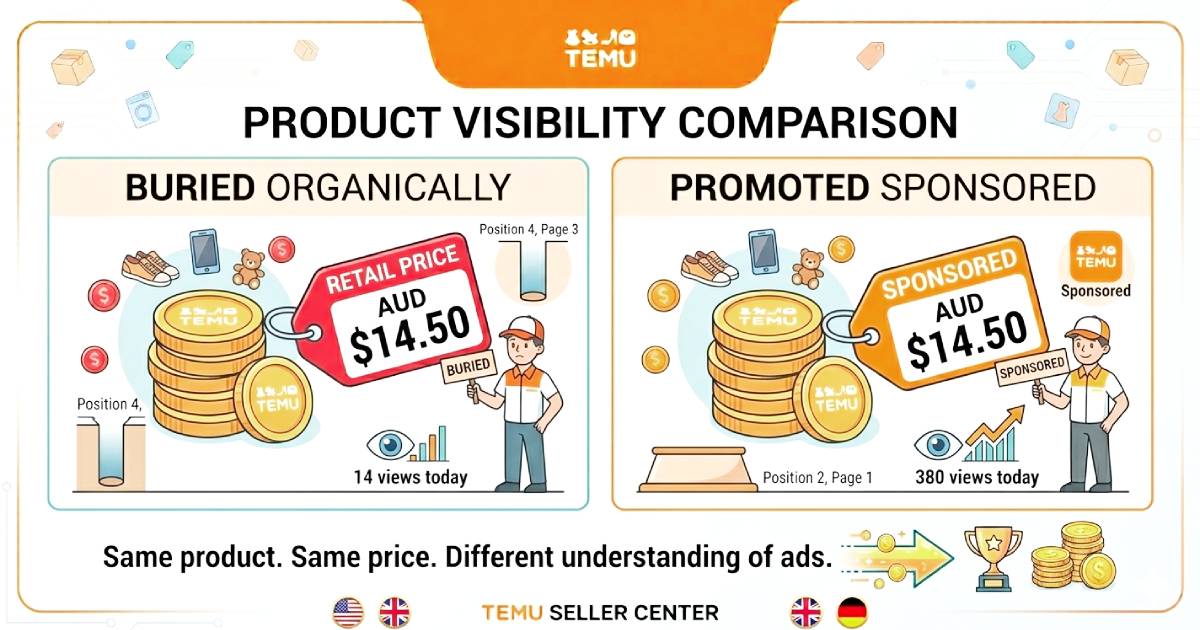
Temu Ads Mastery 2026: Types of Ads, Bidding Strategies, ROI Case Studies & Tips for Sellers in USA, UK, Germany & Australia
Picture this: two sellers, same product, same price, same
listing quality. One is making $3,800 profit a month. The other is making $340.
The difference is not the product. It is not the niche. It is not even
fulfillment — though if you haven't read our Temu Fulfillment Showdown, fix
that first.
The difference is ads. Specifically, whether they understand
them or not.
In 2026, Temu's ad platform has quietly shifted from
optional to essential in most competitive categories. Sellers who understood
this early built visibility and reviews while organic ranking was still
achievable without paid spend. Most sellers entering the market now are
arriving after that window. Ads are the entry fee to visibility in a saturated
category — and if you run them without understanding the math, they will
destroy the margins you worked so hard to build.
This guide is the full picture: ad types, setup, bidding
strategy, real ROI numbers from four markets, and the mistakes that are
currently bleeding money from campaigns that should be profitable. If you have
already read our Temu Algorithm Deep Dive and Fees & Profit Calculator,
this is where that knowledge becomes actionable.
One honest disclaimer before we start: Temu's advertising
platform is still maturing rapidly. Features, bid minimums, and dashboard
layouts vary by market and account tier, and they change. Always verify current
settings in your Seller Center before committing budget.

How Temu Ads Actually Work in 2026
Temu's ad system is auction-based and cost-per-click. You
set a maximum bid — the most you are willing to pay each time someone clicks
your ad. When a buyer searches a keyword you are bidding on, Temu runs a
real-time auction among all eligible sellers. The winner gets the placement.
Your actual cost per click is typically lower than your maximum bid —
determined by what the next-highest bidder is willing to pay, plus a small
increment.
This matters for budget planning. A $0.70 max bid does not
mean every click costs $0.70. It means you will never pay more than $0.70. Your
actual average CPC across a campaign depends entirely on the competition level
in your specific category and keyword set.
The ad platform lives inside Seller Center under Marketing
& Ads. New advertisers must sign an advertising agreement before
launching their first campaign — read it carefully, as it covers payment terms
and content restrictions that vary by market.
Here is the complete picture of what is available to sellers
in 2026:
|
Ad Type |
What It Does |
Best For |
Charged On |
Conversion Intent |
|
Sponsored Products |
Single listing in search results & category pages |
Buyers actively searching to buy |
CPC |
⭐⭐⭐⭐⭐ Highest |
|
Sponsored Brands |
Multi-product banner for store or range |
Brand awareness, cross-selling |
CPC |
⭐⭐⭐ Medium |
|
Display Ads |
Visual placements on homepage & product pages |
New launches, retargeting |
CPC / CPM |
⭐⭐⭐ Medium |
|
Flash Sales |
Temu-featured time-limited deals |
Stock clearance, velocity boosts |
Revenue share |
⭐⭐⭐⭐ High (volume) |
|
Coupon Campaigns |
Seller-funded discount codes |
Repeat buyers, conversion lift |
Per redemption |
⭐⭐⭐ Medium |
Sponsored Products is where 80% of sellers should focus
80% of their budget. It targets buyers with purchase intent — the
highest-converting traffic on the platform. Everything else is secondary until
your Sponsored Products campaigns are profitable and well-optimized.
Sponsored Brands make sense once you have three or
more validated products to cross-sell between. Without that product depth, the
brand banner is awareness spend without a clear conversion path.
Flash Sales are high-volume, low-margin events —
useful for clearing stock before storage fees kick in or for generating the
initial review velocity that feeds organic ranking. Not a sustainable primary
strategy.
Setting Up Your First Campaign: What Actually Matters
The full button-by-button walkthrough exists in Temu's
Seller Center help documentation. What most guides miss is the decision-making
that happens before you touch the dashboard. Here is the setup framework
that determines whether a campaign has any chance of working.
Before you open the ad dashboard, check three things:
One — Does your listing have at least 10 reviews? Paid
traffic sent to a listing with three reviews averaging 3.8 stars will not
convert. You are paying for clicks that leave. Fix the organic foundation
before amplifying with ads.
Two — Do you have lifestyle images? The main image is what
the buyer sees when your sponsored listing appears in search. A white
background product shot next to a competitor's lifestyle image loses the click
before the auction even matters.
Three — Have you calculated your break-even ACoS? This is
covered in detail in the next section and it is the most important number in
your entire ad strategy. Do not set a budget without it.
Once your listing is ready:
Access Marketing & Ads in Seller Center. Create a
new Sponsored Products campaign. Name it specifically — "Cable Organizer
US April 2026" — not "Campaign 1." You will thank yourself later
when comparing multiple campaigns.
Set your daily budget at $10–$20 maximum for your
first campaign. This is not timidity — it is data collection. You need 7–14
days of real click and conversion data before you know what is actually
working. Spending $50/day in that learning phase is expensive guesswork.
For keyword targeting, start with auto-targeting for your
first 7 days. Temu's algorithm will test a range of relevant search terms
against your listing. After 7 days, pull your search term report, identify
which terms generated clicks that converted, and switch to manual targeting
built exclusively around those terms. Kill everything else.
Action Step — Launch Checklist: Before pressing go on
any new campaign: (1) minimum 10 reviews on the listing, (2) lifestyle main
image, (3) break-even ACoS calculated, (4) daily budget $10–$20, (5)
auto-targeting on, (6) calendar reminder for 7-day review. All five or do not
launch.

Bidding Strategies That Protect Your ROI
The One Number You Must Know Before You Bid
Everything in Temu ads comes back to ACoS —
Advertising Cost of Sale. It measures what percentage of your revenue you are
spending on ads to generate that revenue.
ACoS = (Total Ad Spend ÷ Total Ad Revenue) × 100
Your Break-Even ACoS is the point where ad spend
exactly equals your pre-ad profit margin. Above it, you are losing money on
every ad-driven sale. Below it, you are profitable.
Break-Even ACoS = Your Net Margin % Before Ad Spend
If your product has a 30% net margin before ads, you break
even at 30% ACoS. Your target ACoS for a healthy, sustainable campaign
should sit 20–30% below break-even — leaving real profit after ad costs.
|
Net Margin (Pre-Ad) |
Break-Even ACoS |
Target ACoS |
Max CPC ($14.99 product, 9% CVR) |
|
15% |
15% |
10–11% |
~$0.20 |
|
25% |
25% |
17–18% |
~$0.34 |
|
35% |
35% |
24–25% |
~$0.47 |
|
45% |
45% |
31–32% |
~$0.61 |
CVR = conversion rate. Adjust max CPC for your actual
conversion data.
Calculate your break-even ACoS before you set a single bid.
This number tells you exactly how much you can spend per click before the sale
stops being worth making. Without it, you are bidding blind.
Three Bidding Modes — Use the Right One for the Right Phase
Launch Mode (Days 1–30): Accept ACoS up to your
break-even level. You are buying data and sales velocity, not immediate profit.
The ranking improvements generated by early ad-driven sales will pay for this
investment in organic visibility over the following 60–90 days — as covered in
our [Algorithm Deep Dive].
Optimization Mode (Days 31–90): You have data now.
Prune non-converting keywords weekly. Reduce bids on anything running 10+
points above your target ACoS for more than 14 consecutive days. Increase bids
on keywords running well below target — you are leaving profitable impressions
on the table.
Mature Mode (Day 90+): Organic ranking has improved
from early velocity. Reduce ad spend proportionally and test how much of the
traffic load organic now carries. The goal is a declining ad dependency — using
ads to defend and supplement organic position, not substitute for it.
|
Phase |
Days |
ACoS Target |
Priority |
|
Launch |
1–30 |
Up to break-even |
Velocity & data |
|
Optimization |
31–90 |
5–10% below break-even |
Profitability |
|
Mature |
90+ |
15–20% below break-even |
Margin maximization |
Real ROI Case Studies 2026
These are hypothetical but realistic scenarios built on
patterns consistent with what sellers in these markets are reporting in early
2026. Run your own numbers through our Temu Fees & Profit Calculator —
these examples show the shape of the math, not a guarantee of your specific
results.
Case Study 1: When It Works — Modular Drawer Dividers (US
Seller)
Product: Modular drawer divider set | Sale price:
$14.99 | Net margin before ads: 28% | Conversion rate: 9%
|
Metric |
Month 1 (Testing) |
Month 2 (Optimized) |
|
Daily Budget |
$15 |
$25 |
|
Avg. CPC |
$0.48 |
$0.39 |
|
Monthly Clicks |
938 |
1,923 |
|
Monthly Ad Sales |
84 units / $1,259 |
173 units / $2,592 |
|
Monthly Ad Spend |
$450 |
$750 |
|
ACoS |
35.7% (above break-even) |
28.9% (at target) |
|
Ad Profit/Loss |
-$31 |
+$71 |
|
Organic Ranking Shift |
+18 positions |
+34 positions |
Month 1 ran above break-even ACoS because auto-targeting
included broad terms like "organizer" that attracted browsers, not
buyers. Month 2 switched to manual targeting around "modular drawer
divider" and "kitchen drawer organizer set" — higher purchase
intent, stronger conversion rate, lower CPC as a result. The ad losses in Month
1 were not a failure — they were the cost of data that made Month 2 profitable,
and the ranking lift from Month 1 velocity compounded into organic sales that
didn't cost a click.
What this shows: Month 1 ad losses are often a
legitimate investment in ranking, not a signal to quit. The sellers who kill
campaigns after three weeks of break-even performance abandon precisely when
the compounding was about to start.
Case Study 2: When It Fails — And What To Do Next (UK
Seller, LED Car Lights)
This one is more valuable than any success story.
Product: LED ambient car lighting strip | Sale
price: £16.99 | Net margin before ads: 34% | Conversion rate:
7%
|
Metric |
Campaign Result |
|
Daily Budget |
£12 |
|
Avg. CPC |
£0.52 |
|
Monthly Clicks |
692 |
|
Monthly Ad Sales |
48 units / £815 |
|
Monthly Ad Spend |
£360 |
|
ACoS |
44.2% (10 points above break-even) |
|
Ad Profit/Loss |
-£83 |
The campaign was paused after 21 days. And that was the
right call.
But here is what the seller did next — which is the part
most guides skip. They did not abandon the product. They diagnosed why
the campaign failed. The conversion rate of 7% was the problem — not
catastrophically low, but not enough to support a £0.52 CPC on a £16.99 product
given the margin structure. The main listing image was a product shot on a
white background. Every competitor in the top five had lifestyle images of the
lights installed in actual car interiors.
The seller improved the main image with an in-car lifestyle
shot, gathered 8 more reviews, and relaunched at a £19.99 price point three
weeks later. The relaunch hit 31% ACoS — within target — in its second week.
What this shows: A failed ad campaign is diagnostic
information, not a verdict. Low conversion rate = listing problem. High CPC
with low impressions = bid problem. High ACoS with good CVR = price or margin
problem. Find the root cause before you relaunch.

Case Study 3: The Compliance Advantage — Silicone Baking
Mats (Germany Seller)
Product: Silicone baking mat set (3-pack) | Sale
price: €17.99 | Net margin before ads: 31% | Conversion rate:
11%
|
Metric |
Figures |
|
Daily Budget |
€18 |
|
Avg. CPC |
€0.41 |
|
Monthly Clicks |
1,317 |
|
Monthly Ad Sales |
145 units / €2,609 |
|
Monthly Ad Spend |
€540 |
|
ACoS |
20.7% (well below break-even) |
|
Ad Profit/Loss |
+€269 |
|
Decision |
✅ Scaled to €30/day |
The 11% conversion rate is the story here. That number —
significantly above the typical 7–9% — is the direct result of a listing built
properly for the German market: German-language description, VerpackG-compliant
packaging, eco-credibility that German buyers actually trust, and precise
dimensions that matched the physical product exactly. High purchase intent
keywords ("wiederverwendbare Backmatten Set") combined with a listing
that earned the click created ad economics that worked comfortably even at scale.
What this shows: In Germany, listing quality and
compliance compliance create a conversion rate advantage that directly reduces
the CPC you need to be profitable. Sellers who skip the compliance work pay for
it in ad spend — they need more clicks to generate the same sales because their
conversion rate is lower.
Case Study 4: Price Point as the Real Lever — Beach Mat
(Australia Seller)
Product: Waterproof sand-free beach mat | Sale
price: AUD $34.99 | Net margin before ads: 40% | Conversion rate:
8%
|
Metric |
Figures |
|
Daily Budget |
AUD $20 |
|
Avg. CPC |
AUD $0.58 |
|
Monthly Clicks |
1,034 |
|
Monthly Ad Sales |
83 units / AUD $2,904 |
|
Monthly Ad Spend |
AUD $600 |
|
ACoS |
20.7% (well below 40% break-even) |
|
Ad Profit/Loss |
+AUD $561 |
|
Decision |
✅ Maintained and scaled |
The same AUD $0.58 CPC that would be crippling on a $12.99
product is comfortable on a $34.99 product. That CPC represents 1.7% of the
sale price here versus 4.5% on a $12.99 item — nearly three times the margin
pressure per click. This is why product price point is your biggest single ad
ROI lever. If you are selling sub-$15 products and struggling to make ads work,
the fix is often not bidding strategy. It is moving to a price tier where the
same CPC costs proportionally less.
What this shows: Solve ad profitability problems at
the product selection stage whenever possible. Better to sell 80 units of a $35
product with workable ad economics than 300 units of a $12 product where every
click hurts.
Country-Specific Ad Strategy
🇺🇸 United States
— Specificity Wins the Auction
The US is Temu's largest ad market and its most competitive.
Broad category keywords — "organizer," "storage," "car
accessories" — carry high CPCs and attract browser traffic that does not
convert well. The sellers winning US ad campaigns in 2026 are winning on
specificity.
"Modular under-sink bathroom organizer with adjustable
tiers" outperforms "bathroom organizer" on every metric that
matters — lower CPC (fewer competitors bidding), higher CVR (stronger purchase
intent), better ACoS. The US buyer who types a long specific search query is
closer to buying than the one who types a single generic word.
Build your US keyword list from specific phrases, not broad
terms. Then build a negative keyword list before you launch — add
"free," "cheap," "DIY," and broad single-word
category terms. These attract clicks that do not buy, and they drain budget
faster than anything else in the US market.
The US listing also needs social proof to convert. A
sponsored listing with 6 reviews competing against an organic listing with 140
reviews will lose the conversion even if it wins the auction placement. Use the
launch phase ad spend to generate review velocity, not just sales.
🇬🇧 United Kingdom
— Manual Targeting From Day One
UK buyers search with specific intent. They know what they
want and they search for exactly that. Broad auto-targeting in the UK generates
high impression counts and disappointing conversion rates because the algorithm
matches your listing to tangentially related searches that UK buyers are not
interested in.
Start manual in the UK. Research exactly how British buyers
describe your product — not the American English equivalent — and build your
keyword list around those terms. "Clothes airer" not "drying
rack." "Radiator dryer" not "space-saving drying
rack." These are not interchangeable in UK search behaviour.
CPCs in the UK run roughly £0.30–£0.65 for most
mid-competition terms. Conversion rates tend toward 6–9% — slightly lower than
the US, reflecting the more deliberate UK purchase decision. This means your
target ACoS calculation must account for a lower CVR when estimating max
profitable CPC.
🇩🇪 Germany —
Keyword Language Before Bid Strategy
The single most impactful thing a Germany-focused seller can
do for their ad ROI is rebuild their keyword list entirely in German.
German buyers search in German compound nouns. "Silikon
Backmatten Set wiederverwendbar" is a completely different search term
from "silicone baking mat reusable" — not a translation, a different
buyer behaviour. German searchers are more specific by nature, and that
specificity works in your favour: high-intent German keywords typically carry
lower CPCs than equivalent English terms because fewer sellers are bidding on
the precise German phrase.
Use Google's free Keyword Planner (set to Germany, German
language) to research how your product category is actually searched. Copy
those exact compound-noun phrases into your Temu keyword campaign. The
combination of lower CPC and higher conversion rate from genuine intent
alignment is the most reliable path to a profitable German ad campaign.
Compliance also feeds ad performance here in a way unique to
this market. A fully compliant listing — VerpackG packaging, German-language
description, correct safety labels — converts at 10–13% in the right
categories. A non-compliant or poorly adapted listing converts at 5–7%. That
5–6 percentage point difference in CVR changes everything about whether your ad
ACoS is sustainable.
Action Step — Germany: Before your next campaign
launch, verify: (1) keyword list is in German compound nouns, (2) listing
description is fully translated, (3) packaging compliance documentation is
visible in the listing. All three before you spend a single euro.
🇦🇺 Australia —
Time Your Spend Around the Southern Hemisphere
Australia's ad market is smaller and less competitive than
the US or UK — CPCs typically run AUD $0.35–$0.65 for mid-competition terms —
which creates genuine opportunity for sellers who understand one critical
difference: Australia's seasons are inverted.
A beach mat, outdoor organizer, or 4WD accessory campaign
that should run January–August in the US needs to run September–February in
Australia. Summer is October through March. Sellers who copy their Northern
Hemisphere campaign calendar lose their entire peak season and then wonder why
Australian ads "don't work."
The practical application: run maintenance-level ad spend
(AUD $5–8/day) through April to August. Scale aggressively — AUD $25–40/day —
as September approaches. Build your listing's review base during the quiet
months so your peak-season campaign launches into a strong, conversion-ready
listing.
Action Step — Australia: Map your product's peak
season against the Southern Hemisphere calendar today. If you sell outdoor,
beach, or summer lifestyle products, your next peak season starts in
approximately 5 months. Your listing review-building and listing optimization
work needs to start now — not in September when it is already too late.
Advanced Optimization: The Weekly Routine That Compounds
Profitable Temu ad accounts in 2026 share one characteristic
that underperforming ones do not: a consistent weekly optimization habit. This
does not require hours. It requires 30 minutes of focused work applied to the
right metrics.
Every Monday — Kill the Waste Pull your search term
report for the past 7 days. Find every search term that generated 15+ clicks
with zero conversions. Add them all as negative keywords. These terms are
draining budget on traffic that demonstrably does not buy. This single action,
done weekly, consistently lowers ACoS over time.
Every Monday — Protect the Winners Find every keyword
running more than 10 points below your target ACoS for 14+ consecutive days.
Increase their bids by 10–15%. You are underinvesting in your best-performing
terms. Raise the bid, capture more of those impressions, and let the profitable
traffic compound.
Every Two Weeks — Prune the Expensive Middle Find
keywords running 10+ points above target ACoS for more than 14 days. Reduce
bids by 20–25%. Do not eliminate — reduce and reassess. Sometimes a high-ACoS
keyword is generating organic ranking improvements that show up in your total
revenue but not your campaign ACoS. Watch for two more weeks before making a
final decision.
Every Month — Check Your Total ACoS Your campaign
dashboard shows ACoS on ad-attributed sales only. But ads drive organic ranking
improvements, which generate organic sales that cost nothing. Your Total
ACoS = total ad spend ÷ total revenue from all sources. A campaign with 35%
campaign ACoS and booming organic sales might have 15% total ACoS — completely
healthy and worth scaling. Never kill a campaign based on campaign ACoS alone
without checking the organic picture.

The Mistakes Currently Killing Ad ROI
Advertising a listing that cannot convert. Ads are a
traffic source. If the destination — your listing — has weak images, sparse
reviews, or a non-competitive price, paid traffic makes it worse faster, not
better. Fix the listing first. Always.
Evaluating campaigns in the first 48 hours. Temu's
algorithm needs time to identify which placements and search terms match your
listing's conversion behaviour. Making changes in the first 72 hours resets the
learning phase and costs you another full week of useful data. Seven days
minimum before you touch anything.
Confusing campaign ACoS with total ACoS. Covered
above — but worth repeating here because it is the mistake most responsible for
sellers killing profitable campaigns. Always check what ads are doing to
organic ranking before pausing a campaign that looks expensive in the
dashboard.
Scaling before optimizing. Doubling the budget on a
campaign running at 40% ACoS when your break-even is 28% does not fix the
problem — it doubles the losses. Optimize to target ACoS first, then scale.
Scaling an unoptimized campaign is one of the fastest ways to burn through a monthly
ad budget with nothing to show for it.
Treating all markets identically. Running the same
keyword list, the same images, and the same bid structure in Germany that works
in the US is a reliable way to waste money in Germany. Each market has
different search language, different buyer intent signals, and different
competitive intensity. Adapt or overpay.
Your Temu Ads Action Plan for 2026
No repetition of what was already covered. Just the decision
framework.
If you have never run Temu ads: Start with your
single best organic listing. Calculate your break-even ACoS before opening the
ad dashboard. Set $10–$15 daily budget, auto-targeting on, 7-day minimum before
reviewing. That's it.
If you are running ads with ACoS above break-even:
Pull your search term report today. Add every non-converting term as a negative
keyword. Give it another 7 days before making bid changes. Often this single
action brings ACoS into range.
If your ads are profitable but you haven't scaled:
Move into Optimization Mode bidding. Increase bids on your top-converting
keywords by 10–15% increments. Check total ACoS, not just campaign ACoS, to
understand the full return on your spend.
If you're in Germany and ads aren't working: Rebuild
the keyword list in German before changing bids. A technically correct
German-language keyword will almost always outperform an English-language
equivalent in this market, regardless of bid level.
If you're in Australia and seasonal products aren't
performing: Check your campaign calendar against the Southern Hemisphere.
Your problem may not be bidding — it may be timing.
Ads on Temu in 2026 are not complicated. They are
mathematical. Know your break-even. Give campaigns time to generate data.
Optimize weekly. Scale what works. The sellers making four times your profit on
the same revenue are not doing anything magic — they are just doing the math
consistently.
For the complete profit picture after ads, fees, and
fulfillment, use our Temu Fees & Profit Calculator. For how ad-driven
sales velocity connects to your organic ranking, see our Temu Algorithm DeepDive. For making sure the product you're advertising is worth advertising,
revisit our Temu Product Research guide.
Work with ApexBin
Want your Temu store set up and managed properly?
Muhammad Mustafa has over three years in Amazon advertising and five Amazon certifications, working with sellers across the US, UK and UAE.
Temu Store Setup & Management →




Blog Comments (0)
No comments yet. Be the first to comment!