





Temu Automation Mastery 2026: Best Tools, Integrations & Workflows to Scale Without Burning Out
There is a ceiling every manual Temu seller hits. For most,
it arrives somewhere between 40 and 80 orders a day. At that point, the hours
you spend updating inventory across platforms, printing shipping labels,
checking that stock levels have not drifted out of sync, and manually pulling
tracking numbers start to consume the time you need for the things that
actually grow the business — product research, listing optimization, and ad
strategy.
The sellers who break through that ceiling do not hire
faster. They automate smarter.
In 2026, the automation ecosystem for Temu sellers is more
developed than at any point in the platform's history. Tools built specifically
for Temu integration now support near real-time inventory synchronization,
order consolidation from multiple channels into a single workspace, and listing
management directly from an admin panel rather than inside Temu's Seller
Center. What took hours of daily manual work in 2024 can now run largely
unattended — if you have set it up correctly.
This guide is the exact automation framework I recommend to
Temu sellers at every stage in May 2026. It covers what can and cannot be
automated, which tools actually work, the step-by-step workflows for beginner
through advanced sellers, and the mistakes that turn automation from a
time-saver into a suspension risk.
This guide builds directly on our Temu FulfillmentShowdown, Listing Optimization Tutorial, Ads Mastery, and Scale WithoutSuspension guides. Automation amplifies whatever system you already have —
good or bad. Get those foundations right first.

The Temu Automation Landscape: What Can and Cannot Be Automated
Before choosing any tool, you need a clear understanding of
what automation can actually do on Temu in 2026 — and where it cannot help you.
Setting expectations correctly here prevents the most common automation
disappointment: buying a tool that solves a problem you do not have while
leaving your actual bottleneck untouched.
What Can Be Fully Automated
Inventory synchronization — The highest-priority
automation for any multi-channel seller. Real-time inventory sync eliminates
overselling by updating stock levels across Temu and other connected platforms
within seconds of any change. When an item sells on Temu, stock immediately
reduces on Shopify, Amazon, and any other connected channel. This is the single
most impactful automation available to Temu sellers.
Order import and consolidation — Temu orders —
including FBT (Fulfilled by Temu), FBM (Fulfilled by Merchant), and custom
orders — can be imported into your Shopify back-office in real-time, allowing
you to process all orders from one interface regardless of which channel
generated them.
Tracking number upload — Tools like 4Seller integrate
with Temu's official logistics channels to automatically pull tracking numbers
and push them back to Temu's system without manual entry. This is a critical
automation for maintaining your Late Shipment Rate (LSR) metrics — as covered
in our [Scale Without Suspension] guide, delayed tracking uploads are one of
the most common causes of metric deterioration.
Shipping label generation — Rate comparison across
carriers (USPS, UPS, FedEx, Royal Mail, DHL, DPD) and bulk label printing from
a single interface, rather than generating labels inside Temu's Seller Center
one at a time.
Listing migration and bulk listing — Copying product
catalog from an existing platform (Shopify, Amazon, WooCommerce, eBay) to Temu
with one-click migration, preserving titles, descriptions, images, and
variants.
Price synchronization — Keeping prices consistent
across channels, or maintaining deliberate price differentials between
channels, without manual updates.
Reporting and analytics consolidation — Pulling
performance data from Temu alongside other channels into a unified dashboard
for cross-channel revenue, margin, and inventory reporting.
What Cannot Be Fully Automated
Listing optimization quality — Tools can bulk-edit
titles and descriptions, and some use AI to generate them, but no tool replaces
the buyer-psychology-based optimization covered in our Listing OptimizationTutorial. AI-generated descriptions tend toward generic — they need human
review before publishing.
Ad campaign strategy — You can automate ad spend
adjustments based on ACoS thresholds, but the keyword strategy, bid structure,
and campaign architecture require human judgment. As covered in our [Ads
Mastery] guide, the decision-making around which keywords to keep, cut, or
scale is still a human task in 2026.
Product research and trend identification — No tool
currently automates the cross-platform velocity checking, TikTok signal
monitoring, and Amazon Movers & Shakers analysis that the May 2026 ProductReport covers. These processes can be made faster with tools, but not
automated end-to-end.
Compliance and documentation — GPSR documentation,
German-language listing adaptation, and VerpackG compliance cannot be
automated. These require human verification and legal judgment.
Customer service and dispute resolution — Buyer
messages, dispute responses, and review management require human responses.
Templates can speed the process, but automation cannot generate compliant,
contextually appropriate replies to specific buyer situations.
|
Function |
Automation Level |
Best Tool |
Time Saved |
|
Inventory sync |
✅ Full |
4Seller / M2E Cloud / OneCart |
45–90 min/day |
|
Order import |
✅ Full |
4Seller / ToolE |
30–60 min/day |
|
Tracking upload |
✅ Full |
4Seller |
20–45 min/day |
|
Shipping label generation |
✅ Full |
4Seller / ShipBob |
30–60 min/day |
|
Listing migration |
✅ Full (with review) |
4Seller / Temu Shopify App |
2–4 hrs/batch |
|
Price sync |
✅ Full |
4Seller |
20–30 min/day |
|
Reporting |
✅ Full |
4Seller / Shopify Analytics |
30–60 min/day |
|
Ad spend rules |
⚡ Partial |
Manual with rules |
15–20 min/day |
|
Listing quality optimization |
⚡ Partial (AI assist) |
4Seller AI / Manual |
Human-dependent |
|
Product research |
❌ Not yet |
Human + Google Trends |
N/A |
|
Compliance documentation |
❌ Not automatable |
Human + legal advisor |
N/A |
|
Customer disputes |
❌ Not appropriate |
Templates + Human |
Human-dependent |
Core Tools and Integrations — The 2026 Comparison
Here is the complete tool landscape as it exists in May
2026. These are verified, active tools with real Temu integrations — not
theoretical solutions.
Master Tool Comparison Table
|
Tool |
Type |
Temu Integration |
Other Channels |
Free Tier |
Paid Pricing |
Best For |
|
4Seller |
Multi-channel ERP |
✅ Full (official) |
Amazon, Shopify, TikTok, eBay, Walmart, WooCommerce, Etsy,
OTTO, 10+ more |
✅ Yes — free core |
Premium tiers available |
Any seller, all stages |
|
Temu Official Shopify App |
Direct integration |
✅ Official |
Shopify only |
✅ Free |
Free |
Shopify-first sellers |
|
M2E Cloud (Temu Importer) |
Listing + inventory sync |
✅ Near real-time |
Shopify, WooCommerce, Magento |
Limited |
Paid subscription |
Multi-marketplace, existing M2E users |
|
ToolE (Temu Easy Sync) |
Order + inventory sync |
✅ US, EU, UK orders |
Shopify |
Paid |
Monthly subscription |
Shopify sellers wanting lightweight sync |
|
OneCart |
Inventory + order sync |
✅ Real-time |
Shopify, other channels |
Limited |
Paid subscription |
Temu + Shopify focus |
|
ShipBob |
3PL + fulfillment |
✅ Temu partnership |
Amazon, Shopify, Walmart |
N/A — 3PL service |
Per-unit fulfillment |
US sellers scaling with 3PL |
|
API2Cart |
Developer API layer |
✅ API access |
60+ platforms |
Developer pricing |
Volume-based |
Developers building custom integrations |
Tool Deep-Dives
4Seller — The Recommended Core Tool for Most Sellers
4Seller ERP is a multi-platform store management system that
integrates with Temu, Amazon, Shopify, TikTok Shop, eBay, Walmart, Etsy,
WooCommerce, and 10+ other platforms. It covers product listing, order
processing and shipping, inventory management, data statistics, procurement
management, and customer service management.
What makes 4Seller the starting recommendation for most Temu
sellers in 2026 is not just its feature breadth — it is its pricing model.
4Seller's core features are available free of charge, with premium tiers
available for advanced features. For sellers who are evaluating automation for
the first time, starting with a capable free tool that scales into paid tiers
is significantly lower risk than committing to a paid subscription before
proving the ROI.
4Seller integrates deeply with Temu's official logistics
channels to automatically pull tracking numbers and print shipping labels — you
focus on packing the box, the automation handles the rest. It also supports
one-click product migration between Amazon, Shopify, eBay, TikTok, Temu, and
more, with AI-powered category mapping and automatic title generation for bulk
editing.
Real seller feedback on 4Seller is consistently strong on
two dimensions: the reliability of inventory synchronization across platforms,
and the responsiveness of support when setup issues arise. Sellers report
having 4Seller up and running within 48 hours, with inventory sync verified
across Shopify, eBay, Amazon, and Temu simultaneously.
Temu Official Shopify App — The Simplest Entry Point
Temu's official Shopify app, launched in December 2025,
enables Shopify merchants to seamlessly sync products to Temu, keep inventory
updated in real-time, and manage all orders directly from Shopify. It covers
more than 30 markets where the Local Seller Program operates, including the US,
Canada, UK, Germany, Spain, and Australia.
The app enables one-click product sync for faster, more
accurate listings, real-time inventory updates to prevent overselling, and
access to list across more than 600 product categories.
The limitation is its scope — it only bridges Shopify and
Temu. Sellers running Amazon, eBay, or WooCommerce alongside Temu need a
multi-channel tool like 4Seller rather than the official Shopify app alone. But
for Shopify-first sellers adding Temu as their first additional channel, it is
the lowest-friction starting point available.
M2E Cloud (Temu Importer) — For Existing Multi-Marketplace Sellers
M2E Cloud enables near real-time inventory synchronization
with Temu, allowing sellers to create and manage listings from their admin
panel rather than inside Temu's Seller Center. Orders from all connected
channels consolidate in one workspace for streamlined fulfillment.
M2E is the natural choice for sellers who are already using
M2E's ecosystem for Amazon or eBay and want to add Temu without changing their
core tool stack. The learning curve is low if you are already familiar with
M2E's interface.
ToolE (Temu Easy Sync) — Lightweight Shopify-Temu Bridge
ToolE syncs inventory and sets rules for how much to sell on
Temu or Shopify, instantly imports US, EU, and UK orders into Shopify in
real-time, and handles fulfillment, cancellation, and refunds with advanced
tracking technology.
ToolE is positioned as a lightweight, white-glove
implementation option — useful for sellers who want guided setup support rather
than self-service configuration. The trade-off is that it covers fewer channels
than 4Seller and comes with a monthly subscription cost.
OneCart — Temu + Shopify Specialist
OneCart offers 24/7 inventory synchronization between Temu
and Shopify, updating both platforms within seconds of any change. Sellers
report 75% reduction in admin work, 90% faster order processing, and the
ability to copy entire product catalogs between platforms in a few clicks.
OneCart is particularly strong if Temu and Shopify are your
only two channels and you want a specialized tool rather than a broad ERP. Its
limitation becomes apparent when expanding to Amazon, eBay, or TikTok Shop — at
that point, 4Seller's broader integration network makes more sense.
ShipBob — For US Sellers Scaling with 3PL
ShipBob has partnered specifically with Temu to expand
marketplace access for US merchants, providing 3PL fulfillment that integrates
with Temu's Local Seller Program. For US sellers who have outgrown
self-fulfillment and want a professional 3PL with a verified Temu integration,
ShipBob is the market leader in the US for this specific combination.
As covered in our [Fulfillment Showdown], the break-even
point for 3PL versus self-fulfillment is approximately 100–200 monthly orders.
Below that threshold, ShipBob's per-unit costs typically do not justify the
integration complexity. Above it, the combination of professional fulfillment
and automated tracking upload through Temu's system is one of the strongest
setups available for US local sellers.
Step-by-Step Automation Workflows
Here is the exact workflow setup I recommend for each seller
stage in May 2026.
Workflow 1 — Beginner: Basic Temu + Shopify Sync (Week 1)
Who this is for: Sellers new to automation who have a
Shopify store and are adding Temu as a second channel, or Temu sellers who want
basic inventory protection without operational complexity.
Tools needed: Temu Official Shopify App (free) or
4Seller (free core)
Time to set up: 2–4 hours
Step 1 — Install and connect
For the official Shopify app: Install from the Shopify App
Store. Authenticate with your Temu Seller Center credentials. Select your
target market (US, UK, EU, etc.). Follow the guided sync wizard.
For 4Seller: Create a free account at 4seller.com. Connect
your Shopify store using the OAuth connection. Connect your Temu Seller Center
account. Navigate to the inventory section and click "Enable Inventory
Sync." Once enabled, 4Seller automatically aligns inventory quantity on
your Temu sales channels with your Shopify store. Every new order on either
platform triggers an immediate reduction in inventory.
Step 2 — Map your products
Match existing products between platforms. For new listings,
use the bulk migration tool to push Shopify products to Temu — but review each
listing before publishing. AI-generated descriptions need human optimization
before they go live. Use our [Listing Optimization Tutorial] checklist on every
migrated listing.
Step 3 — Set inventory buffer rules
Set rules for how much to sell on Temu versus Shopify. If
you have 100 units of a product, you might allocate 70 to Temu and keep 30 as a
buffer for Shopify and direct channels. This prevents a surge in Temu orders
from creating stockouts that damage your other channels.
Step 4 — Verify the sync
Manually adjust stock in Shopify by 1 unit. Confirm the
change appears in your Temu Seller Center within 60 seconds. If it does, the
sync is working. This test takes 2 minutes and saves you from discovering sync
failures in a live order situation.
What this workflow automates: Inventory sync, basic
listing management Time saved: 45–60 minutes daily (no more manual stock
updates) Monthly ROI at 40 orders/day: Approximately 22 hours saved per
month
Workflow 2 — Intermediate: Full Order + Inventory + Fulfillment Automation (Week 2–3)
Who this is for: Sellers doing 30–100 orders per day,
using self-fulfillment or a local 3PL, who need the full order processing cycle
automated.
Tools needed: 4Seller (free) + carrier account
(USPS/UPS/Royal Mail/DHL depending on market)
Time to set up: 4–8 hours (including 3PL integration
if applicable)
Step 1 — Set up the unified order dashboard
Once integrated, all orders from Shopify, Temu, and other
connected platforms appear in a single centralized 4Seller page in real-time.
No more logging into Temu Seller Center, then Shopify, then manually
cross-referencing. Every order — regardless of channel — appears in one view
with status, customer details, and fulfillment requirement.
Step 2 — Configure shipping rules
Set up shipping logic in 4Seller: which carrier to use for
which product weight, destination, and service level. For US sellers: configure
USPS Ground Advantage for small parcels, UPS Ground for medium, and set
Temu-fulfilled orders to route through ShipBob or your 3PL automatically. For
UK sellers: configure Royal Mail 48 as the default with DPD as the upgrade for
priority orders.
Step 3 — Automate label generation
4Seller compares carrier rates in real-time and generates
shipping labels in bulk. Flexible label printing supports batch label printing
with separate PDF files named by tracking number, plus picking list combination
printing for warehouse efficiency. Instead of printing one label at a time
inside Temu's Seller Center, you print all labels for the day in a single batch
action.
Step 4 — Automate tracking upload
4Seller automatically pulls tracking numbers and pushes them
back to Temu's system. This is the automation that most directly protects your
Late Shipment Rate metric — because tracking numbers now upload immediately
after dispatch rather than waiting for manual entry at the end of the day.
Step 5 — Set up low-stock alerts
Configure stock level alert triggers: when any SKU drops
below 14 days of stock at current velocity, send an email notification. This
replaces the manual Friday inventory check from our monitoring routine — the
system tells you when to act rather than requiring you to check.
What this workflow automates: Order processing, label
generation, tracking upload, stock alerts Time saved: 2.5–4 hours daily
at 50 orders/day Monthly ROI at 50 orders/day: Approximately 75–120
hours saved per month
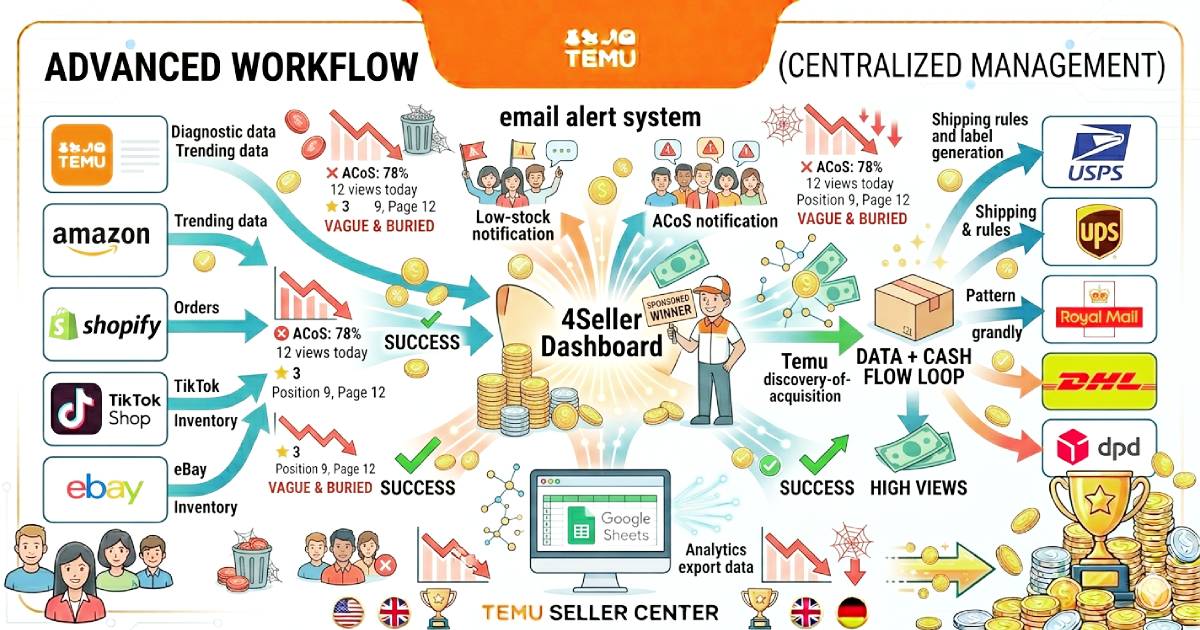
Workflow 3 — Advanced: Multi-Channel, Ads Integration, Analytics (Month 2+)
Who this is for: Sellers running Temu alongside
Amazon, Shopify, TikTok Shop, and/or eBay, doing 100+ orders per day, wanting a
single system that manages the entire operation.
Tools needed: 4Seller (premium) + Temu Seller Center
ads + Google Sheets or Looker Studio for reporting
Time to set up: 1–2 weeks (including testing and
verification)
Step 1 — Multi-channel inventory pooling
Connect all sales channels to 4Seller: Temu, Amazon,
Shopify, TikTok Shop, eBay, Walmart — whichever apply. Set master inventory
levels at the product/SKU level. Allocate channel-specific inventory pools with
automatic rebalancing when one channel depletes faster than another.
Sellers running this configuration report significantly
reduced manual intervention across regions, with inventory synchronization
operating reliably across all connected channels without ongoing maintenance.
Step 2 — Build channel-specific pricing rules
Use 4Seller's price sync with differentiated rules: Temu
gets price tier A (competitive), Amazon gets price tier B (premium), Shopify
direct gets price tier C (highest — no marketplace fee). When you change a
sourcing cost or want to run a promotion, the price update cascades correctly
to each channel according to its rule, not uniformly across all.
Step 3 — Create an ACoS monitoring system
This is a semi-automated setup rather than fully automated.
Build a Google Sheet that pulls Temu ad campaign data (manually exported weekly
from Temu Seller Center) and automatically calculates ACoS, break-even ACoS,
and total ACoS (including organic sales) for each campaign. Use conditional
formatting to flag any campaign running more than 10 points above break-even
ACoS in red. The system does not adjust bids automatically — that remains a
human decision — but it makes the decision obvious and fast.
Step 4 — Cross-channel reporting dashboard
Use 4Seller's analytics alongside Shopify's native reporting
and Amazon Seller Central to build a weekly cross-channel view: total revenue
by channel, total units sold by channel, average margin by channel, and total
ad spend as a percentage of total revenue. This is the report that tells you
where to invest more and where to pull back — across all channels
simultaneously rather than in siloed views.
Step 5 — Automate compliance calendar reminders
For EU and UK sellers: set calendar automation for
compliance document renewals. VerpackG registration annual renewal, EU
Authorized Representative appointment renewal, CE marking test report expiry,
VAT return filing deadlines. Use Google Calendar with recurring annual
reminders set 60 days before each deadline. This is not sophisticated software
— it is the simplest automation that prevents the most expensive compliance
mistakes.
What this workflow automates: Full multi-channel
operations, pricing, reporting, compliance reminders Time saved: 4–6
hours daily at 100+ orders/day Monthly ROI at 100 orders/day:
Approximately 120–180 hours saved per month

Country-Specific Automation Notes
🇺🇸 United States
— Local Fulfillment Sync is the Priority
The most important automation investment for US local
sellers in 2026 is not listing sync or order consolidation — it is the tracking
upload automation that directly protects your delivery metrics.
ToolE and 4Seller both support instant import of US orders
into Shopify back-office in real-time, with advanced tracking technology for
fulfillment and cancellation processing. At the volume levels where US local
sellers are operating, manual tracking upload is the first metric that breaks —
and the first metric Temu's system penalizes.
For INFORM Act compliance, ensure your automation tools do
not strip business address information from order records. US sellers at or
above the $20,000 annual revenue threshold need verifiable business information
on file — automation should preserve this data, not obscure it.
Recommended US starter stack: Temu Official Shopify
App (if Shopify-only) or 4Seller (multi-channel) + ShipBob integration for 3PL
sellers.
🇬🇧 United Kingdom
— Royal Mail Integration Critical
UK automation priorities: carrier integration with Royal
Mail and DPD for 48-hour delivery commitment, and tracking upload timing. UK
buyers have low tolerance for delivery uncertainty, and the fastest path to a
negative UK review is a tracking number that does not update.
4Seller supports Royal Mail integration directly, making it
the strongest UK automation choice for local sellers. Set your shipping rules
to default Royal Mail 48 for standard orders and DPD next-day for any order
flagged as high-value or fragile.
For WEEE and Battery Directive compliance: build annual
renewal calendar reminders alongside your VAT return schedule. These compliance
cycles are annual and easy to automate as calendar events — the documentation
itself is not automatable, but the reminder certainly is.
🇩🇪 Germany — VAT
Automation Deserves Serious Investment
Germany's VAT compliance complexity creates a genuine case
for dedicated VAT automation software — specifically OSS filing automation and
German VAT return management. Tools like Taxdoo, Avalara, or hellotax integrate
with Shopify and can automate EU VAT calculation, OSS quarterly filing
preparation, and VerpackG reporting data collection.
These tools are not free — they range from €50–€200/month
depending on transaction volume and feature tier — but the alternative is
manual VAT calculation across multiple EU markets with German tax authority
filing deadlines. The cost-benefit calculation is straightforward for any
seller with meaningful German volume.
The listing automation caution for Germany: AI-generated
German translations are consistently poor quality for the compound-noun keyword
structure that German search requires. As covered in our [Listing Optimization
Tutorial], German listings need to be rebuilt from scratch in German — not
translated by an AI tool. Use automation for operational workflows in Germany,
but keep listing content under human control.
🇦🇺 Australia —
AusPost Integration and Carrier Comparison
Australia's primary automation priority is carrier rate
comparison. AusPost retail rates for parcels above 500g are expensive — a tool
that automatically compares AusPost, CouriersPlease, Sendle, and Aramex rates
per shipment and routes to the cheapest option for the destination postcode and
weight band can save AUD $1–$3 per order at scale.
4Seller's carrier comparison functionality covers major US
and EU carriers but has more limited Australian carrier integration as of April
2026. Sellers who need granular AusPost versus Sendle comparison should
evaluate whether a dedicated Australian shipping platform (such as eParcel or a
Sendle API integration) works alongside 4Seller's order management rather than
relying on 4Seller alone for carrier optimization.
Cost vs ROI Examples — Real Numbers
These are hypothetical but realistic calculations based on
tool costs and time savings reported by sellers in 2026.
Scenario 1: Beginner Seller — 30 Orders/Day, Shopify +
Temu
|
Item |
Without Automation |
With Automation |
|
Daily time on inventory updates |
45 min |
0 min |
|
Daily time on order processing |
60 min |
15 min |
|
Daily time on tracking upload |
30 min |
0 min |
|
Total daily operational time |
135 min |
15 min |
|
Monthly time saved |
— |
60 hours |
|
Tool cost (4Seller free tier) |
$0 |
$0 |
|
Value of time saved (at $25/hr) |
— |
$1,500/month |
|
Overselling incidents (avg/month) |
3–5 |
0 |
|
Cost of overselling (returns + metric damage) |
~$150–$300 |
$0 |
|
Total monthly ROI |
— |
$1,650–$1,800 |
Scenario 2: Intermediate Seller — 70 Orders/Day,
Multi-Channel
|
Item |
Without Automation |
With Automation |
|
Daily operational time |
4.5 hours |
45 min |
|
Monthly time saved |
— |
113 hours |
|
Tool cost (4Seller premium + shipping integration) |
$0–$49/month |
$0–$49/month |
|
Value of time saved (at $25/hr) |
— |
$2,825/month |
|
Shipping rate optimization savings (avg $0.40/order) |
— |
$840/month |
|
Error-related return reduction |
— |
$200–$400/month |
|
Total monthly ROI |
— |
$3,865–$4,065 |
|
Net ROI after tool cost |
— |
$3,816–$4,065 |
Scenario 3: Advanced Multi-Channel Seller — 150
Orders/Day
|
Item |
Cost/Saving |
|
4Seller (multi-channel, premium) |
~$49–$99/month |
|
VAT automation (EU — Taxdoo or equiv.) |
~€100–€200/month |
|
ShipBob 3PL integration (US) |
Per-unit — no software fee |
|
Daily time saved vs. manual operation |
5–7 hours |
|
Monthly time saved |
150–210 hours |
|
Value of time saved (at $30/hr) |
$4,500–$6,300/month |
|
Shipping optimization savings |
$1,800–$2,500/month |
|
Total monthly ROI |
$6,300–$8,800 |
|
Net ROI after all tool costs |
$6,050–$8,500 |
Common Pitfalls and Best Practices
Pitfalls That Can Trigger Suspension or Metric Damage
Setting up inventory sync without testing it first.
The worst time to discover your sync tool is not working is when you have 200
Temu orders in a queue for a product that actually has 0 stock on your shelf.
Before going live with any sync tool, manually reduce stock by 1 unit in your
master system and verify the change propagates to Temu within 60 seconds. Do
not skip this test.
Using AI-generated listing content without human review.
4Seller's AI generates market-trend-based titles and descriptions. These are
useful starting points — not finished listings. AI-generated descriptions are
consistently reviewed as less accurate and less specific than human-written
content. Before any AI-generated listing goes live, run it through the [Listing
Optimization Tutorial] checklist. Publishing AI descriptions unreviewed is how
you end up with listings that fail Temu's content requirements or mislead
buyers — both of which generate returns and metric damage.
Over-automating and under-monitoring. Automation does
not eliminate the need for the weekly monitoring routine from our [Scale
Without Suspension] guide — it changes what you monitor. Your ODR and LSR still
need weekly checks. Your listing visibility still needs manual verification.
What automation removes is the manual processing work. The strategic oversight
remains human.
Applying the same pricing automation rules across all
markets. A pricing rule that maintains 30% margin in the US market may
deliver 8% margin in Germany once VAT (19%), VerpackG compliance costs, and
local fulfillment are factored in. Build market-specific pricing rules, not
universal ones.
Connecting automation before your listings are optimized.
Automation amplifies your current state. If your current listings have weak
titles, poor images, and missing attributes, automating them across more
channels or at higher speed just distributes those problems faster. Optimize
listings first, automate second.
Best Practices
Start with one tool and one workflow. The temptation
when discovering automation is to set up everything simultaneously. This
creates a debugging nightmare when something breaks — because you cannot
isolate which tool caused the problem. Set up inventory sync first. Verify it
works for 48 hours. Then add order import. Then add label generation. Each
layer sequentially.
Maintain a "manual override" day monthly.
Once a month, process 20–30 orders manually — not because the automation is
failing, but to maintain your understanding of what the automation is doing.
Sellers who have never manually processed an order in six months often discover
their automation has been silently misbehaving in ways the dashboard does not
obviously surface.
Version control your pricing rules. Every time you
change a pricing rule in your automation tool, document it: what you changed,
why, and what you expected it to do. This creates a change log that makes
debugging significantly faster when a margin problem appears three weeks later
and you cannot remember what you adjusted.
Future-Proofing Your Automation Setup for Late 2026
Three developments to watch for in the second half of 2026
that will affect automation strategy:
Temu's API expansion. Temu's API currently covers
products, orders, inventory, and fulfillment data. Reports from developer
communities suggest expanded API endpoints for advertising data — which would
enable true automated ACoS-based bid adjustment rather than the semi-manual
approach currently required. If this releases in H2 2026, the ads automation
gap in the current tool ecosystem closes significantly.
EU VAT compliance automation improvements. The
combination of the €3 parcel duty (July 1, 2026), potential additional handling
fees, and ongoing OSS scheme evolution will drive rapid improvement in
EU-focused VAT automation tools. The tools that exist today were built for a
pre-€3-duty world. Expect better automation specifically for the new customs
duty calculation and filing requirements in H2 2026.
AI listing optimization tools. The current generation
of AI listing tools generates competent but generic content. By H2 2026,
several tools are expected to release market-specific keyword generation that
understands German compound-noun structure, UK English versus US English distinctions,
and Temu's specific algorithm signals. When this generation of tools arrives,
AI-assisted listing creation will require less human correction — but not zero.
Your Temu Automation Starter Stack + Action Checklist
Recommended Starter Stack by Stage
|
Stage |
Monthly Orders |
Core Tool |
Add-On |
Monthly Cost |
|
Beginner |
Under 600 |
4Seller (free) + Temu Shopify App |
— |
$0 |
|
Intermediate |
600–3,000 |
4Seller (premium) |
ShipBob (US) or Royal Mail integration |
$0–$99 |
|
Advanced (EU/UK) |
3,000+ |
4Seller (premium) + Taxdoo/Avalara |
VAT compliance automation |
$100–$299 |
|
Advanced (US) |
3,000+ |
4Seller (premium) + ShipBob |
Carrier rate comparison |
$49–$149 |
Your Automation Action Checklist
Week 1 — Foundation
- ☐
Choose your core tool (4Seller recommended for multi-channel; Temu Shopify
App for Shopify-only)
- ☐
Install and connect Temu Seller Center to chosen tool
- ☐
Map existing products between platforms
- ☐
Enable inventory sync
- ☐
Run the 60-second sync verification test
- ☐
Set inventory buffer rules per channel
Week 2 — Order Processing
- ☐
Configure unified order dashboard
- ☐
Connect carrier accounts (USPS/UPS/Royal Mail/DHL as applicable)
- ☐
Set shipping rules by weight, destination, and service level
- ☐
Enable automated tracking upload to Temu
- ☐
Test end-to-end: place a test order, fulfill it, verify tracking uploads
automatically
Week 3 — Monitoring and Alerts
- ☐
Set low-stock alerts at 14-day threshold for all active SKUs
- ☐
Build weekly ACoS monitoring sheet (Google Sheets)
- ☐
Set compliance calendar reminders for EU/UK sellers (VerpackG, GPSR, VAT
deadlines)
- ☐
Schedule monthly "manual override day" in calendar
Month 2+ — Scale
- ☐
Add additional sales channels to unified dashboard (Amazon, TikTok Shop,
eBay)
- ☐
Build channel-specific pricing rules
- ☐
Evaluate VAT automation tool if EU volume justifies it
- ☐
Review automation performance: time saved vs. expected, error rate vs.
manual baseline
Conclusion
Automation on Temu in 2026 is not about replacing judgment
with software. It is about eliminating the operational work that consumes the
hours your judgment needs to operate effectively — the inventory updates, the
label generation, the tracking uploads, the channel-switching.
Sellers who have implemented proper Temu automation report
75% reduction in admin work, 90% faster order processing, and the ability to
scale without adding staff. Those are not marginal improvements. That is the
difference between a business that scales and one that adds complexity at the
same rate it adds revenue.
The starting point is simpler than most sellers expect.
4Seller's core functionality is free, the official Temu Shopify App is free,
and the inventory sync that protects your most critical metric — ODR — can be
operational in under four hours from now.
Start with the foundation. Verify it works. Add layers. The
ceiling you hit manually does not exist in an automated operation.
Next in the ApexBin series: We will be covering Temu's Flash Sale and Lightning Deal system — how to qualify, when to use them for velocity boosts versus when they compress margins too far, and the exact promotional calendar strategy that winning Temu sellers are running in Q3 2026. Subscribe to ApexBin to receive it as soon as it publishes.
Work with ApexBin
Want your Temu store set up and managed properly?
Muhammad Mustafa has over three years in Amazon advertising and five Amazon certifications, working with sellers across the US, UK and UAE.
Temu Store Setup & Management →






Blog Comments (0)
No comments yet. Be the first to comment!