





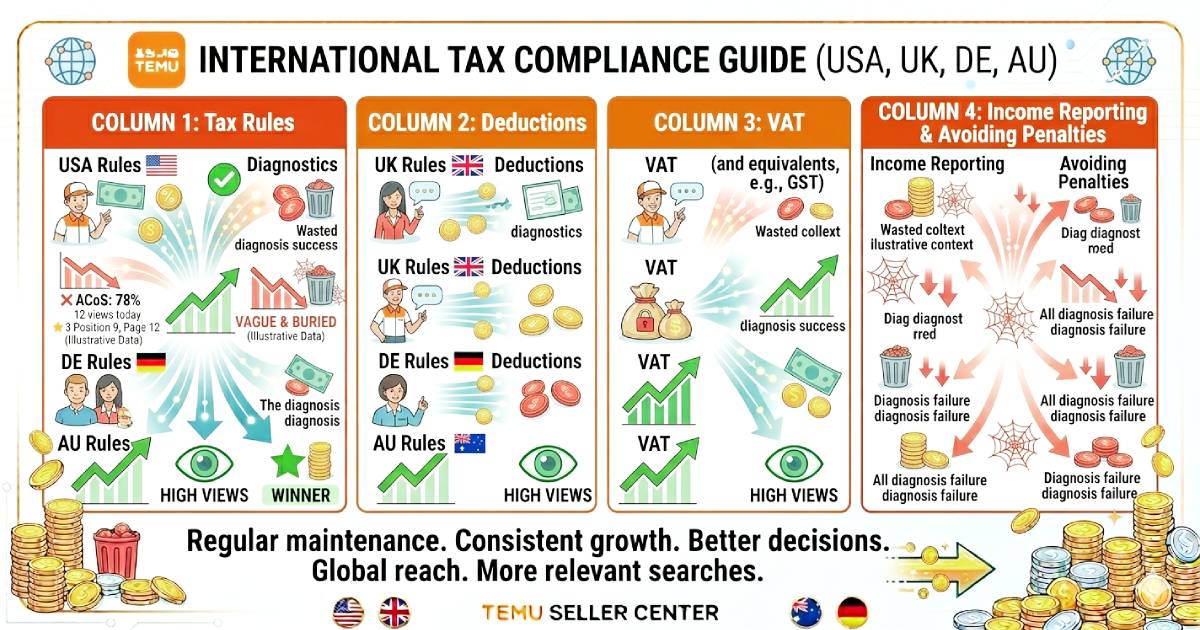
Temu Seller Taxes 2026: Complete Guide to Tax Rules, Deductions, VAT, Income Reporting & Avoiding Penalties (USA, UK, Germany & Australia)
There is a knock on the door that every successful
e-commerce seller dreads. It doesn’t come from an angry customer or a copycat
competitor undercutting your prices. It comes in the form of an official,
high-penalty notice from the IRS, HMRC, or a European tax authority.
When you start scaling your Temu business, it’s easy to get
completely blinded by topline numbers. You see the sales graphs climbing, your
local warehouse fulfillment humming, and your ad campaigns finally hitting a
sweet conversion loop. But behind every single transaction, a silent tracking
mechanism is running.
In 2026, tax authorities across the globe have completely
caught up to the hyper-growth of Temu. Legislative updates like the One Big
Beautiful Bill Act (OBBBA) in the United States and the newly enacted €3
per-item import duty in the European Union have fundamentally reshaped how
e-commerce revenue is tracked, verified, and taxed. If you are treating your
Temu store like an informal, untracked side hustle, you are stepping directly
onto a tax landmine.
The Reality Check: Taxes feel incredibly
overwhelming, but they don't have to be. Ignoring them will kill your business;
systemizing them will save your margins.
Before we dive into the raw mechanics, a quick
professional disclaimer: I am an expert e-commerce operations mentor, not a
certified public accountant (CPA) or a registered tax attorney. Tax laws change
rapidly, and your specific corporate structure changes your obligations. Always
consult a certified professional in your local jurisdiction before making final
financial filings.
Let’s break down exactly how Temu interacts with tax
authorities, how to legally optimize your business write-offs, and what you
need to do in May 2026 to ensure you keep every single dollar, pound, and euro
you rightfully earned.
Temu Tax Basics: How Your Earnings Are Monitored
A common point of confusion for new merchants is assuming
that because Temu handles the front-end checkout payment collection, your
backend earnings are invisible to the government. This is an incredibly
dangerous mistake.
Temu operates as a registered corporate marketplace entity.
To maintain its operating licenses in western regions, it must share data.
The Paper Trail: What Is Reported
When you register your seller profile, you submit an
Employer Identification Number (EIN), Social Security Number (SSN), VAT
Registration Number, or local business tax ID. From that exact second, your
store's lifetime gross revenue is linked to your legal identity.
At the end of the fiscal year, Temu compiles your total
sales volume—including the money you refunded to customers and the fees
deducted for platform use—and forwards this aggregate data directly to your
local revenue authority.
When Do You Officially Become a "Business"?
Many casual hobbyists believe they don't need to report
their earnings until they establish a formal corporate structure like an LLC.
Tax authorities view this completely differently. The second you list an item
with the intent to generate a recurring net profit, you are legally operating
as a Sole Proprietorship / Sole Trader. Every dollar of net income
generated from that point forward is subject to standard income reporting
rules.
Country-Specific Tax Rules (2026 Operational Updates)
Tax compliance changes significantly depending on where your
inventory is stored and where your customers reside. Let’s break down the exact
operational parameters for our four core global markets.
United States: The Reverted 1099-K Landscape
The US tax environment underwent an absolute rollercoaster
over the last few seasons regarding third-party marketplace reporting
thresholds. The previously proposed, highly intrusive $600 federal threshold
was repealed. Following the passage of the OBBBA, the IRS officially stabilized
the reporting framework.
- The
Federal 1099-K Threshold: Temu will issue you a Form 1099-K federally
only if your gross payment volume exceeds $20,000 AND you clear more
than 200 individual transactions within the calendar year. Both
conditions must be met.
- The
State-Level Catch: Be incredibly careful here. Individual states have
independent reporting floors. States like Massachusetts, Vermont, and
Virginia still mandate marketplace reporting at a flat $600 threshold,
completely independent of the federal floor.
- Self-Employment
Tax: If your clean net profit from your Temu store clears $400 or
more, you must file Schedule C and pay self-employment tax (currently 15.3%
to cover Social Security and Medicare) alongside standard federal and
state income brackets.
United Kingdom: Making Tax Digital Enforcement
The UK continues to tighten its digital sales monitoring
network via HMRC’s aggressive implementation of advanced tracking systems.
- Income
Tax Brackets: If you operate as a Sole Trader, you can earn up to
£1,000 tax-free under the generic Trading Allowance. Once your gross sales
clear this point, your full net profit must be reported via an annual Self
Assessment tax return.
- The
VAT Registration Threshold: For the 2026/2027 fiscal year, the UK VAT
registration threshold stands firmly at £90,000 in rolling 12-month
taxable turnover. If your Temu store clears this volume, you must register
for VAT and submit digital records through HMRC-approved software under
the Making Tax Digital (MTD) protocol.
Germany: The Absolute Compliance Zone
Germany represents one of Temu's highest-margin regions, but
it features zero flexibility regarding tracking.
- Value
Added Tax (Umsatzsteuer): The standard VAT rate in Germany is 19%.
Under EU marketplace facilitator frameworks, Temu handles the collection
of this tax on standard B2C cross-border imports, but local domestic
fulfillment requires clean internal bookkeeping.
- Trade
Tax (Gewerbesteuer): If your Temu operation is formally registered as
a local German commercial enterprise (Gewerbe), you are subject to
local trade tax if your net profit exceeds the statutory allowance of €24,500.
- The
GPSR Compliance Matrix: In addition to pure fiscal taxes, Germany
heavily penalizes entities failing to adhere to General Product Safety
Regulation (GPSR) reporting requirements. The costs of maintaining
registered EU product representatives are a vital operating deduction.
Australia: GST & BAS Tracking
The Australian Taxation Office (ATO) treats digital
marketplace entities with the same scrutiny as traditional brick-and-mortar
storefronts.
- Goods
and Services Tax (GST): The Australian GST rate is a flat 10%.
If your overall e-commerce business turnover clears $75,000 AUD
within any consecutive 12-month window, you are legally required to
register for GST.
- Business
Activity Statements (BAS): Once registered for GST, you must file
regular BAS reports (usually quarterly) to declare your intake and claim
back credits for the GST you paid on domestic business expenses, such as
local 3PL warehousing and shipping materials.
At-A-Glance: Global Temu Tax Obligations
|
Country |
Core Reporting Document |
Major Threshold to Memorize |
Standard Sales Tax / VAT |
Local Fulfillment Risk |
|
United States |
Form 1099-K / Schedule C |
$20,000 revenue + 200 transactions (Federal floor) |
Varies by state (Facilitated by Temu) |
Creates physical sales tax Nexus in state where 3PL sits. |
|
United Kingdom |
Self Assessment Return |
£90,000 turnover (VAT registration mark) |
20% Standard VAT |
Non-UK residents face immediate £0-threshold VAT rules. |
|
Germany |
Einkommensteuererklärung |
€24,500 net profit (Trade Tax exemption floor) |
19% Standard Umsatzsteuer |
Tax IDs must perfectly match your Temu Portal certificate. |
|
Australia |
Business Activity Statement |
$75,000 AUD turnover (GST mandate point) |
10% Flat GST |
Requires Australian Business Number (ABN) linkage. |
Common Deductions Temu Sellers Can Claim
Here is where you save your margins. You do not pay income
taxes on your overall gross revenue; you pay taxes on your net profit.
To shrink your tax bill legally, you must document every single legitimate
expense involved in running your storefront.
Let's look at the primary deduction categories that you can
write off against your Temu revenue.
1. Cost of Goods Sold (COGS)
This is your largest deduction. It encompasses the raw
wholesale price paid to your manufacturers for your inventory units. Crucially,
this deduction also includes bulk overseas factory shipping costs, customs
clearing fees, import tariffs, and freight forwarding expenses required to
position inventory at your distribution points.
2. Fulfillment, Warehousing, & Logistics
Every fee paid to pick, pack, and transport a product to an
end consumer is an immediate deduction.
- Domestic
shipping label costs generated through local carrier networks.
- Monthly
storage space rents, intake pallet fees, and outbound pick fees charged by
third-party logistics (3PL) providers.
- Packaging
materials, including custom-branded cardboard mailers, protective bubble
wrap, thermal shipping labels, and product safety insert cards.
3. Marketing & Platform Costs
Operational costs deducted directly by Temu or spent
externally to scale sales velocity are entirely deductible.
- Temu
Inside Ads spend and promotional marketing budget allocations.
- Platform-retained
service fees or commissions sliced out of your transaction totals.
- External
traffic ad spend distributed across TikTok Ads, Instagram Reels campaigns,
or Google Search pipelines.
4. Software, Tools, & Digital Services
The monthly digital infrastructure keeping your business
operational forms an immediate operational expense write-off.
- E-commerce
analytics platforms, product research spy software, and keyword
optimization tools.
- Cloud
accounting packages like QuickBooks, Xero, or specialized sales tax
tracking modules.
- AI
subscription platforms used directly to draft script templates, enhance
listing images, or optimize descriptions.
5. Workspace & Overhead Deductions
If you manage your Temu operations from a home office or a
dedicated workspace, you are eligible to claim specialized overhead write-offs.
- The
Home Office Deduction: A proportional calculation of your rent,
mortgage interest, utilities, and internet connectivity based on the exact
square footage dedicated exclusively to managing store logistics.
- Professional
Fees: Retainer costs and filing fees paid to accountants, bookkeepers,
registered corporate agents, or intellectual property attorneys managing
your trademark registrations.
Real-World Deduction Math: Saving a $100k Store
Let's look at how utilizing clean expense tracking
transforms an intimidating tax scenario. Imagine a mid-tier Temu store
operating in the US that brings in $100,000 in gross revenue over the
course of the fiscal year.
$$\text{Taxable Income} = \text{Gross Revenue} - \text{Total
Allowable Deductions}$$
Without systematic tracking, this seller might fail to claim
their true operational expenses, leading to massive financial loss.
[Add Table Screenshot Here: A detailed breakdown comparison
chart.
Column A: "The Untracked Strategy" showing
$100,000 gross revenue with only basic $40,000 factory sourcing tracked,
leaving a massive $60,000 exposed to standard self-employment and income tax
brackets.
Column B: "The Systematized Strategy" showing the
exact same $100,000 gross revenue but fully deducting $40,000 COGS, $15,000 3PL
logistics fees, $12,000 ad spend, $2,400 software, and $3,000 home office
space—successfully dropping the net taxable income down to a clean, stress-free
$27,600.
By systematically proving your secondary operating
deductions, you legally drop your taxable income by $32,400. Assuming a
conservative blended tax bracket of 25%, this simple act of organized
record-keeping prevents you from accidentally overpaying $8,100 in
unrecoverable cash to the government.
VAT & Sales Tax Deep Dive: The Front-End Flow
Sales tax and Value Added Tax represent a massive point of
friction because they occur on the front-end of the transaction. Thankfully,
modern marketplace legislation offers significant protection to independent
merchants.
Marketplace Facilitator Laws: Your Shield
In the USA, UK, Germany, and Australia, Temu is legally
recognized as a Marketplace Facilitator. This means that when a consumer
clicks "Buy Now" on your listing, Temu’s internal payment engine
automatically calculates the precise local sales tax or regional VAT rate based
on the buyer's shipping address. Temu adds that tax amount to the customer's
total invoice, collects it directly, and remits it straight to the respective
government agency.
Warning Box: While Temu automatically collects sales
tax on cross-border transactions, if you utilize the Temu Local Seller
Program and place inventory inside a physical 3PL warehouse in a state like
California or Texas, you may establish a local physical Nexus. This can
require you to register a state sales tax license and file zero-dollar
informational returns even if Temu handles the physical cash collection.
The July 2026 EU Customs Shift: The €3 Parcel Realignment
If you are shipping goods into the European Union, you must
understand the major structural reform taking effect on July 1, 2026.
The long-standing €150 customs duty exemption for low-value
import parcels entering the EU is officially abolished. To manage the massive
volume of incoming e-commerce parcels, the EU has established a transitional
flat-rate duty of €3 per item on all shipments valued below €150,
provided the transaction VAT is settled via the Import One-Stop Shop (IOSS)
mechanism.
This change does not impact your front-end consumer VAT
calculations directly, but it adds a fixed operational cost per physical item
inside your shipping profiles. You must factor this €3 fee directly into your
pricing logic to ensure your backend net margins aren't quietly eaten alive by
import friction.
Record Keeping & Accounting Best Practices
The absolute worst time to organize your financial records
is the night before tax filings are due. Sifting through twelve months of mixed
bank statements looking for an anonymous factory wire transfer is a recipe for
missed deductions and extreme stress.
The Simple Monthly Bookkeeping Workflow
To keep your store audit-proof without losing hours of
operational time, execute this three-step checklist on the first day of every
single month:
1.Isolate Your Financial Pipelines:Prerequisite Step.
Open a dedicated business checking account and an isolated
credit card line exclusively for your Temu operations. Never purchase personal
groceries and factory inventory using the same card. This clean separation
protects your corporate liability and simplifies data tracking.
2.Extract Backend Statement Reports:Execute Monthly.
Download your monthly transaction summaries directly from
the Temu Seller Central backend. These files contain your total gross sales,
processing fees, and ad campaign spend. Match these platform figures directly
against incoming deposits hitting your business bank account.
3.Match and File Digital Receipts:Execute Monthly.
Upload your raw manufacturing invoices, 3PL storage bills,
and digital software receipts into a cloud-based folder system (e.g., Google
Drive, Dropbox). Link these documents directly inside accounting software like
QuickBooks or Xero to create a clean ledger trail.
Common Tax Mistakes That Cost Temu Sellers Fortune
Many promising businesses fail not because their products
are poor, but because they commit easily avoidable structural errors with their
accounting logic.
- Under-Reporting
Total Gross Volume: Some sellers try to hide revenue by reporting only
the clean net cash deposited into their bank accounts. Tax authorities
receive the raw 1099-K or platform data showing your gross
performance before platform fees. If your reported tax return numbers
don't perfectly match the data sheet sent over by Temu, your return
triggers an automatic algorithmic flag for an audit.
- Forgetting
to Track Returned Inventory Costs: When a buyer returns a product, you
lose the retail sale value. But what happened to the physical unit? If the
item was broken and disposed of by the warehouse, that unit’s original
manufacturing cost shifts from inventory asset value directly into a deductible
business loss. If you fail to track write-offs for destroyed returns, you
are paying taxes on inventory that no longer exists.
- Ignoring
Cross-Border Currency Conversion Fees: If you sell in Europe or
Australia but your main corporate bank account operates in US Dollars,
your payment processors charge a conversion margin fee on every payout
transfer. These minor fractions add up to thousands of dollars across a
high-volume year. These fees represent an immediate operational deduction
that must be claimed.
Working with Accountants: A Cost-Benefit Analysis
You do not need to hire an expensive full-time corporate
accountant when your store is making a few hundred dollars a month. But as you
scale, trying to manage cross-border sales configurations, domestic warehouse
tax boundaries, and complex corporate deductions by yourself becomes a massive
operational liability.
When Is It Time to Hand Over the Reins?
As a general rule of thumb, look to engage a professional
e-commerce accountant the exact second your store clears $50,000 in gross
annual sales volume. At this scale, the risk of a single filing error
costing you thousands in back-taxes and compliance penalties completely
outweighs the cost of professional support.
What to Ask an E-Commerce Accountant Before Hiring
Not all tax professionals understand the intricate nuances
of digital marketplaces. When interviewing a potential CPA or local tax
advisor, ask these three specific screening questions:
- “Do
you have active experience working with sellers operating on high-volume
marketplace facilitator platforms like Temu or Amazon?”
- “How
do you traditionally handle the integration of multi-currency payouts and
local warehouse fulfillment nexus compliance?”
- “Are
you familiar with tracking cost of goods sold (COGS) across high-frequency
manufacturing order batches shipped from overseas?”
Your 2026 Tax Compliance Action Plan
To ensure your Temu enterprise remains fully compliant and
highly optimized for profit preservation, check off these steps systematically
across the operating year:
- [ ] Verify
Account Metadata: Confirm that your legal business name, registered
tax ID (EIN/VAT/ABN), and banking details perfectly match across both your
official government business registration filings and your Temu Seller
Portal certificates.
- [ ] Establish
a Separate Financial Pipeline: Ensure 100% of store expenditures flow
through isolated business banking cards, keeping personal transactions
completely removed from business records.
- [ ] Configure
Digital Cloud Storage: Create dedicated folders organized by fiscal
year to safely preserve manufacturing invoices, customs entry clearance
sheets, and local 3PL warehousing statements for a minimum of 5 to 7 years
depending on local law.
- [ ] Monitor
Rolling Regional Turnover: Track your 12-month trailing gross sales
volume against localized thresholds, such as the UK’s £90k VAT
registration ceiling or Australia’s $75k GST mark, to ensure you register
for relevant tax programs well before passing the legal deadlines.
- [ ] Schedule
Quarterly Performance Audits: Review your net profit margin
calculations at the end of every quarter, factoring in platform fees,
actual ad spend, and inventory losses to estimate your tax payments
accurately.
Over to You: What is Your Biggest Tax Bottleneck?
Taxes can feel like a heavy weight, but once you break down
the numbers, establish an isolated bank line, and build a consistent monthly
tracking habit, you unlock true peace of mind. Knowing your exact net positions
allows you to make aggressive scaling decisions without fearing an unexpected
end-of-year tax bill.
Let’s get a conversation going in the comments below: Which country are you currently operating your Temu storefront from, and what is the single biggest tax rule or deduction puzzle currently holding your operational momentum back? Drop your scenario, and let's map out the answer!
Work with ApexBin
Want your Temu store set up and managed properly?
Muhammad Mustafa has over three years in Amazon advertising and five Amazon certifications, working with sellers across the US, UK and UAE.
Temu Store Setup & Management →








Blog Comments (0)
No comments yet. Be the first to comment!