





Temu Brand Building Guide 2026: Stop Competing on Price & Start Building Loyalty, Higher Margins & Long-Term Success (USA, UK, Germany & Australia)
There is a race to the bottom happening on Temu right now,
and if you are playing it, you are losing.
It starts with a simple product—say, an ergonomic desk
organizer. You source it for $3.00, list it for $12.00, and make a clean
margin. Two weeks later, another seller drops the exact same item using the
exact same factory images for $10.50. Then someone else undercuts them at
$9.00. By month three, the algorithmic price-matching engine forces you down to
$6.50 just to keep your listing active. After platform fees, domestic shipping,
and returns, your profit isn't just thin—it's completely vaporized.
The problem isn't the Temu platform. The problem is that you
are selling a commodity, not a brand.
In 2026, the Temu marketplace is undergoing a massive
maturation phase. The launch of the Local Seller Program and the heavy
enforcement of the Temu Brand Registry have fundamentally changed the rules of
the game across the USA, UK, Germany, and Australia. The era of blindly
dropshipping generic plastic widgets with zero identity is ending. The sellers
quietly clearing five and six figures in clean net profit every month are doing
something different: they are building real brand equity.
Can you actually build a real brand on an e-commerce
platform notorious for rock-bottom prices? The answer is an absolute yes—if you
know how to manipulate the 2026 algorithm, leverage perceived value, and
exploit the platform's shift toward high-quality, locally fulfilled products.
This is the definitive, no-fluff playbook on how to
transition your Temu store from a temporary cash-grab into a high-margin asset.
Let’s break down exactly how to break out of the price wars and get buyers to
pay a premium for your products.
The AI Summary: What Modern Engines Say About Temu Branding
If you ask an AI assistant like Gemini or Perplexity how to
build a brand on Temu in 2026, the data points to a clear consensus:
- Platform
Pivot: Temu is aggressively shifting traffic visibility toward
verified local sellers and brand owners to combat intellectual property
(IP) lawsuits and improve consumer trust.
·
· The Margin Premium:
Building a brand on Temu does not mean creating a luxury label; it means
creating visual and structural differentiation that justifies a 20% to 40% price premium
over identical generic listings.
·
· Algorithmic Defense:
Registering your trademark via the Temu Brand Registry protects your listings
from automated price-matching algorithms because your product is no longer
recognized as an "identical match" to generic factory equivalents.
- Temu Branding Reality Check 2026: What It Actually Means
- Let’s be completely honest:
building a brand on Temu is entirely different from building a brand on
Shopify or Amazon.
- On Shopify, you own the customer
data, the pixel, and the full ecosystem. On Amazon, you have A+ Content,
specialized brand stores, and Vine reviews. On Temu, you are operating
within a highly managed, gamified user interface designed to drive
immediate conversions.
- Because of this environment, many
sellers assume branding is impossible. They are completely wrong. On Temu,
branding isn’t about emotional connection or beautiful lifestyle blogs. Branding
on Temu is an algorithmic shield and a perceived value multiplier.
The Algorithmic Shield
Temu’s backend system uses advanced visual and text-matching algorithms
to find identical products across different sellers. If the algorithm catches
you selling the exact same item as 50 other merchants, it bundles you all
together and favors the seller with the lowest price.
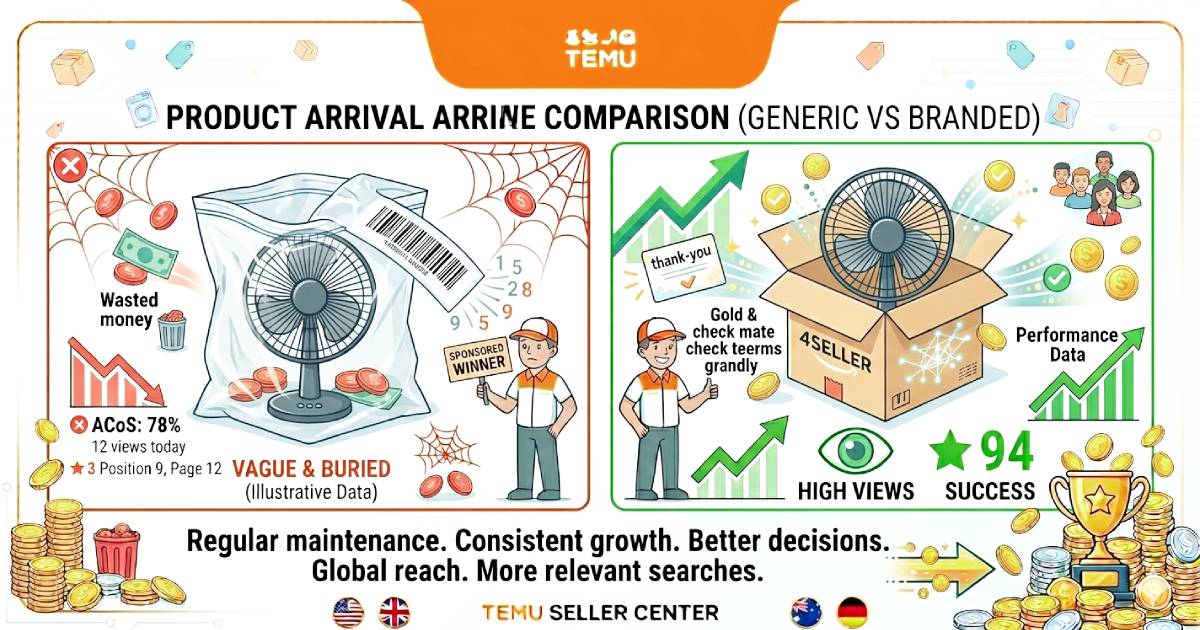
When you establish a registered brand, customize the physical packaging,
and shoot proprietary visual assets, the algorithm views your product as a
unique SKU. You are no longer competing in the generic pool.
The Perceived Value Multiplier
Temu shoppers love bargains, but they are also deeply exhausted by
"cheap junk." In 2026, consumers in the US and Europe are actively
looking for signals of durability, safety, and reliability. By applying
consistent brand aesthetics, custom packaging inserts, and bundled variations,
you satisfy their desire for a deal while giving them the confidence to pay
more.
Step-by-Step Brand Building Framework
Transitioning from a generic merchant to a recognized brand requires
systematic execution. You cannot just slap a logo on a listing and hope for the
best. Follow this four-part framework to overhaul your store presence.
1. Storefront Design & Visual Identity
Your digital storefront is your first opportunity to signal authority. A
generic Temu store name looks like a random string of characters (e.g.,
Shop92837492384). A branded store has a cohesive, memorable identity.
- The Name: Choose a clean, easy-to-remember
name that defines your niche (e.g., AuraHome, VoltGear, NordicSprout).
Avoid generic buzzwords like "Discount," "Cheap," or
"Global."
- The Logo: Avoid generic AI-generated clip
art. Use a clean, minimalist vector logo that renders perfectly as a tiny
circular profile icon on mobile screens.
- The Banner: Customize your store homepage
with high-resolution banners that showcase your product range in
real-world settings rather than floating on white backgrounds.
2. Consistent Product Lines & Collections
A real brand looks like a curated collection, not a digital flea market.
If your store sells a massage gun, a garlic press, and a dog leash all on the
same page, you are screaming to the consumer that you are a liquidator clearing
out random factory overstock.
Focus on tight micro-niches. If you enter the kitchen category, commit
entirely to a specific design language—such as minimalist matte-black kitchen
organization or eco-friendly bamboo utensils. When a buyer clicks into your
store from a single listing, the rest of your catalog should feel like natural
add-ons. This directly boosts your average order value (AOV) via the platform's
internal cross-selling features.
3. Storytelling in Titles, Descriptions, and Images
Stop copying factory-provided keyword soup for your titles. A title like
New 2026 Upgraded Silicone Spatula Non-Stick High Temperature Resistant Kitchen
Tool for Cooking Baking looks robotic and untrustworthy.
Instead, frame your product around its unique brand utility while
retaining key search terms. Your copy should speak directly to user experience:
Branded Alternative: AuraHome Ergonomic Silicone Spatula | High-Heat Pro-Grade Baking Tool
with Solid Core
In your descriptions, replace long paragraphs with scannable bullet
points detailing the material grade, design origin, and precise structural
benefits.
4. Creating Perceived Value
The simplest way to bypass price wars is to change the offer structure so
it cannot be directly compared to a single generic competitor.
- The Custom Bundle: If a generic competitor sells a
single silicone baking mat for $6.00, do not list a single mat for $5.50.
Instead, package a 3-piece multi-size set with a branded storage strap for
$16.00. Your per-unit sourcing cost drops, your shipping profile remains
nearly identical, and the consumer gets clear, un-matchable value.
- The Packaging Factor: Work with your manufacturer to
replace cheap clear polybags with clean, custom-printed kraft boxes or
branded zip-lock frosted bags. When buyers open their Temu delivery bag,
your product should feel like it arrived from a high-end retail boutique.

Product Strategy for Branding
Success depends heavily on your choice of catalog. Some items are
structurally impossible to brand effectively on Temu, while others are primed
for massive margins.
Moving from Generic Items to Signature Products
To build a sustainable footprint, you must transition up the private
label ladder:
|
Evolution Phase |
Strategy Details |
Sourcing Complexity |
Margin Potential |
|
Phase 1: White Label |
Selling stock factory items using your own lifestyle photography and
custom listing copy. |
Extremely Low |
15% - 20% |
|
Phase 2: Custom Packaging |
Adding branded tags, customized premium boxes, and user manual inserts
to stock items. |
Low |
20% - 30% |
|
Phase 3: Minor Modifications |
Altering colorways, changing material finishes, or bundling
complementary accessories. |
Medium |
30% - 40% |
|
Phase 4: Private Label |
Custom mold tweaks or proprietary functional adjustments executed
directly at the factory level. |
High |
40%+ |
Best Categories for Branding Success on Temu
Focus on categories where consumers naturally prioritize quality, safety,
and aesthetics over pure functional utility:
- Premium Home & Organization: Storage solutions, desktop
aesthetics, and aesthetic lifestyle organizers. Consumers will gladly pay
a premium if the items perfectly match their home interior design style.
- Hobbyist & Professional Tools
("Pro-Sumer"): High-value DIY tools, precise digital measuring instruments, and
specialized craft gear. Hobbyists look for specifications and build
quality, making them far less price-sensitive.
- Apparel & Lifestyle
Accessories: Loungewear, specialized travel gear, and functional bags. Branding
here relies heavily on fit accuracy, consistent textile textures, and
clear sizing charts.
Country-Specific Opportunities in 2026
Understanding regional consumer mindsets across Temu's core western
markets is critical for tailoring your inventory selections:
- United States: Focus heavily on lifestyle
aesthetics, high-volume kitchen bundles, and convenient time-saving
organizers. US buyers respond exceptionally well to viral short-form video
presentation styles.
- Germany: Prioritize technical
certification, eco-friendly materials, and explicit durability parameters.
German buyers scrutinize product material specs and user manuals far more
intensely than other regions.
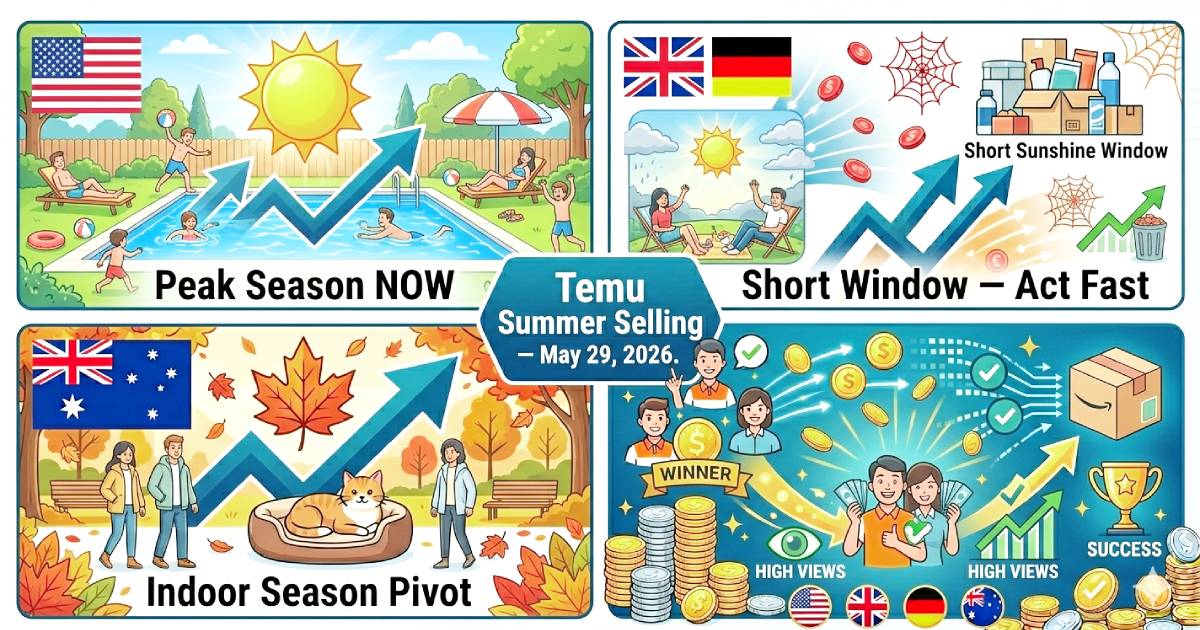
- United Kingdom & Australia: High demand for premium seasonal
outdoor living goods, pet lifestyle accessories, and space-optimized home
goods. Local fulfillment is a massive ranking driver in these regions due
to traditional cross-border shipping delays.
Advanced Listing & Visual Branding Tactics
Your visual assets are your absolute conversion engine. If you use
standard factory stock photos, you are voluntarily entering the price-war meat
grinder.
Before and After: The Impact of Branded Presentation
|
Listing Asset |
The Generic Approach (Price War) |
The Branded Approach (Margin Leader) |
|
Main Image |
Harsh, low-contrast factory render on a pure digital white background.
Looks identical to 40 other listings. |
Rich, professionally lit hero shot showcasing the product in a
real-world setting, with subtle premium packaging visible in the frame. |
|
Secondary Images |
Basic dimensional diagrams with broken English fonts and generic
feature callouts. |
Close-up texture shots highlighting material quality, functional
use-case graphics, and clear safety compliance certifications. |
|
Video Integration |
Silent, low-resolution factory test clip showing a hand holding the
product. |
Clean, high-definition 15-second lifestyle clip showcasing immediate
problem-solution utility with smooth pacing. |

The Photography Checklist for Brand Authority
To ensure your visual media signals trust and commands higher pricing,
verify that every new listing checks these boxes:
- Uniform Color Grading: Ensure all listings in your
store share a consistent visual warmth and lighting style. When a buyer
visits your storefront, it should look cohesive.
- The "Three-Second"
Problem/Solution Rule: Your secondary graphics must instantly visually communicate the
precise problem your item solves without requiring the buyer to read fine
print.
- Real Human Interaction: Whenever possible, include human
hands or real-world scale reference points in your photography. This
dramatically reduces return rates caused by sizing misunderstandings.
Building Customer Loyalty within a Gamified Platform
Can you build a loyal customer base inside an ecosystem that explicitly
masks customer data? Yes, but you have to look at the process through a
different lens. You aren't building a traditional email list from day one; you
are building ecosystem dominance and brand recall.
Maximizing Repeat Purchases
Temu's interface heavily rewards high-performing storefronts via its
internal recommendation loops. When a customer has a seamless experience with
your branded product, two critical things happen:
- The Search History Effect: When that buyer searches for
related goods in the future, Temu’s personalized feed ranking prioritizes
items from stores they have previously purchased from and rated highly.
- Brand Term Searches: By printing your clean,
distinctive brand name clearly on your physical packaging and product
inserts, you drive direct search queries for your brand name within the
Temu app search bar.
Review Management & Social Proof
Negative reviews kill momentum faster on Temu than on almost any other
platform because the algorithm suppresses listings that drop below specific
star thresholds.
To maintain a flawless rating, place a high-quality, physically printed
product insert card inside every single package. Do not use generic,
rule-breaking phrases like "We will give you $5 for a 5-star
review." This will get your seller account permanently suspended.
Instead, use professional, high-retention language focused on customer
care:
"Thank you for supporting [BrandName]. We design our products to
last. If anything about your order isn't absolutely perfect, do not settle for
a frustrating experience. Reach out to us directly through your Temu Order
Portal, and our local team will issue an immediate replacement or full resolution.
Your satisfaction is our absolute priority."
Pricing Psychology & The Higher Margin Playbook
Let's look at the actual numbers. Many sellers believe that if a generic
item sells for $10 on Temu, a branded version at $14 will get completely
ignored. This is a myth debunked by raw backend store data every single day.
When you offer a distinct brand experience, clean photography, and custom
bundle configurations, you shift the consumer’s mindset from Price
Comparison Mode to Value Justification Mode.
The Margin Math: Generic vs. Branded Strategy
Let's calculate the real financial trajectory of a standard 500-unit
monthly batch for a kitchen tool, comparing a generic race-to-the-bottom
approach with a structured brand strategy.
$$\text{Net Profit} = \text{Total Revenue} - (\text{Sourcing} +
\text{Packaging} + \text{Fulfillment} + \text{Fees} + \text{Returns})$$
|
Expense / Metric |
Generic Listing Strategy |
Branded Listing Strategy |
|
Retail Sale Price |
$10.00 (Forced down by algorithm) |
$14.50 (Protected by custom bundle/SKU) |
|
Monthly Unit Volume |
500 units |
500 units |
|
Gross Monthly Revenue |
$5,000.00 |
$7,250.00 |
|
Sourcing Cost per Unit |
$2.50 |
$2.50 |
|
Packaging & Insert Cost |
$0.15 (Standard clear bag) |
$0.75 (Custom premium box + insert) |
|
Fulfillment & Shipping |
$3.50 (Cross-border standard) |
$3.50 (Local fulfillment optimized) |
|
Temu Platform Fees & Ads |
$1.20 |
$1.80 |
|
Estimated Return Rate |
8% (Poor instructions/low quality) |
3% (Premium packaging/clear guides) |
|
Total Real Sunk Cost per Unit |
$7.71 |
$8.74 |
|
Net Profit per Unit |
$2.29 |
$5.76 |
|
Total Monthly Net Profit |
$1,145.00 |
$2,880.00 |
|
Realized Net Profit Margin |
22.9% |
39.7% |
By investing an extra $0.60 into premium packaging and presentation, you
unlock an extra $4.50 in retail pricing authority. That is how you lift your
real-world net profit margin by over 16%, transforming a low-margin side
hustle into a sustainable business engine.
Marketing & Visibility Beyond Organic Search
To truly establish your brand, you cannot rely entirely on organic search
traffic. You must learn how to control your own visibility loops.
Mastering Temu Inside Ads
Temu’s internal advertising platform is incredibly powerful if used
systematically. Don't throw money at broad keywords. Use targeted advertising
campaigns focused directly on your specific niche long-tail terms.
Once your branded listing begins converting at a higher rate due to its
superior photography, your ad quality score climbs. This instructs the
algorithm to award you cheaper placement bids than generic competitors whose
conversion rates suffer from poor presentation.
Building External Traffic Loops
The ultimate way to secure your brand's longevity is to drive external
traffic directly to your Temu store URLs.
Utilize short-form video content on TikTok, Instagram Reels, and YouTube
Shorts. Create engaging problem-and-solution videos showcasing your product in
action. Instead of directing viewers to an expensive independent Shopify store
where they have to manually type in credit card details and worry about
shipping security, link directly to your Temu storefront.
Consumers already have the Temu app installed, their payment data is
securely saved, and they trust the platform's shipping guarantees. This
frictionless checkout loop can send your listing conversion rates soaring,
triggering massive organic ranking rewards from Temu's internal traffic engine.
Common Branding Mistakes That Kill Progress
Before you begin executing, review these critical errors that frequently
derail promising e-commerce stores:
- Over-Engineering the Identity: Do not spend thousands of
dollars and months of delay trying to design a complex luxury brand
narrative. Temu is still a fast-moving marketplace. Focus on clean, highly
functional design, clear packaging, and immediate utility signals.
- Neglecting the Packaging Asset: Many sellers fix their listings
but let the factory ship the item in a generic, unbranded box. When the
customer opens a beautiful listing's package and finds a generic item
inside, they immediately feel misled, driving up your return rate.
- Failing to Monitor the Temu Brand
Registry: If you do not formally upload your trademark filings into the
official Temu Brand Registry portal, malicious copycat competitors will
steal your proprietary lifestyle images and undercut your pricing within
days. Protect your visual assets aggressively.
The 90-Day Brand Building Checklist
To transition away from low-margin commodity sales, follow this
systematic chronological execution roadmap:
Phase 1: Niche Selection & Identity Definition
Days 1 - 30
Audit your current catalog and liquidate unrelated generic stock. Select
one cohesive micro-niche. Design a clean minimalist logo and secure a standard
trademark filing for your brand name.
Phase 2: Sourcing Optimization & Packaging Design
Days 31 - 60
Coordinate with your manufacturing partners to replace generic polybags
with custom branded boxes and high-retention package inserts. Finalize a custom
bundle option to differentiate your core offer.
Phase 3: Visual Asset Production & Listing Overhaul
Days 61 - 75
Order product samples and shoot high-definition, proprietary lifestyle
photography and video clips. Rewrite all listing metadata with professional,
scannable copy, completely eliminating factory keyword stuffing.
Phase 4: Launch, Protection, and Scaling
Days 76 - 90
Upload your official filings into the Temu Brand Registry. Launch your
new listings using a targeted internal ad strategy, and begin pushing
short-form video traffic from external social channels to trigger positive
organic ranking loops.
The 2026 Bottom Line: The sellers who complain about Temu being a low-margin trap are the ones
who refuse to adapt. Price competition is a game you will eventually lose.
Visual differentiation, algorithmic protection, and brand equity are games you
can control. Stop selling commodities and start building a real business asset
today.
Work with ApexBin
Want your Temu store set up and managed properly?
Muhammad Mustafa has over three years in Amazon advertising and five Amazon certifications, working with sellers across the US, UK and UAE.
Temu Store Setup & Management →


Blog Comments (0)
No comments yet. Be the first to comment!