





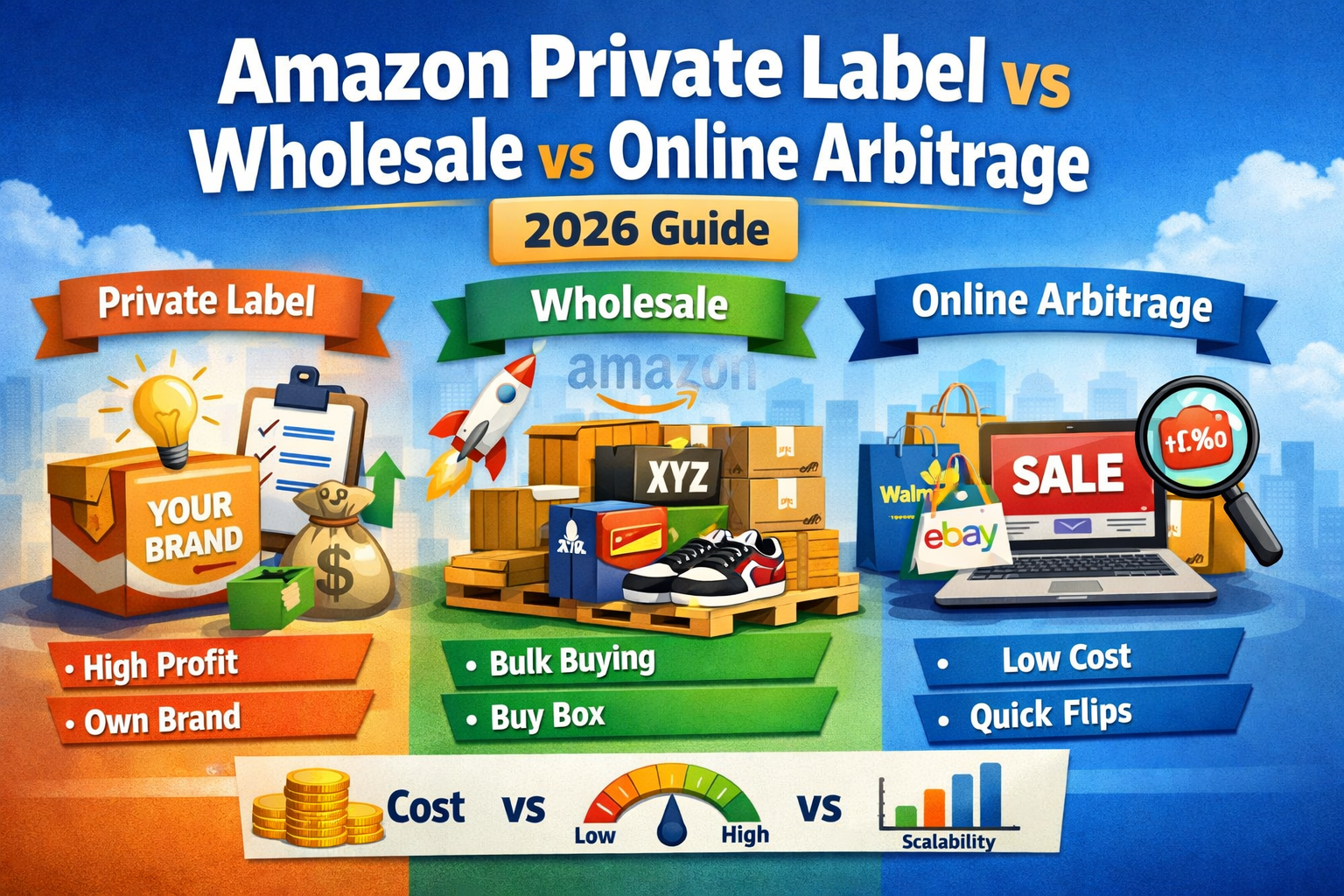
Amazon Private Label vs Wholesale vs Online Arbitrage: Which Business Model Is Best in 2026?
If you're looking to make money on Amazon, you've probably come across three popular business models: Private Label, Wholesale, and Online Arbitrage. Each comes with its own pros, cons, startup costs, and risk levels.
In this guide, we’ll break down Amazon private label vs wholesale vs online arbitrage so you can decide which model fits your goals, budget, and experience level.
What Is Amazon Private Label?
Private label means creating your own branded product by sourcing it from a manufacturer (often from Alibaba or similar platforms), then selling it under your brand on Amazon.
Key Features:
- You own the brand
- You control pricing and listing
- Requires product research and branding
Pros:
- High profit margins
- Brand ownership (long-term asset)
- Less direct competition (if done right)
Cons:
- High upfront investment
- Risk of product failure
- Requires marketing and optimization
Best For:
Entrepreneurs who want to build a long-term brand and are willing to invest time and money upfront.
What Is Amazon Wholesale?
Wholesale involves buying branded products in bulk from authorized distributors or manufacturers and reselling them on Amazon.
Key Features:
- Selling existing popular brands
- Competing on shared listings (Buy Box)
Pros:
- Lower risk than private label
- Established demand
- No need for branding
Cons:
- Lower margins compared to private label
- Buy Box competition
- Requires supplier relationships
Best For:
Sellers who prefer a stable and scalable business with less branding effort.
What Is Online Arbitrage?
Online arbitrage is the process of buying discounted products from online retailers and reselling them on Amazon for a profit.
Key Features:
- Source from websites like Walmart, eBay, etc.
- No need for bulk buying
Pros:
- Low startup cost
- Beginner-friendly
- Quick to start
Cons:
- Time-consuming sourcing
- Inconsistent inventory
- Lower scalability
Best For:
Beginners who want to start with minimal investment and learn Amazon selling.
Private Label vs Wholesale vs Online Arbitrage: Comparison
| Feature | Private Label | Wholesale | Online Arbitrage |
|---|---|---|---|
| Startup Cost | High | Medium | Low |
| Profit Margins | High | Medium | Low–Medium |
| Risk Level | High | Medium | Low |
| Scalability | High | High | Limited |
| Branding | Yes | No | No |
| Competition Type | Your own listing | Buy Box competition | Buy Box competition |
Which Amazon Business Model Should You Choose?
Choosing between Amazon private label, wholesale, and online arbitrage depends on your situation:
- Low budget? → Start with online arbitrage
- Want steady income? → Go for wholesale
- Want to build a brand? → Choose private label
Pro Tips for Success on Amazon
- Always use product research tools like Helium 10 or Jungle Scout
- Focus on high-demand, low-competition products
- Optimize your listings with SEO keywords
- Monitor your profit margins carefully
- Start small, then scale strategically
Final Thoughts
There’s no one-size-fits-all answer when comparing Amazon private label vs wholesale vs online arbitrage. Each model offers unique advantages:
- Private label = high reward, high risk
- Wholesale = balanced and scalable
- Online arbitrage = easy entry, limited growth
If you're just starting out, online arbitrage can help you learn the ropes. As you gain experience, transitioning into wholesale or private label can significantly increase your profits.
FAQs
Is private label better than wholesale?
It depends. Private label offers higher profits but comes with more risk. Wholesale is safer but less profitable.
Can I start Amazon FBA with $500?
Yes, online arbitrage is the best option with a small budget like $500.
Which model is most profitable?
Private label is generally the most profitable in the long run if executed properly.
Work with ApexBin
Spending on Amazon ads and watching ACoS climb anyway?
Muhammad Mustafa has over three years in Amazon advertising and five Amazon certifications, working with sellers across the US, UK and UAE.
Amazon PPC Management →




Blog Comments (0)
No comments yet. Be the first to comment!