





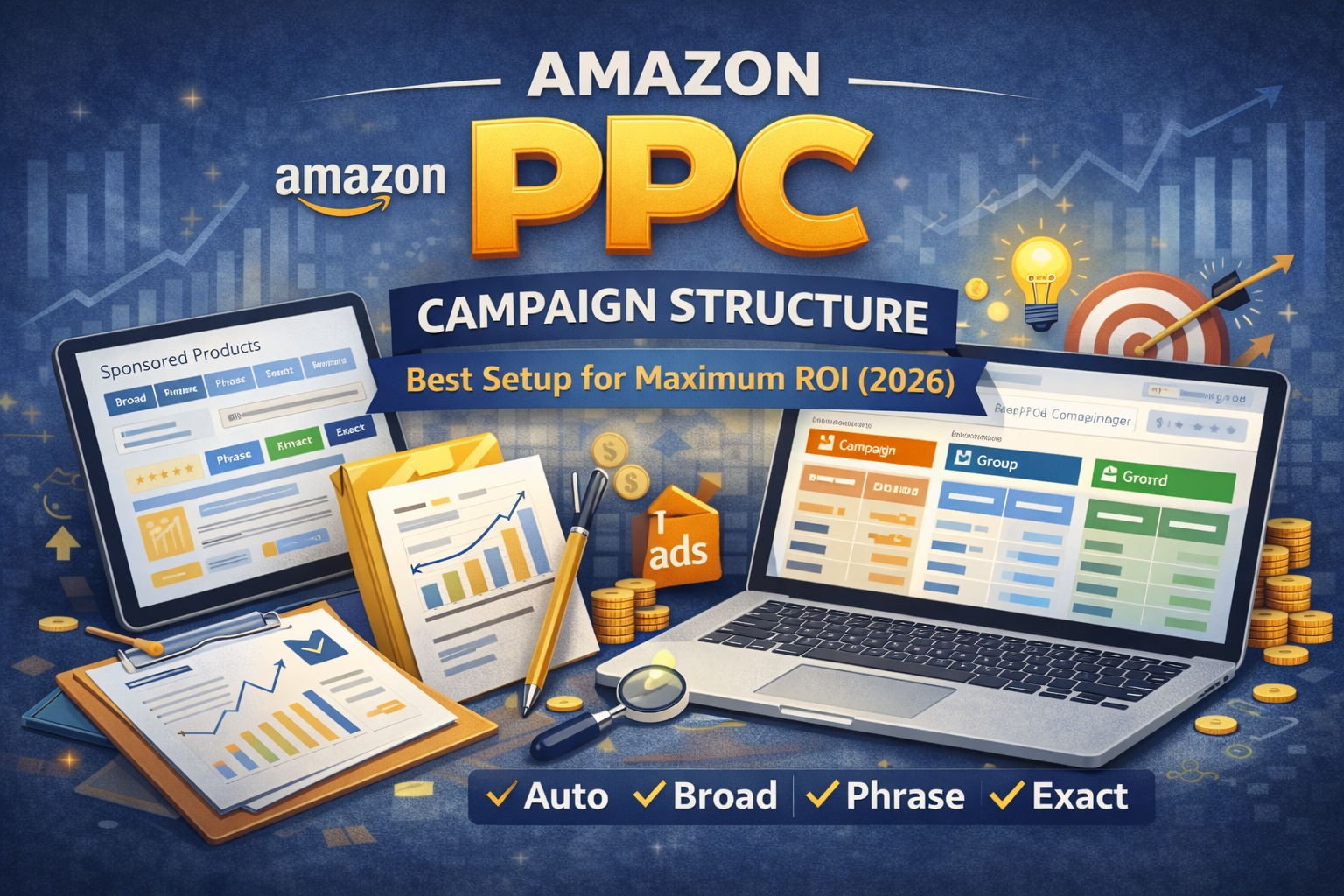
Amazon PPC Campaign Structure: Best Setup for Maximum ROI (2026)
If you're running Amazon ads without a proper structure, you're likely wasting money instead of scaling profitably. In 2026, success with Amazon PPC is no longer about just launching campaigns — it's about building a smart, data-driven campaign structure that maximizes ROI.
In this guide, you’ll learn the best Amazon PPC campaign structure, how to set it up step-by-step, and how to optimize it for long-term profitability.
What is Amazon PPC Campaign Structure?
Amazon PPC campaign structure refers to how you organize your:
- Campaigns
- Ad groups
- Keywords
- Match types
- Bids
A well-structured setup helps you:
✔ Control ad spend
✔ Improve keyword targeting
✔ Increase conversions
✔ Scale profitable campaigns
Why Campaign Structure Matters in 2026
Amazon’s algorithm has become more sophisticated. It now favors:
- Highly relevant keywords
- Strong conversion signals
- Consistent performance data
A messy PPC setup leads to:
❌ Wasted ad spend
❌ Poor keyword tracking
❌ Low ROI
👉 A clean structure = better data + better decisions + higher profits
The Best Amazon PPC Campaign Structure (Proven Model)
Here’s a simple yet powerful structure used by top sellers:
1. Automatic Campaign (Keyword Discovery)
Purpose: Find new keywords and ASIN targets
Setup:
- 1 campaign per product
- Default bid: Low to medium
- Dynamic bids: Down only
Targeting segments:
- Close match
- Loose match
- Substitutes
- Complements
👉 Let this run continuously for data mining
2. Manual Campaign – Exact Match (High Converting)
Purpose: Maximize profit
Setup:
- Only proven converting keywords
- Higher bids for top performers
Why it works:
- High control
- Best ROI
- Precise targeting
3. Manual Campaign – Phrase Match (Scaling)
Purpose: Expand reach with control
Setup:
- Keywords from auto + research
- Moderate bids
👉 Captures variations of your main keywords
4. Manual Campaign – Broad Match (Discovery)
Purpose: Find new keyword opportunities
Setup:
- Lower bids
- Wide targeting
👉 Works alongside auto campaigns for keyword expansion
5. Product Targeting Campaign (ASIN Targeting)
Purpose: Steal competitor traffic
Setup:
- Target competitor products
- Target your own listings (defensive strategy)
Ideal Campaign Structure Diagram (Simple View)
Auto Campaign → Keyword Discovery
        ↓
Manual Broad → Find Variations
        ↓
Manual Phrase → Refine Targeting
        ↓
Manual Exact → Maximize Profit
Step-by-Step Setup Guide
Step 1: Launch Auto Campaign
- Budget: $10–$20/day
- Run for 7–14 days
Step 2: Extract Winning Keywords
From Search Term Report:
✔ High clicks + sales → move to exact
✔ Clicks, no sales → negative keywords
Step 3: Build Manual Campaigns
Create 3 separate campaigns:
- Exact match campaign
- Phrase match campaign
- Broad match campaign
Step 4: Set Bidding Strategy
- Exact: High bids (for profit keywords)
- Phrase: Medium bids
- Broad: Low bids
Step 5: Add Negative Keywords
Prevent wasted spend by:
- Blocking irrelevant terms
- Removing non-converting traffic
Advanced PPC Structure (For Scaling)
Once you grow, use this structure:
Tier 1: Research Layer
- Auto + Broad campaigns
Tier 2: Validation Layer
- Phrase campaigns
Tier 3: Profit Layer
- Exact campaigns
Keyword Funnel Strategy
Think of PPC like a funnel:
- Top Funnel: Broad & Auto (discovery)
- Middle Funnel: Phrase (filtering)
- Bottom Funnel: Exact (conversion)
👉 Move keywords down the funnel as they prove performance
Budget Allocation Strategy
For beginners:
- Auto: 30%
- Broad/Phrase: 40%
- Exact: 30%
For scaling:
- Exact campaigns get the highest budget
Optimization Tips for Maximum ROI
✔ Optimize every 3–5 days
✔ Increase bids on profitable keywords
✔ Lower bids on high ACOS keywords
✔ Pause poor performers
✔ Focus on TACOS (total ad spend vs total sales)
Common PPC Structure Mistakes
❌ Mixing match types in one campaign
❌ Not separating campaigns by intent
❌ Ignoring negative keywords
❌ Scaling too fast without data
❌ Not analyzing reports
Pro Tips for 2026
- Use AI tools for keyword grouping
- Focus on long-tail keywords first
- Test different bidding strategies
- Optimize listing before scaling ads
- Combine PPC with external traffic
Final Thoughts
A strong Amazon PPC campaign structure is the foundation of profitable advertising.
If you follow this setup:
- Start with auto campaigns
- Move data into manual campaigns
- Separate match types properly
- Optimize consistently
You’ll build a system that:
👉 Reduces wasted spend
👉 Improves conversion rates
👉 Scales your profits over time
FAQs
What is the best Amazon PPC structure?
A mix of Auto + Broad + Phrase + Exact campaigns works best.
How many campaigns should I run?
Start with 3–5 campaigns per product.
How often should I optimize PPC?
Every 3–5 days for best results.
Work with ApexBin
Spending on Amazon ads and watching ACoS climb anyway?
Muhammad Mustafa has over three years in Amazon advertising and five Amazon certifications, working with sellers across the US, UK and UAE.
Amazon PPC Management →




Blog Comments (0)
No comments yet. Be the first to comment!