





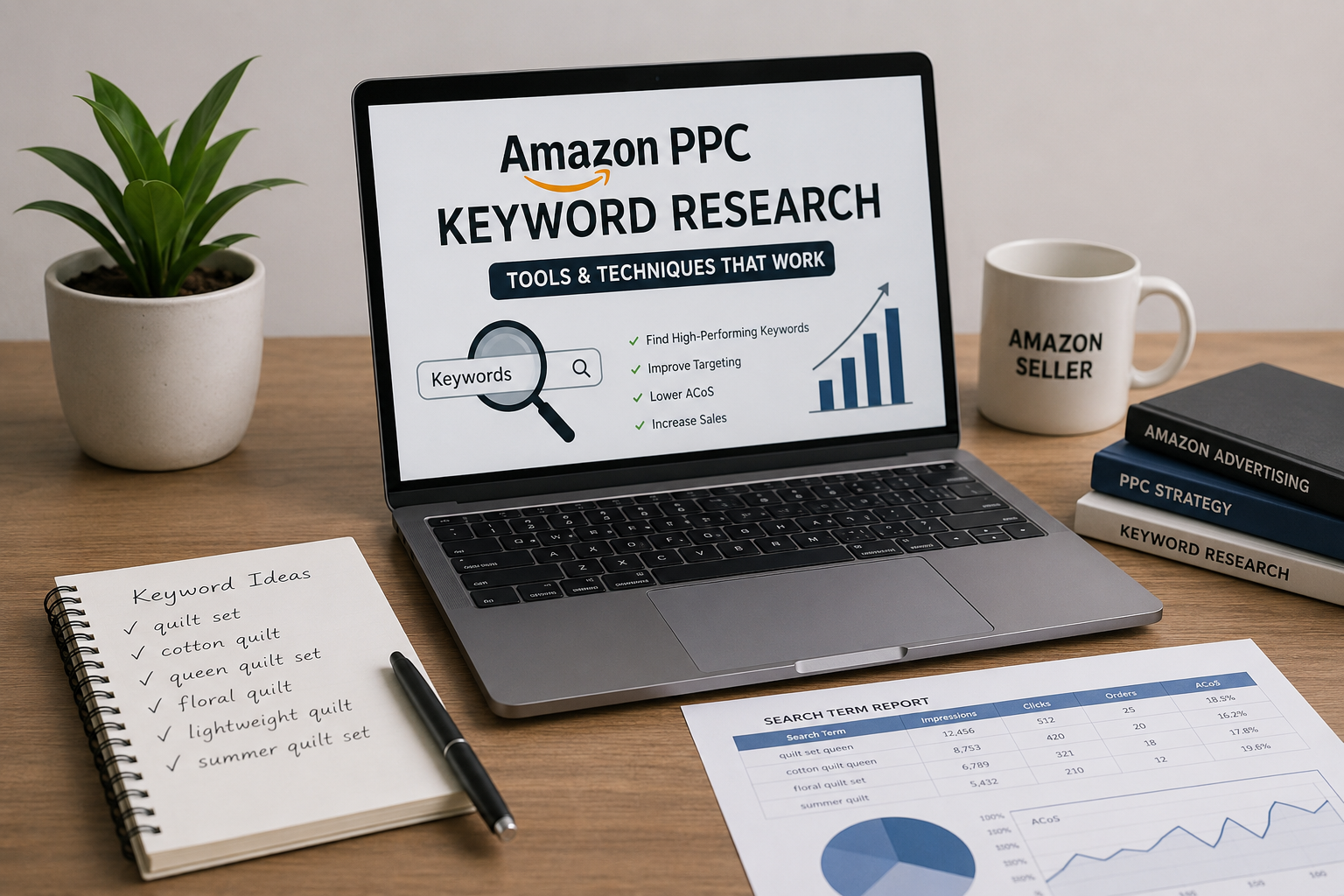
Amazon PPC Keyword Research: Tools & Techniques That Work (Complete 2026 Guide)
Table of Contents
- What Is Amazon PPC Keyword Research?
- Why Keyword Research Matters
- Types of Amazon PPC Keywords
- Best Amazon PPC Keyword Research Tools
- How to Find Profitable Keywords
- Reverse ASIN Keyword Research
- Organizing Keywords for Better PPC Performance
- Common Keyword Research Mistakes
- Amazon PPC Keyword Research Workflow
- Final Thoughts
- Frequently Asked Questions
Amazon PPC Keyword Research: Tools & Techniques That Work
Launching an Amazon PPC campaign without proper keyword research is like opening a store without putting up a sign. Your products may be excellent, but shoppers won't find them if you're targeting the wrong search terms.
Keyword research is the foundation of every profitable Amazon advertising campaign. By identifying the words and phrases customers use when searching for products, you can place your ads in front of highly motivated buyers, increase conversions, reduce wasted ad spend, and improve your overall Return on Ad Spend (ROAS).
Whether you're launching your first product or managing hundreds of ASINs, this guide will walk you through the best Amazon PPC keyword research tools, proven techniques, and optimization strategies that successful sellers use in 2026.
What Is Amazon PPC Keyword Research?
Amazon PPC keyword research is the process of identifying customer search terms that are relevant to your products and using them in Sponsored Products, Sponsored Brands, and Sponsored Display campaigns.
Instead of guessing what customers search for, keyword research relies on actual shopping behavior and data to identify high-converting search terms.
The goal is simple:
- Reach shoppers actively looking for your product
- Increase qualified traffic
- Generate more sales
- Lower Advertising Cost of Sales (ACoS)
- Improve organic keyword rankings over time
Simply put, better keywords lead to better advertising performance.
Why Keyword Research Matters
Amazon's advertising algorithm rewards relevance. The more closely your keywords match what shoppers are searching for, the more likely your ads are to receive impressions, clicks, and conversions.
Effective keyword research helps you:
- Increase product visibility
- Improve Click-Through Rate (CTR)
- Reduce Cost Per Click (CPC)
- Lower wasted advertising spend
- Improve Conversion Rate (CVR)
- Discover profitable niche opportunities
- Increase organic keyword rankings
- Maximize Return on Ad Spend (ROAS)
Without proper keyword research, even a large advertising budget can produce disappointing results.
Pro Tip: The highest search volume keyword isn't always the most profitable. Long-tail keywords often convert better because they match buyer intent more closely.
Types of Amazon PPC Keywords
Understanding keyword intent is essential for building successful campaigns.
1. Broad Match Keywords
Broad match keywords allow Amazon to display your ads for related searches.
Example:
- Quilt Set
- Bedding Set
- Comforter
Best for:
- Keyword discovery
- New product launches
- Expanding reach
2. Phrase Match Keywords
Phrase match requires your keyword phrase to appear in the customer's search query.
Example:
- Floral Quilt Set
- Cotton Quilt Queen
Best for:
- Balanced reach
- Better targeting
- Mid-funnel shoppers
3. Exact Match Keywords
Exact match targets highly specific customer searches.
Example:
- Pink Floral Quilt Queen Size
These keywords usually generate:
- Higher conversion rates
- Lower ACoS
- Better ROAS
4. Long-Tail Keywords
Long-tail keywords are highly specific phrases that indicate strong purchase intent.
Examples:
- Lightweight summer quilt queen
- Floral patchwork quilt king size
- Cotton quilt set for hot sleepers
Benefits include:
- Lower competition
- Lower CPC
- Higher conversion rates
- Better profitability
5. Branded Keywords
These contain brand names.
Examples:
- Bedsure Quilt
- Utopia Bedding Quilt
- Amazon Basics Comforter
Branded campaigns help capture customers already familiar with competing products.
Best Amazon PPC Keyword Research Tools
Choosing the right keyword research tool can significantly improve campaign performance.
| Tool | Best For | Reverse ASIN | Search Volume | Ideal User |
|---|---|---|---|---|
| Helium 10 | Advanced Keyword Research | Yes | Yes | Intermediate & Advanced Sellers |
| Jungle Scout | Product & Keyword Research | Yes | Yes | Beginners |
| DataDive | Listing Optimization | Limited | Yes | Brand Owners |
| SellerApp | PPC Optimization | Yes | Yes | Growing Businesses |
| MerchantWords | Keyword Discovery | No | Yes | Keyword Expansion |
| Amazon Brand Analytics | First-Party Search Data | No | Yes | Brand Registered Sellers |
Amazon Search Autocomplete
Amazon's own search bar is one of the best free keyword research tools available.
Simply start typing your product name, and Amazon will suggest popular searches based on real customer behavior.
For example, typing "quilt set" may reveal suggestions like:
- quilt set queen
- quilt set king
- quilt set floral
- quilt set lightweight
- quilt set cotton
These suggestions often uncover valuable long-tail keywords.
Amazon Brand Analytics
Brand Registered sellers can access valuable insights, including:
- Top search terms
- Search frequency rank
- Click share
- Conversion share
This first-party data can help prioritize keywords with proven buyer demand.
Helium 10
Helium 10 is one of the most comprehensive Amazon seller platforms.
Popular keyword research features include:
- Cerebro (Reverse ASIN)
- Magnet
- Keyword Tracker
- Search Volume Trends
It is ideal for identifying competitor keywords and estimating search demand.
Jungle Scout
Jungle Scout offers:
- Keyword Scout
- Reverse ASIN Lookup
- Historical search trends
- Keyword difficulty analysis
Its intuitive interface makes it especially useful for newer sellers.
DataDive
DataDive focuses on semantic keyword research and listing optimization.
It helps sellers identify:
- Primary keywords
- Secondary keywords
- Keyword clusters
- Relevance scores
SellerApp
SellerApp combines keyword research with PPC optimization.
Features include:
- Keyword suggestions
- Search volume
- Competition analysis
- PPC recommendations
MerchantWords
MerchantWords specializes in Amazon shopper search data and is particularly useful for discovering niche and seasonal keywords.
How to Find Profitable Amazon PPC Keywords
Successful sellers rarely rely on just one source for keyword research. Instead, they combine multiple methods to build a high-quality keyword list.
1. Use Amazon Autocomplete
Record every relevant suggestion that appears when typing your primary keyword.
2. Analyze Competitor Listings
Review competitors' product:
- Titles
- Bullet points
- Product descriptions
- A+ Content
- Customer reviews
- Questions & Answers
Customer reviews often reveal natural language keywords that shoppers actually use.
3. Use Reverse ASIN Research
Reverse ASIN research is one of the fastest ways to discover profitable keywords.
Example
Imagine you're selling a Floral Quilt Set.
You identify a top-selling competitor and analyze their ASIN using Helium 10 Cerebro.
You may discover keywords such as:
- floral quilt queen
- lightweight quilt set
- patchwork quilt queen
- summer bedding queen
- cotton floral quilt
- quilt set queen size
Instead of guessing which keywords work, you're leveraging data from products already generating sales.
Pro Tip: Don't copy every competitor keyword. Only target keywords that accurately describe your product.
4. Launch Automatic Campaigns
Automatic campaigns are excellent keyword discovery tools.
Amazon tests hundreds of relevant searches and provides valuable data through the Search Term Report.
Review these campaigns every 7–14 days to identify:
- High-converting search terms
- Irrelevant searches
- Negative keyword opportunities
Move converting keywords into manual campaigns.
5. Review Search Term Reports
Your Search Term Report contains some of the most valuable PPC insights.
Monitor metrics including:
- Impressions
- Clicks
- CTR
- CPC
- Orders
- Conversion Rate
- ACoS
- ROAS
Pause keywords with high spend but no sales, and increase bids on consistently profitable terms.
Organizing Keywords for Better PPC Performance
Avoid placing hundreds of unrelated keywords into a single campaign.
Instead, group keywords by intent.
Campaign 1 – Generic
- Quilt Set
- Bedding Set
Campaign 2 – Material
- Cotton Quilt
- Polyester Quilt
Campaign 3 – Size
- Queen Quilt
- King Quilt
Campaign 4 – Style
- Floral Quilt
- Patchwork Quilt
Campaign 5 – Seasonal
- Summer Quilt
- Lightweight Quilt
Campaign 6 – Competitor
- Brand-specific keywords
Organized campaigns make optimization easier and improve bidding accuracy.
Don't Forget Negative Keywords
Negative keywords prevent your ads from appearing for irrelevant searches.
Examples:
If you sell premium queen-size quilts, you may exclude:
- baby
- twin
- used
- cheap
- blanket
Adding negative keywords helps:
- Reduce wasted ad spend
- Improve CTR
- Lower ACoS
- Increase conversion rates
Review your Search Term Report regularly to find new negative keyword opportunities.
Common Keyword Research Mistakes
Avoid these common mistakes:
- Chasing only high-volume keywords
- Ignoring long-tail keywords
- Not reviewing Search Term Reports
- Skipping negative keywords
- Copying competitor keywords without checking relevance
- Mixing unrelated keywords in one campaign
- Never updating keyword lists
- Optimizing for clicks instead of profitability
Amazon PPC Keyword Research Workflow
Use this repeatable workflow for every product launch.
Step 1
Identify your top competitors.
Step 2
Perform Reverse ASIN research.
Step 3
Collect keyword suggestions from Amazon Autocomplete.
Step 4
Export keywords from research tools.
Step 5
Remove irrelevant keywords.
Step 6
Group keywords by intent.
Step 7
Launch Automatic campaigns.
Step 8
Launch Manual campaigns using Broad, Phrase, and Exact match.
Step 9
Review Search Term Reports weekly.
Step 10
Add negative keywords and scale winning keywords.
Following this process consistently helps improve advertising performance over time.
Final Thoughts
Amazon PPC success isn't determined by who spends the most—it's determined by who targets the right keywords.
By combining Amazon's native search data, competitor analysis, reverse ASIN research, and ongoing Search Term Report optimization, you can build campaigns that consistently generate qualified traffic while keeping advertising costs under control.
Remember that keyword research is not a one-time task. Customer search behavior, competition, and market trends change continuously. Reviewing your keyword strategy regularly and refining your campaigns based on real performance data will help you stay ahead of competitors and maximize your advertising investment.
If you're serious about growing your Amazon business, treat keyword research as an ongoing process rather than a one-time setup. The time invested in finding and optimizing the right keywords today can produce stronger rankings, higher conversions, and more profitable campaigns for months to come.
Frequently Asked Questions
What is Amazon PPC keyword research?
Amazon PPC keyword research is the process of identifying customer search terms to target in Amazon advertising campaigns, helping sellers increase visibility, drive sales, and improve ad performance.
Which tool is best for Amazon PPC keyword research?
Helium 10 and Jungle Scout are among the most popular choices due to their reverse ASIN capabilities, search volume estimates, and competitor analysis features. Amazon Brand Analytics is also highly valuable for Brand Registered sellers.
How often should I update my Amazon PPC keywords?
Review campaign performance weekly and perform a comprehensive keyword audit at least once a month to identify new opportunities and eliminate underperforming keywords.
Should I use Broad Match or Exact Match keywords?
A balanced strategy is ideal. Use Broad Match for keyword discovery and Exact Match for proven, high-converting keywords to maximize profitability.
What are long-tail keywords?
Long-tail keywords are highly specific search phrases, such as "lightweight floral quilt queen size." They generally have lower competition, lower cost per click, and higher conversion rates because they align closely with buyer intent.
Related Articles
To further improve your Amazon advertising strategy, you may also find these guides helpful:
- How to Lower ACoS on Amazon Ads (Proven Strategies)
- Amazon PPC Campaign Structure: The Complete Guide
- Amazon Sponsored Products Ads Explained
- Amazon Listing Optimization Checklist
- Amazon SEO: How to Rank Higher Organically
Latest Amazon news
- Amazon Rufus Ads 2026: Sponsored Product Prompts — why conversational keywords now matter
- Amazon Ads Agent and Auto-Optimization — automated keyword expansion explained
- Amazon FBA Peak Fulfillment Fees 2026
- 6 New Amazon Policies Hitting US Sellers in October 2026
Work with ApexBin
Spending on Amazon ads and watching ACoS climb anyway?
Muhammad Mustafa has over three years in Amazon advertising and five Amazon certifications, working with sellers across the US, UK and UAE.
Amazon PPC Management →





Blog Comments (0)
No comments yet. Be the first to comment!