





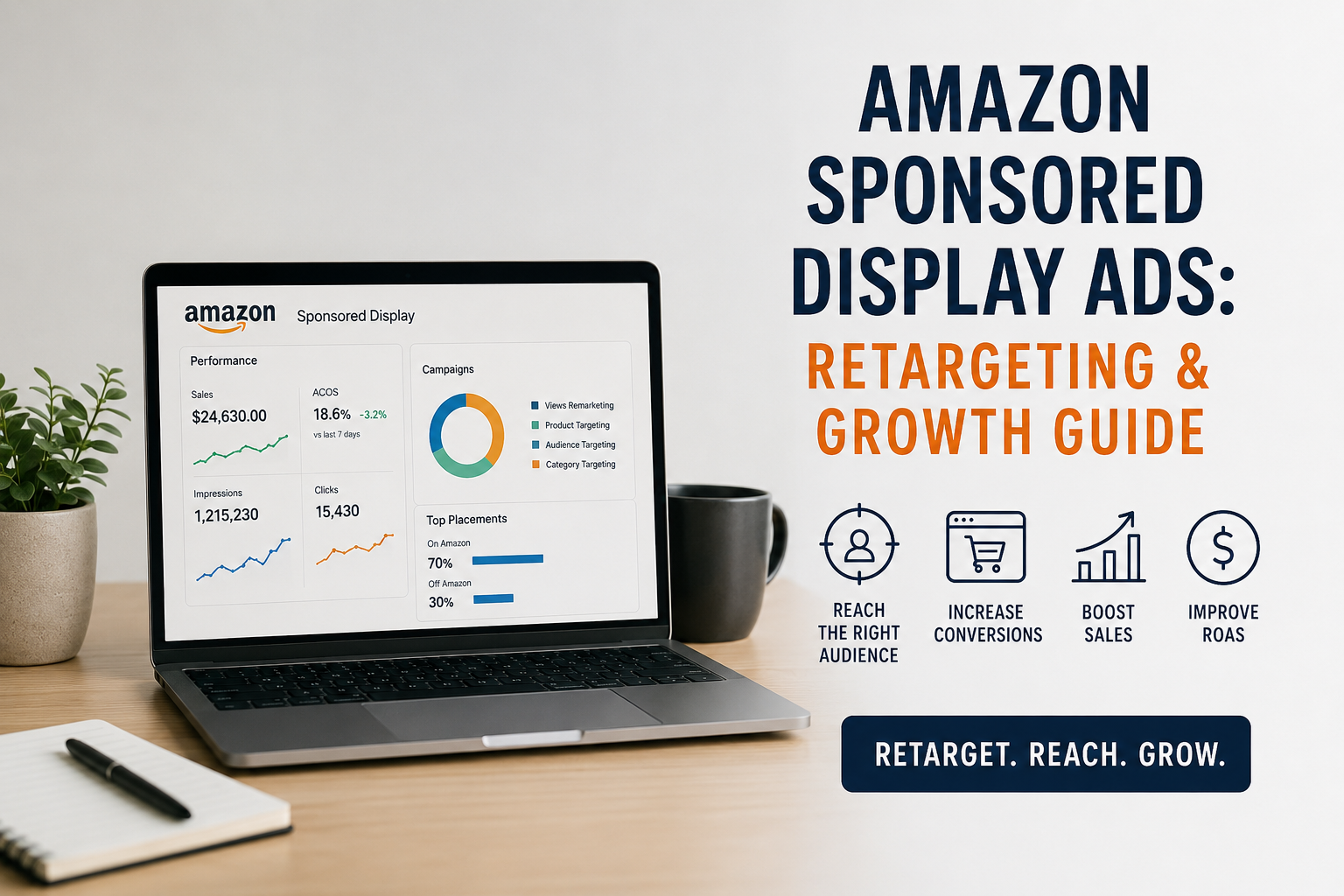
Amazon Sponsored Display Ads: Retargeting & Growth Guide (2026)
Meta Description: Learn how Amazon Sponsored Display Ads work, how to build high-converting retargeting campaigns, and proven strategies to grow sales while lowering ACoS in 2026.
Amazon Sponsored Display Ads: The Complete Retargeting & Growth Guide (2026)
Amazon advertising has become more competitive than ever. Simply running Sponsored Products campaigns is no longer enough to maximize visibility and increase sales. Brands that consistently outperform competitors use Amazon Sponsored Display Ads to retarget shoppers, protect their listings, and reach new audiences both on and off Amazon.
Whether you're launching a new product or scaling an established brand, Sponsored Display Ads can help recover abandoned shoppers, increase repeat purchases, and improve your overall advertising performance.
In this complete guide, you'll learn how Sponsored Display Ads work, the different targeting options, best practices, and advanced growth strategies for 2026.
What Are Amazon Sponsored Display Ads?
Amazon Sponsored Display Ads are self-service display advertisements that allow sellers and vendors to reach shoppers throughout their buying journey.
Unlike Sponsored Products, these ads don't rely only on keyword targeting. Instead, they use audience behavior, shopping interests, and product targeting to display relevant ads.
Your ads can appear:
- Amazon search results
- Product detail pages
- Customer review pages
- Amazon homepage
- Amazon mobile app
- Third-party websites and apps within Amazon's advertising network
This allows brands to remain visible even after shoppers leave a product page.
Why Sponsored Display Ads Matter
Modern shoppers rarely purchase during their first visit.
Most customers:
- Compare multiple products
- Read reviews
- Check competitors
- Leave Amazon
- Return later
Without retargeting, many of these potential buyers never come back to your product.
Sponsored Display Ads help you reconnect with these high-intent shoppers.
Key Benefits
- Increase conversions
- Recover abandoned traffic
- Improve brand awareness
- Protect product pages from competitors
- Boost repeat purchases
- Reach shoppers beyond Amazon
- Improve overall advertising efficiency
Types of Amazon Sponsored Display Targeting
1. Views Remarketing (Retargeting)
This is the most popular Sponsored Display strategy.
Amazon automatically shows ads to shoppers who viewed your product but didn't purchase.
Example:
A shopper visits your duvet cover listing, compares it with two competitors, and leaves.
Later, Amazon shows your product again while they browse Amazon or partner websites.
This significantly increases the chances of converting the customer.
Best for:
- High-traffic listings
- Competitive niches
- Product launches
- Seasonal products
2. Product Targeting
Your ads appear on specific competitor product pages.
You can target:
- Individual ASINs
- Entire product categories
- Price ranges
- Star ratings
- Brand names
Example:
Your premium bedding set appears directly on a competitor's product detail page.
This helps attract shoppers before they complete their purchase.
3. Audience Targeting
Audience targeting reaches shoppers based on their shopping behavior.
Examples include:
- In-market audiences
- Lifestyle audiences
- Interest-based audiences
- Purchase behavior
- Amazon shopping signals
This is ideal for expanding brand awareness and reaching new customers.
Sponsored Display vs Sponsored Products
| Feature | Sponsored Display | Sponsored Products |
|---|---|---|
| Keyword Targeting | No | Yes |
| Audience Targeting | Yes | Limited |
| Retargeting | Yes | No |
| Off-Amazon Ads | Yes | No |
| Product Targeting | Yes | Yes |
| Best For | Brand Growth | Direct Sales |
Both campaign types work best together rather than separately.
Best Retargeting Strategy for 2026
A highly effective campaign structure includes:
Campaign 1
Views Remarketing
Audience:
Viewed product in the last 30 days
Bid:
Dynamic bidding
Goal:
Recover abandoned visitors
Campaign 2
Product Targeting
Target:
Top competitors
Goal:
Steal market share
Campaign 3
Category Targeting
Filter by:
- 4-star and below
- Higher price than yours
Goal:
Offer better value
Campaign 4
Audience Expansion
Target:
In-market shoppers
Goal:
Acquire new customers
Budget Recommendations
| Business Size | Daily Budget |
| New Seller | $10–20 |
| Growing Brand | $20–50 |
| Established Brand | $50–150+ |
| Large Brand | $150–500+ |
Increase budgets gradually after identifying profitable campaigns.
Creative Best Practices
Sponsored Display automatically uses your product information, but optimizing your listing greatly improves performance.
Ensure you have:
- High-resolution product images
- Strong product titles
- SEO-optimized bullet points
- A+ Content
- Premium Brand Story
- Video content
- Plenty of positive reviews
Your product detail page acts as the landing page for every Sponsored Display click.
Smart Bidding Tips
Avoid chasing the highest impression volume.
Instead:
- Start with Amazon's suggested bid.
- Increase bids on profitable audiences.
- Lower bids for expensive placements.
- Monitor CPC weekly.
- Allocate more budget to campaigns with the highest ROAS.
Small bid adjustments often outperform aggressive bidding.
Advanced Growth Strategies
Combine Sponsored Products and Sponsored Display
Use Sponsored Products to capture active search traffic.
Use Sponsored Display to bring those visitors back.
This creates a full-funnel advertising strategy.
Defend Your Best Sellers
Target your own ASINs so your complementary products appear on your listings.
Example:
Customers viewing a comforter may also see your matching pillowcases or bed sheets.
This encourages larger basket sizes.
Target Competitor Listings
Focus on:
- Lower-rated competitors
- Higher-priced products
- Out-of-stock listings
- Weak product images
- Poor review history
This increases your chances of winning conversions.
Scale Winning Campaigns
Instead of increasing every budget, identify campaigns with:
- Highest conversion rate
- Lowest ACoS
- Strongest ROAS
- Consistent sales
Increase budgets by 15–20% every few days while monitoring performance.
Common Mistakes to Avoid
Many advertisers waste money by:
- Running only one Sponsored Display campaign
- Ignoring retargeting audiences
- Setting bids too high immediately
- Forgetting negative product targeting where applicable
- Not monitoring placements
- Using poorly optimized product listings
- Making large budget changes too quickly
Regular optimization leads to better long-term results.
Key Performance Metrics
Track these KPIs:
- Impressions
- Click-Through Rate (CTR)
- Cost Per Click (CPC)
- Conversion Rate (CVR)
- Advertising Cost of Sales (ACoS)
- Return on Ad Spend (ROAS)
- Total Sales
- New-to-Brand Orders (where applicable)
Review performance weekly and adjust bids, budgets, and targeting based on data.
Frequently Asked Questions (FAQs)
Are Sponsored Display Ads worth it?
Yes. They are particularly effective for retargeting shoppers who have already shown interest in your products and for expanding your reach beyond Amazon search results.
Can new sellers use Sponsored Display Ads?
Yes, provided they meet Amazon's eligibility requirements. Even modest budgets can produce valuable insights and incremental sales.
What is the difference between Sponsored Display and Sponsored Brands?
Sponsored Brands focus on promoting your brand and product portfolio with custom creatives in search results, while Sponsored Display emphasizes audience-based targeting, retargeting, and product placements across Amazon and its advertising network.
What is a good ACoS for Sponsored Display?
A "good" ACoS depends on your profit margins, product lifecycle, and business goals. Many brands aim for profitability first, then optimize campaigns over time as conversion data accumulates.
How long does it take to see results?
Most campaigns gather enough data for meaningful optimization within one to two weeks, though newer products may require more time.
Final Thoughts
Amazon Sponsored Display Ads have evolved into one of the most effective tools for building a full-funnel advertising strategy. By combining retargeting, audience targeting, and competitor placements, brands can reconnect with interested shoppers, protect their market share, and drive sustainable growth.
Success doesn't come from launching a campaign and leaving it untouched. The strongest results come from continuous testing, refining bids, improving product listings, and analyzing performance metrics. As Amazon advertising becomes increasingly competitive in 2026, advertisers who embrace data-driven optimization will be best positioned to increase sales while maintaining efficient advertising costs.
Explore More Amazon Advertising Guides
Looking to improve your Amazon marketing strategy? Browse our latest blogs covering PPC optimization, Sponsored Brands, Sponsored Products, keyword research, TikTok Shop integration, and other eCommerce growth strategies to stay ahead of the competition.
Need Expert Help with Amazon Advertising?
Whether you're launching a new product, optimizing existing campaigns, or looking to scale your brand, our Amazon advertising specialists can help you create data-driven PPC strategies that maximize sales while reducing wasted ad spend. Contact us today to discuss how we can help grow your business.
Work with ApexBin
Spending on Amazon ads and watching ACoS climb anyway?
Muhammad Mustafa has over three years in Amazon advertising and five Amazon certifications, working with sellers across the US, UK and UAE.
Amazon PPC Management →




Blog Comments (0)
No comments yet. Be the first to comment!