





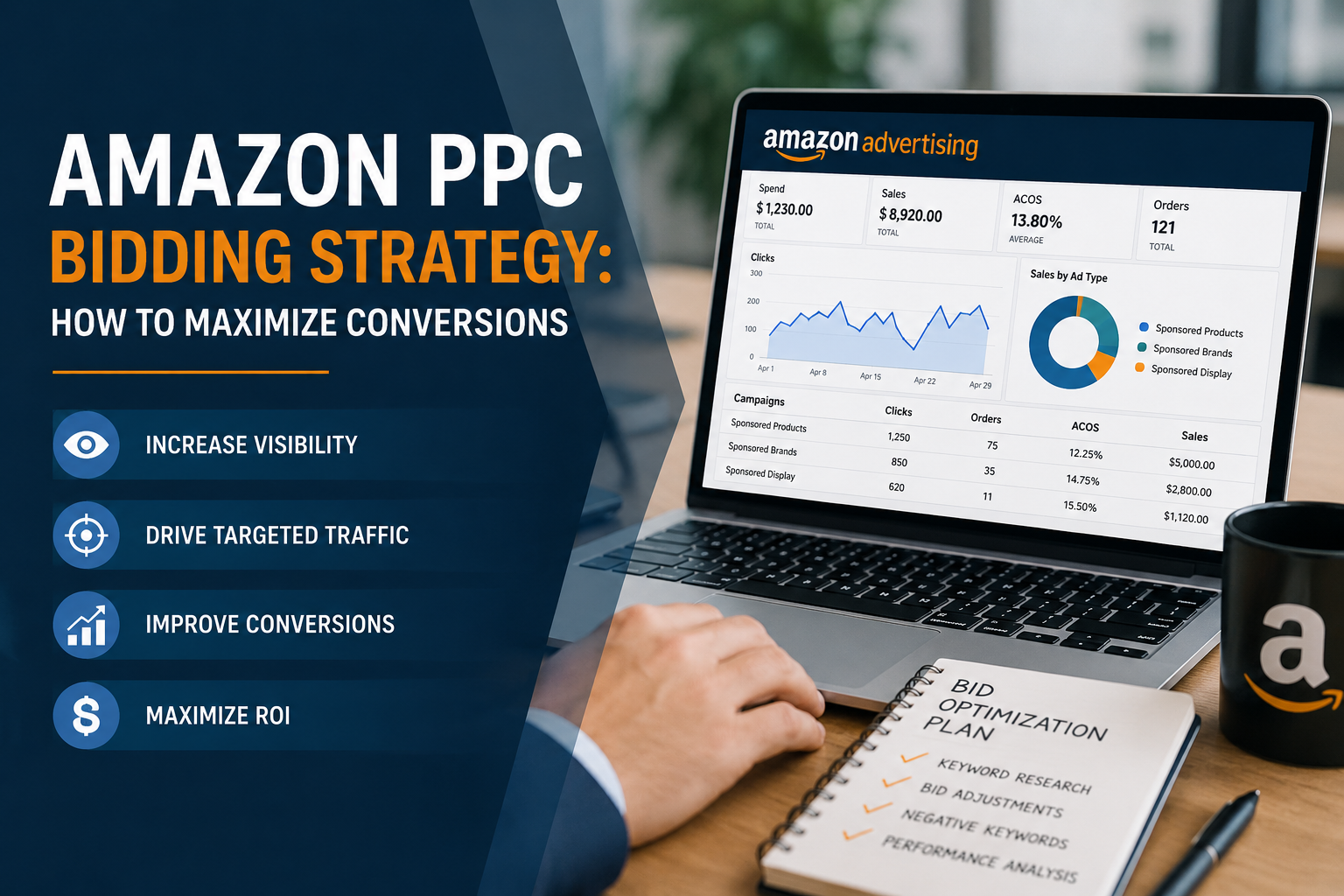
Amazon PPC Bidding Strategy: How to Maximize Conversions and Boost ROI
Selling on Amazon is more competitive than ever, and simply listing a product is no longer enough to generate consistent sales. To stand out in crowded marketplaces, sellers need a strong advertising strategy — and that’s where Amazon PPC bidding becomes essential.
A well-planned Amazon PPC (Pay-Per-Click) bidding strategy can help increase product visibility, drive highly targeted traffic, improve conversion rates, and maximize profitability while keeping advertising costs under control.
In this guide, you’ll learn:
- What Amazon PPC bidding is
- The different Amazon bidding strategies
- How to optimize bids for maximum conversions
- Common PPC mistakes to avoid
- Advanced tips to improve ROAS and reduce ACoS
What Is Amazon PPC Bidding?
Amazon PPC bidding is the process of setting the maximum amount you are willing to pay when a shopper clicks on your advertisement.
Amazon uses an auction-based advertising system where sellers compete for ad placements. The combination of your bid amount and ad relevance determines where your ads appear.
High-performing ads can secure premium placements such as:
- Top of Search
- Product Detail Pages
- Rest of Search
An optimized Amazon PPC bidding strategy helps sellers:
- Increase product visibility
- Drive targeted traffic
- Improve conversion rates
- Reduce wasted ad spend
- Maximize Return on Ad Spend (ROAS)
Why Amazon PPC Bidding Matters
Your bidding strategy directly affects several key advertising metrics, including:
| Metric | Why It Matters |
|---|---|
| CTR (Click-Through Rate) | Measures ad relevance |
| Conversion Rate | Indicates sales effectiveness |
| CPC (Cost Per Click) | Impacts advertising costs |
| ACoS (Advertising Cost of Sales) | Tracks profitability |
| ROAS (Return on Ad Spend) | Measures revenue efficiency |
Even excellent products may struggle if bidding is poorly optimized. On the other hand, strategic bidding can dramatically improve conversions, organic rankings, and sales velocity.
Types of Amazon PPC Bidding Strategies
Amazon provides three primary bidding strategies for Sponsored Products campaigns.
1. Dynamic Bids – Down Only
With this strategy, Amazon lowers your bid when a conversion is less likely.
Best For:
- New sellers
- Conservative budgets
- Low-converting products
- PPC testing campaigns
Benefits:
- Reduces wasted spend
- Helps maintain lower ACoS
- Safer for beginners
This is usually the best starting point for new Amazon advertisers.
2. Dynamic Bids – Up and Down
Amazon automatically increases your bid when the likelihood of conversion is high and decreases it when conversion chances are lower.
Best For:
- High-converting products
- Competitive categories
- Scaling profitable campaigns
Benefits:
- Maximizes conversions
- Improves top-of-search visibility
- Captures high-intent shoppers
However, CPC costs can rise quickly, so campaigns must be monitored closely.
3. Fixed Bids
Amazon uses your exact bid without adjusting it dynamically.
Best For:
- Experienced advertisers
- Stable campaigns
- Strict budget control
Benefits:
- Predictable CPC
- Better manual control
- Easier performance analysis
Fixed bids work well when you already understand your campaign profitability.
Best Amazon PPC Bidding Strategy for Maximum Conversions
There is no single bidding strategy that works for every seller. The ideal approach depends on your product margins, campaign objectives, and competition level.
Here’s a proven framework used by successful Amazon sellers.
Step 1: Start With Automatic Campaigns
Automatic campaigns help discover profitable search terms and shopper behavior.
Recommended Setup:
- Use Dynamic Bids – Down Only
- Start with moderate bids
- Run campaigns for 1–2 weeks
Goal:
Collect keyword data and identify converting search terms.
Automatic campaigns provide valuable insights before scaling into manual targeting.
Step 2: Move Winning Keywords Into Manual Campaigns
Once you identify profitable keywords:
- Create Exact Match campaigns
- Increase bids for high-converting keywords
- Add negative keywords to eliminate wasted spend
This improves targeting precision and increases conversion rates.
Step 3: Use Placement Bid Adjustments
Amazon allows advertisers to increase bids for premium ad placements.
Recommended Strategy:
- Increase Top of Search bid adjustments by 20%–50%
- Closely monitor conversion performance
- Reduce adjustments if ACoS increases too much
Top-of-search placements typically deliver the highest conversion rates because shoppers see your product first.
Step 4: Optimize Based on Performance Metrics
Successful PPC management requires continuous optimization.
Key Metrics to Monitor
| Metric | Purpose |
|---|---|
| CTR | Measures ad relevance |
| Conversion Rate | Evaluates sales performance |
| CPC | Controls advertising costs |
| ACoS | Tracks campaign profitability |
| ROAS | Measures revenue efficiency |
Analyze campaigns weekly and adjust bids based on real performance data.
Advanced Amazon PPC Bidding Tips
1. Increase Bids on High-Converting Keywords
If certain keywords consistently generate profitable sales:
- Raise bids gradually
- Improve placement visibility
- Capture more market share
Avoid sudden aggressive increases that can spike CPC costs.
2. Lower Bids on Poor-Performing Keywords
Keywords with:
- High clicks
- Low conversions
- Weak ROAS
should have reduced bids or be paused entirely.
This helps protect your advertising budget.
3. Use Dayparting
Dayparting involves adjusting bids during high-conversion hours.
Example:
- Increase bids during peak shopping periods
- Reduce bids during low-converting hours
This improves advertising efficiency and lowers wasted spend.
4. Segment Campaigns by Match Type
Separate campaigns for:
- Broad Match
- Phrase Match
- Exact Match
allow better bid control and clearer performance tracking.
Exact match keywords often produce the highest conversion rates.
5. Focus on Organic Ranking
Amazon PPC also impacts organic keyword rankings.
More PPC-driven conversions can:
- Improve organic visibility
- Increase keyword rankings
- Generate long-term sales growth
A strong strategy combines Amazon SEO with PPC optimization.
Common Amazon PPC Bidding Mistakes to Avoid
Overbidding Too Early
Aggressive bidding without enough data can quickly drain budgets.
Ignoring Search Term Reports
Search term reports reveal which keywords actually convert and which waste money.
Not Using Negative Keywords
Without negative keywords, ads may appear for irrelevant searches, increasing wasted spend.
Poor Product Listings
Even the best PPC strategy cannot fix weak product listings.
Your:
- Product title
- Images
- Bullet points
- Product description
- Reviews
all impact conversion rates.
Recommended Amazon PPC Optimization Workflow
Consistency is critical for long-term PPC success.
Daily Tasks
- Monitor ad spend
- Check campaign budgets
- Watch for overspending
Weekly Tasks
- Adjust keyword bids
- Add negative keywords
- Analyze conversion rates
- Review placement performance
Monthly Tasks
- Scale profitable campaigns
- Pause underperforming ads
- Test new keywords and strategies
Best Tools for Amazon PPC Optimization
Several tools help automate PPC management and bid optimization.
Popular Amazon PPC Tools
- Helium 10
- Jungle Scout
- SellerApp
- Perpetua
These tools provide:
- Keyword tracking
- Bid automation
- Competitor analysis
- PPC reporting
- Campaign optimization insights
Final Thoughts
A successful Amazon PPC bidding strategy is not about spending more money — it’s about spending smarter.
By using data-driven bidding techniques, optimizing keywords regularly, monitoring placements, and improving listings, sellers can significantly increase conversions while maintaining profitability.
Start with conservative bids, identify winning keywords, and gradually scale campaigns that produce strong ROAS. Over time, a well-optimized Amazon PPC strategy can become one of the most powerful drivers of sustainable business growth.
If you want to maximize conversions on Amazon, your PPC bidding strategy should continuously evolve based on real campaign data, customer behavior, and marketplace competition.
Latest Amazon news
- Amazon Ads Agent and Auto-Optimization — automated bidding is coming to campaign settings
- Amazon Rufus Ads 2026: Sponsored Product Prompts — the placement you cannot bid on
- Amazon FBA Peak Fulfillment Fees 2026
- Amazon Fee Category Changes October 31, 2026
Work with ApexBin
Spending on Amazon ads and watching ACoS climb anyway?
Muhammad Mustafa has over three years in Amazon advertising and five Amazon certifications, working with sellers across the US, UK and UAE.
Amazon PPC Management →




Blog Comments (0)
No comments yet. Be the first to comment!