





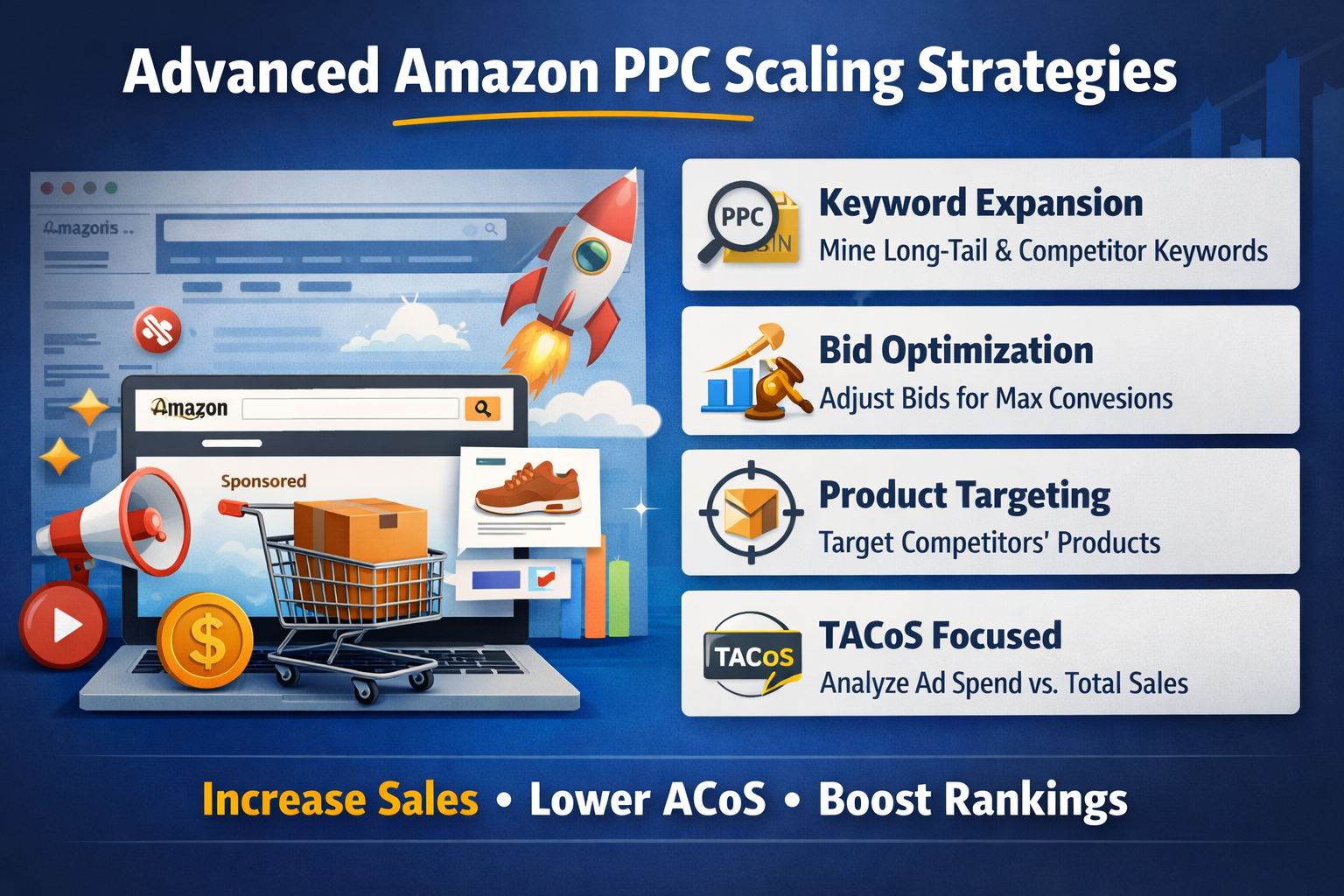
Advanced Amazon PPC Scaling (2026 Guide): Proven Strategies to Increase Sales & Lower ACoS
Amazon PPC scaling is one of the fastest ways to grow your revenue—but if done incorrectly, it can quickly increase your ACoS and reduce profitability.
In this complete guide, you’ll learn advanced Amazon PPC scaling strategies used by top sellers to increase sales, improve rankings, and maintain a profitable advertising structure.
Table of Contents
- What is Amazon PPC Scaling
- Why Amazon PPC Scaling Matters
- How to Scale Amazon PPC Campaigns
- Advanced Strategies for Scaling
- Common Mistakes to Avoid
- FAQs
What is Amazon PPC Scaling?
Amazon PPC scaling is the process of increasing ad spend strategically to generate more sales while maintaining or improving ACoS and TACoS. It helps boost organic rankings, increase product visibility, and drive long-term profitability.
Why Amazon PPC Scaling Matters
Scaling your Amazon PPC campaigns correctly allows you to:
- Increase product visibility on Amazon
- Rank higher for competitive keywords
- Drive consistent sales velocity
- Improve organic rankings
- Reduce dependency on ads over time
👉 Amazon’s algorithm rewards products that generate consistent sales—PPC is the fastest way to achieve that.
How to Scale Amazon PPC Campaigns (Step-by-Step)
1. Build a Scalable Campaign Structure
Before scaling, your account structure must be optimized.
Recommended Setup:
- Auto Campaign (keyword discovery)
-
Manual Campaigns:
- Broad match (research)
- Phrase match (refinement)
- Exact match (scaling)
- Product targeting campaigns
- Sponsored brand campaigns
A clean structure ensures better data and control.
2. Vertical Scaling (Increase Budget Safely)
Vertical scaling means increasing budgets on campaigns that are already performing well.
Best Practices:
- Increase budgets by 10–25% every 3–5 days
-
Only scale campaigns with:
- Consistent conversions
- Stable or improving ACoS
👉 If your campaign runs out of budget early, it’s ready to scale.
3. Horizontal Scaling (Expand Reach)
To scale aggressively, you need to expand beyond your current audience.
Keyword Expansion:
- Use search term reports
- Target long-tail keywords
- Add competitor keywords
- Include variations and misspellings
This increases traffic without over-relying on the same keywords.
4. Keyword Isolation Strategy (Advanced Technique)
One of the most powerful Amazon PPC strategies is keyword isolation.
What to Do:
Move top-performing keywords into single-keyword exact campaigns.
Benefits:
- Full control over bids
- Higher conversion rates
- Cleaner performance data
Top Amazon sellers rely heavily on this method.
5. Optimize Bids for Maximum Profitability
Scaling requires data-driven bid optimization.
Increase bids for:
- High-converting keywords
- Top-of-search placements
Reduce bids for:
- High spend, low conversion keywords
Placement Optimization:
- Top of Search: +50% to +200%
- Product Pages: Test and optimize
6. Scale with Product & ASIN Targeting
Product targeting is one of the most underrated scaling strategies.
Target:
- Competitors with higher prices
- Listings with poor reviews
- Complementary products
This allows you to capture high-intent traffic.
7. Optimize Your Product Listing First
Scaling ads to a weak listing will waste your budget.
Improve:
- Main image (increase CTR)
- Title (keyword-rich and clear)
- Bullet points (benefit-focused)
- A+ content
- Customer reviews
👉 Even a 10% increase in conversion rate can dramatically improve scaling results.
8. Use Negative Keywords to Reduce Waste
Scaling increases spend—but also increases wasted spend if not controlled.
Add negative keywords for:
- Irrelevant searches
- Low-converting queries
- High-cost, no-sales keywords
This protects your profitability.
9. Focus on TACoS for Long-Term Growth
Most sellers focus only on ACoS—but advanced sellers track TACoS.
TACoS Formula:
TACoS = Ad Spend ÷ Total Revenue
Why It Matters:
- Measures real profitability
- Reflects organic growth
- Shows long-term scaling success
👉 A decreasing TACoS means your PPC is improving organic sales.
10. Use All Amazon Ad Types for Scaling
To maximize growth, combine all ad formats:
- Sponsored Products (core campaigns)
- Sponsored Brands (brand visibility)
- Sponsored Display (retargeting and competitor targeting)
A multi-channel strategy improves reach and conversions.
Advanced Amazon PPC Scaling Strategies
Dayparting (Time-Based Optimization)
Analyze when your ads perform best and adjust bids accordingly.
- Increase bids during high-converting hours
- Reduce spend during low-performance times
Search Term Mining Loop
Top sellers follow this cycle:
- Launch campaigns
- Collect search term data
- Identify winning keywords
- Move winners to exact match
- Scale budgets
- Add negatives
- Repeat
Ranking Strategy (Hidden Growth Hack)
Use PPC to rank for high-volume keywords:
- Focus on converting keywords
- Maintain consistent sales velocity
- Increase visibility on top keywords
👉 This boosts organic ranking and reduces long-term ad dependency.
Common Amazon PPC Scaling Mistakes
Avoid these common mistakes:
❌ Increasing budget too quickly
❌ Ignoring keyword data
❌ Not optimizing listings
❌ Overbidding without data
❌ Mixing branded and non-branded campaigns
FAQs About Amazon PPC Scaling
How do I scale Amazon PPC without increasing ACoS?
Focus on high-converting keywords, optimize your listing, and gradually increase budgets while monitoring performance.
What is a good TACoS for scaling?
It depends on your margins, but a decreasing TACoS while revenue increases indicates successful scaling.
When should I scale my campaigns?
Scale when campaigns show consistent conversions and stable ACoS over time.
Final Thoughts: Scale Smarter, Not Harder
Advanced Amazon PPC scaling is not about spending more—it’s about spending smarter.
By combining:
- Data-driven optimization
- Strong campaign structure
- Continuous testing
You can turn your Amazon PPC campaigns into a predictable revenue engine.
Work with ApexBin
Spending on Amazon ads and watching ACoS climb anyway?
Muhammad Mustafa has over three years in Amazon advertising and five Amazon certifications, working with sellers across the US, UK and UAE.
Amazon PPC Management →




Blog Comments (0)
No comments yet. Be the first to comment!