

 Mar 05, 2026
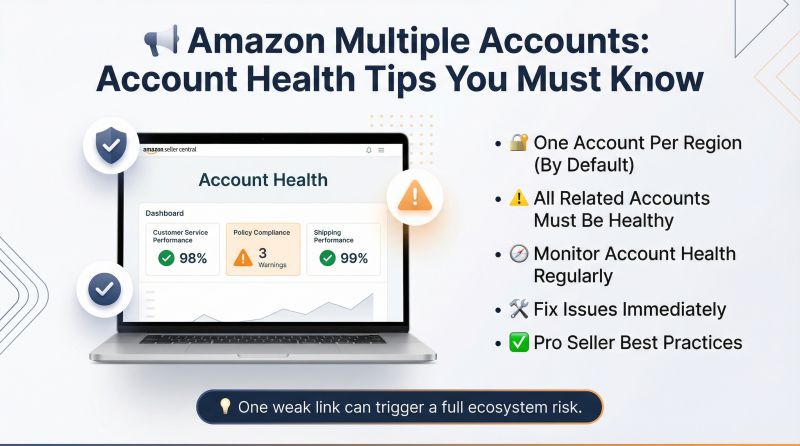
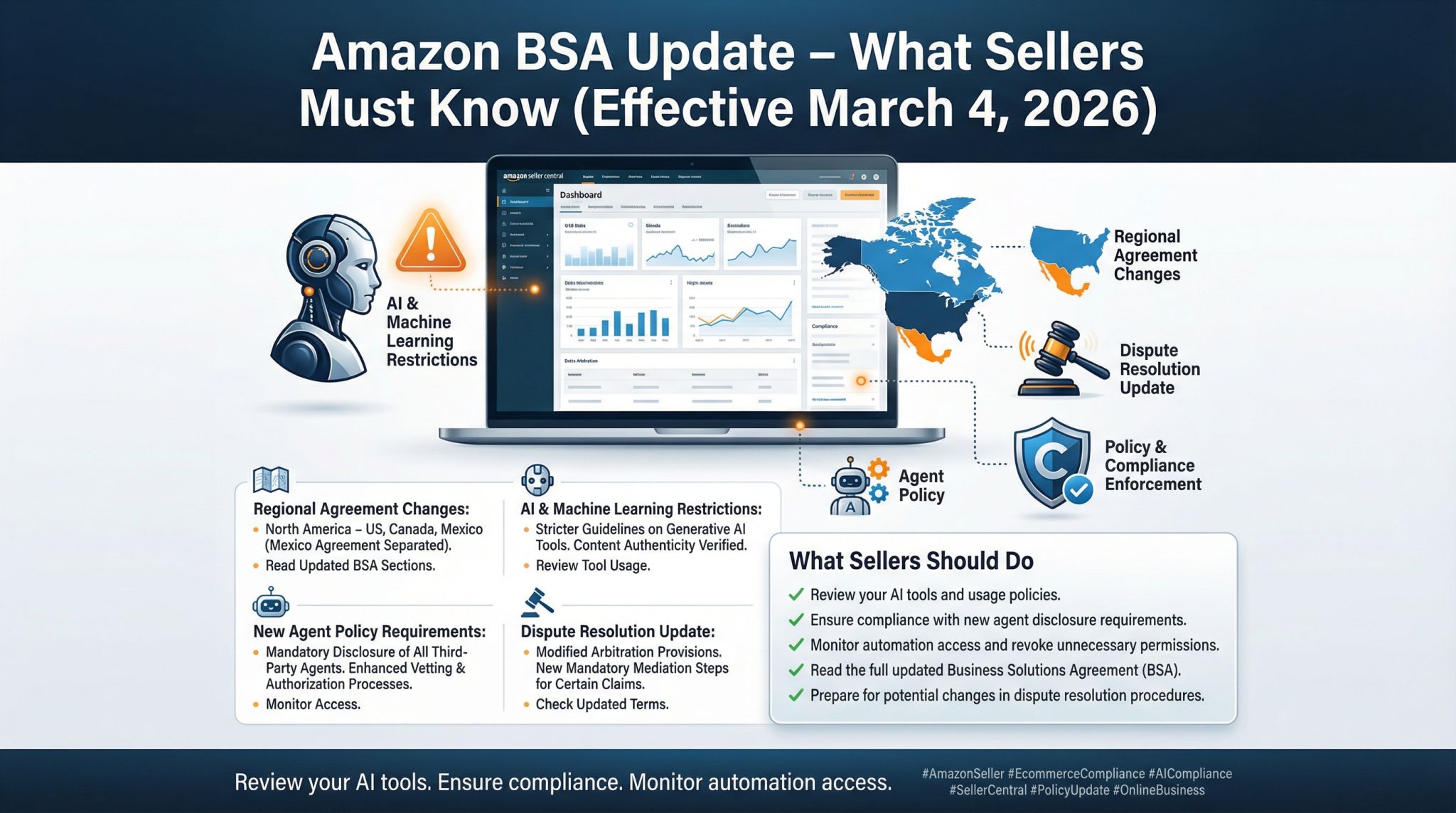
In 2026, the "green checkmark" on your Account Health Dashboard is no longer a static goal—it is a moving target. With the recent updates to Amazon’s Business Solutions Agreement (BSA) and the introduction of stricter Agent Policies for AI-driven automation, staying compliant has evolved from a back-office task into a high-stakes defensive strategy.
If your Account Health Rating (AHR) dips below 200, you aren't just at risk of a warning; you are at risk of an automated shutdown that can freeze your payouts and inventory for months.
Here is how advanced account handling services are navigating the new landscape of Amazon Compliance in 2026.
1. Navigating the 2026 Account Health Rating (AHR) Scale
Amazon now evaluates your account on a holistic scale of 0 to 1,000. While 200 is the "passing" grade, 2026’s top-tier sellers aim for 250+ to qualify for Priority Seller Support and faster appeal windows.
The "Repeat Violation" Trap: In 2026, Amazon has a zero-tolerance policy for "repeat offenders." If you incur the same policy violation (like Restricted Product or Inauthentic Complaint) more than twice in 180 days, your AHR can drop to zero instantly, triggering a Section 3 Deactivation.
AHR Impact by Severity: Violations are now categorized as Low, Medium, High, or Critical. A single "Critical" violation—such as review manipulation or suspected counterfeit—gives you a mere 3-day grace period to resolve the issue before total deactivation.
2. Proactive Defense: The "Audit-Ready" Supply Chain
In 2026, Amazon doesn't just ask for invoices when there is a problem; they perform Proactive Supply Chain Audits. To stay safe, your documentation must be flawless:
GS1 Validation: Every UPC and GTIN must perfectly match the GS1 Database. Mismatched brand names in the GS1 registry are now a primary trigger for ASIN suppression.
Digital SDS & Safety Compliance: For categories such as toys or electronics, the 2026 rules require independent Third-Party Testing (TIC) verification. Uploading a PDF is no longer enough; your lab must now sync the results directly with Amazon’s compliance portal.
LOA (Letter of Authorization): Having a "good relationship" with your supplier isn't a defense. You need a formal, digitally-verifiable LOA from the brand owner on file at all times.
3. Mastering the 2026 Plan of Action (POA)
The days of "copy-pasting" a Plan of Action from a forum are dead. Amazon’s Reinstatement AI now scans for templated language and rejects it within minutes. A successful 2026 POA must be data-heavy and include:
The Requirement | What It Means in 2026 |
Root Cause | Identify exactly which internal system or human error failed—don't blame the customer. |
Corrective Action | Show proof of immediate fixes (e.g., "Deleted 4,000 units of stock," or "Refunded 12 buyers"). |
Preventative Measures | This is the most important. You must show Process Improvement (e.g., "We have integrated a new AI-audit tool that checks all listings for restricted keywords every 4 hours"). |
4. Automation vs. Human Oversight: The March 2026 BSA Update
As of March 4, 2026, Amazon requires all AI Agents used for account management to identify themselves. Using "covert" automation to manage your pricing or customer service is now a grounds-for-suspension offense.
Our managed services ensure that all automation tools are fully compliant with the new Agent Policy, preventing "Related Account" flags that often stem from improper API usage.
Is Your Account Health Ready for an Audit?
Compliance in 2026 is about Prevention, not Reinstatement. By the time you get a notification, the damage to your sales velocity is already done.
How We Can Help:
Don't wait for the "Red Status" warning. Our team specializes in Proactive Compliance Audits and AHR Recovery.
The 2026 Amazon Account Health & Compliance Checklist
Use this 3-step audit to ensure your brand remains "Healthy" (250+ AHR) and avoids the March 4th automation crackdown.
Step 1: The "March 4th" Automation Audit
As per the 2026 Business Solutions Agreement (BSA) update, all automated tools must now be documented and compliant with the new Agent Policy.
- [ ] Identify "Agents": List every tool that accesses your Seller Central (Repricers, PPC bots, Inventory managers, and VA browser extensions).
- [ ] Verify Identification: Confirm with your software providers that their tools correctly identify themselves as "Automated Systems" to Amazon’s API.
- [ ] The "Kill Switch" Test: Ensure you can revoke access to any third-party app in under 60 seconds if Amazon flags "unusual activity."
- [ ] Remove "Gray-Area" Tools: Disconnect any scrapers or "stealth" bots that simulate human clicks to bypass Amazon’s rate limits.
Step 2: Product & Supply Chain "Fortress"
Amazon now performs Proactive Supply Chain Audits. If you can't produce these within 72 hours, your ASIN is suppressed.
- [ ] GS1 Database Sync: Verify that your Brand Name on Amazon exactly matches the "Company Name" registered in the GS1 GEPIR database for your UPCs.
- [ ] TIC Direct Validation: For high-risk categories (Toys, Electronics, Baby), ensure your test results were sent directly to Amazon by an approved TIC lab (SGS, Intertek, UL). Manual PDF uploads are no longer accepted for these categories.
- [ ] LOA Freshness: Ensure your Letters of Authorization are less than 12 months old and contain a digital signature or QR code for instant verification.
Step 3: Performance & AHR Maintenance
Maintaining a "Healthy" status in 2026 requires hitting higher thresholds than in previous years.
- [ ] The 250+ Goal: Aim for an Account Health Rating (AHR) of 250 or higher to qualify for "Account Health Assurance" (which prevents deactivation without a phone call first).
- [ ] Repeat Violation Monitor: Check your "Policy Compliance" section. Ensure you have zero repeat violations of the same type within the last 180 days. (A 3rd "Restricted Product" hit often triggers an automatic 7-day suspension).
- [ ] ODR & LSR Safety Buffers: Keep your Order Defect Rate (ODR) below 0.5% and Late Shipment Rate (LSR) below 2% to stay in the "Elite Seller" tier for 2026.
In 2026, the cost of being 'almost' compliant is a total business freeze.